

Safe Exercise Intensity Calculator
Find your safe exercise intensity level based on your statin type, age, and fitness level. Remember: Moderate exercise (5-6 on the 10-point Borg scale) is generally safe and recommended.
Many people on statins worry that exercise might hurt their muscles. It’s a real concern. You take the pill to protect your heart, but then you feel sore after a walk or struggle to climb stairs after a workout. Is it the statin? The exercise? Or both? The truth is more nuanced than most people think. Statins and exercise don’t have to be enemies. In fact, when done right, they work together to keep you healthier than either could alone.
Why Statins Might Make Muscles Sore
Statins lower cholesterol by blocking an enzyme in your liver called HMG-CoA reductase. That’s good for your heart. But that same enzyme is also involved in making other important compounds - including coenzyme Q10 (CoQ10), which your muscles need to produce energy. When CoQ10 drops, some people feel muscle fatigue or aching. It’s not full-blown damage, but enough to make you hesitate before your next workout.
Not everyone feels this. Studies show only about 1 in 10 statin users report noticeable muscle symptoms. And here’s the key: those symptoms often show up even without exercise. The real problem comes when you add intense physical activity on top of an already sensitive system. Older adults, especially those over 65, seem more vulnerable. So it’s not that exercise causes injury - it’s that it can make underlying sensitivity more obvious.
What the Science Actually Says
Let’s cut through the noise. In 2023, researchers at Radboud University Medical Center did one of the most thorough studies yet. They tracked 100 adults aged 55 to 73 - some on statins, some not - as they cycled for 45 minutes at 60% of their maximum oxygen capacity. That’s moderate effort, like a brisk, steady ride you could hold for a while.
The results? No drop in muscle strength. No loss of performance. Nothing alarming. But one subtle change stood out: half relaxation time - how long it takes a muscle to loosen after contracting - increased by 40-60% in statin users. That’s a sign of mild muscle stiffness, not injury. Think of it like tightness after a long day, not a tear.
Compare that to the Boston Marathon study from 2010. Runners on statins had nearly 40% higher levels of creatine kinase (CK), a marker of muscle breakdown, after the race. Why the difference? Intensity. Marathon running is extreme. The body is pushed far beyond normal limits. That’s when statins might tip the scales.
Bottom line: Moderate exercise is safe. Vigorous, prolonged, or high-impact activity? Proceed with caution.
Which Statins Are Easier on Muscles?
Not all statins are created equal. Some are more likely to cause muscle issues than others. This has to do with how they’re absorbed and cleared by the body.
Hydrophilic statins - like pravastatin and rosuvastatin - are water-soluble. They stay mostly in the liver, where you want them. Studies show they’re associated with 23% fewer muscle symptoms during exercise compared to lipophilic statins.
Lipophilic statins - like simvastatin, atorvastatin, and lovastatin - dissolve in fat. That means they spread more easily into muscle tissue. That’s why they’re more often linked to soreness, especially in older adults or those with lower body weight.
If you’re on simvastatin or atorvastatin and you’re active, talk to your doctor. Switching to rosuvastatin or pravastatin might reduce your symptoms without losing any heart protection. Some people even switch to rosuvastatin 20 mg every other day and see fewer side effects while keeping the same cholesterol-lowering effect.
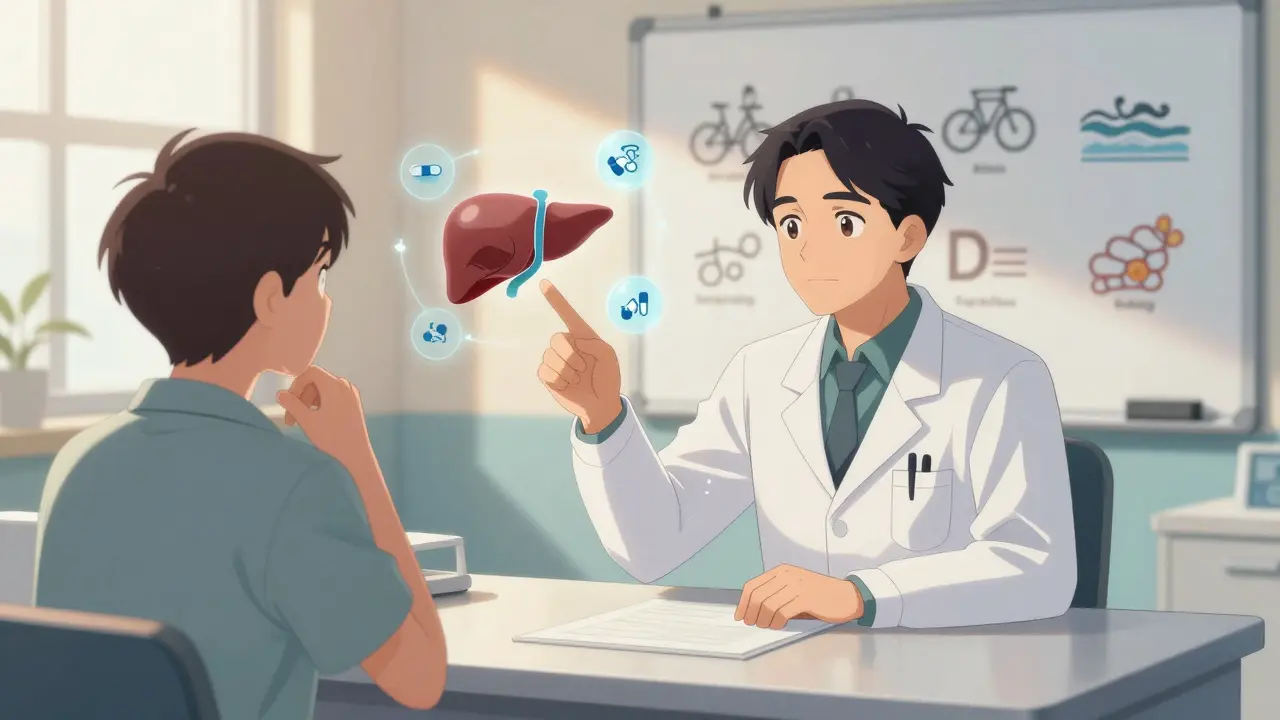
7 Proven Ways to Prevent Muscle Problems
- Stick to moderate intensity - Aim for 5-6 on the 10-point Borg scale. That’s where you can talk but not sing. A brisk walk, steady cycling, or light swimming fits perfectly. Avoid high-intensity intervals, heavy weightlifting, or long-distance running unless you’ve built up slowly over months.
- Build up slowly - If you’re new to exercise or restarting after a break, increase your time or effort by no more than 10% per week. Your muscles adapt. Studies in mice show pre-training prevents statin-related muscle weakness. Humans are no different.
- Time your workout - Most statins peak in your blood 2-4 hours after you take them. Try to exercise either before your dose or 6+ hours after. This isn’t proven, but it’s a simple tweak that many people find helps.
- Check your vitamin D - Low vitamin D is linked to worse statin muscle symptoms. Get your levels tested. If you’re under 30 ng/mL, supplementation (1,000-2,000 IU daily) can make a real difference.
- Avoid drug interactions - Fibrates (like gemfibrozil) raise your risk of muscle injury 3-5 times when taken with statins. Same with certain antibiotics (like erythromycin) or antifungals. Always tell your doctor what else you’re taking.
- Listen to your body - Normal soreness fades in 24-48 hours. If pain lasts longer, gets worse, or you notice dark urine (like cola-colored), stop exercising and call your doctor. That could be a sign of rhabdomyolysis - rare, but serious.
- Keep moving, even if you’re sore - Quitting exercise because of muscle discomfort is riskier than continuing. People who stick with moderate activity for 6 months report 72% fewer symptoms. Adaptation happens. Your muscles get used to it.
What About People Who Already Have Muscle Pain?
If you’re already avoiding exercise because of statin-related soreness, you’re not alone. About 27% of statin users say they’re worried about this. But here’s the twist: those who stopped exercising actually increased their risk of heart attack or stroke more than those who kept going.
A study from the American Heart Association found that people who quit exercise due to muscle pain had a 30% higher chance of cardiovascular events over 5 years - even if they stayed on statins. Why? Because exercise protects your heart independently. It lowers blood pressure, improves insulin sensitivity, and reduces inflammation. All of that matters.
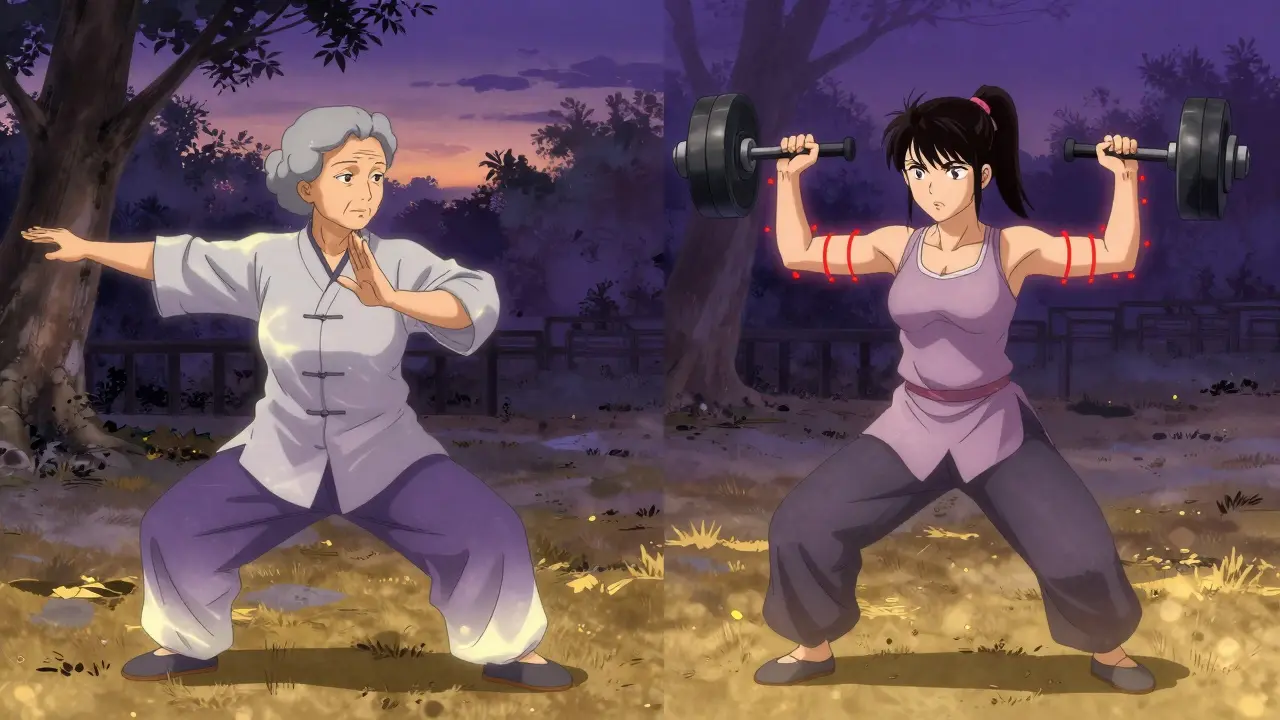
Don’t assume the pain means you can’t move. Try switching to low-impact activities: walking, water aerobics, stationary cycling, or tai chi. Many people find that moving differently - not less - makes all the difference.
The Bigger Picture: Why This Matters
Statins prevent heart attacks and strokes. That’s not theoretical. For people with high cholesterol or a history of heart disease, statins reduce risk by 25-35%. Regular exercise? It cuts risk by 20-30%. Together? You’re looking at a 50%+ reduction in heart events. That’s life-changing.
And it’s not just about longevity. People who stay active on statins report better sleep, less fatigue, improved mood, and more independence as they age. That’s quality of life - not just survival.
The fear of muscle pain shouldn’t keep you from living. It should guide you to move smarter. You don’t need to run a marathon. You don’t need to lift heavy weights. You just need to move regularly, consistently, and at a pace that feels sustainable.
What’s Next?
Research is still evolving. The NIH-funded STATIN-EX trial (NCT04567890), running through 2025, is testing how different exercise intensities affect muscle health in statin users. Early data suggests genetics play a role too - certain gene variants (like SLCO1B1) may make some people more sensitive. In the future, we may be able to test for this.
For now, the message is clear: exercise is not the enemy. It’s part of the solution. Statins and movement aren’t competing - they’re cooperating. The goal isn’t to eliminate all discomfort. It’s to find the sweet spot where you’re protected, energized, and moving forward.
Can I still run if I take statins?
You can, but it depends. If you’re older, new to running, or on a lipophilic statin like simvastatin or atorvastatin, long-distance running may raise muscle injury markers like CK. If you’ve been running for years without issues, you’re likely fine. But if you’re starting out or feeling sore, stick to brisk walking or cycling first. Build up slowly. Never push through sharp or lasting pain.
Do statins cause permanent muscle damage?
No. Statins don’t cause permanent muscle damage in most people. Muscle symptoms are usually temporary and go away when you adjust your activity, switch statins, or lower the dose. True rhabdomyolysis - severe muscle breakdown - is extremely rare, affecting fewer than 1 in 10,000 statin users per year. If you notice dark urine or extreme weakness, seek help immediately, but don’t assume the worst.
Should I take CoQ10 supplements with statins?
It’s a reasonable idea, but the evidence isn’t strong. Some small studies show CoQ10 may reduce muscle pain, while others show no benefit. It’s not a substitute for medical advice, but if you’re struggling with soreness and your doctor agrees, trying 100-200 mg daily is low-risk. Don’t expect miracles, but it might help.
Is it safe to lift weights on statins?
Light to moderate resistance training is fine - think bodyweight exercises, resistance bands, or light dumbbells. Avoid heavy lifting, especially if you’re new to it or on a high-dose statin. If you feel deep, localized muscle pain or swelling after lifting, stop. You don’t need to max out to get strong. Consistency matters more than intensity.
Can I stop statins if my muscles hurt?
Don’t stop without talking to your doctor. Stopping statins increases your risk of heart attack or stroke - especially if you’ve had prior heart disease. Instead, work with your doctor to try alternatives: lower dose, different statin, or less intense exercise. The goal is to keep both your heart and your muscles healthy.
9 Responses
Just wanted to say this post saved my workout routine. I was on simvastatin and thought I had to give up lifting altogether. Switched to rosuvastatin and started walking 45 mins daily - no more muscle cramps, and my cholesterol’s never been better. It’s not about quitting exercise, it’s about tuning it to your body. 🙌
Okay, but have you seen the FDA’s 2021 whistleblower report? 🤔 They quietly admitted that statins can cause mitochondrial dysfunction… and CoQ10 supplements? Totally a band-aid. Big Pharma doesn’t want you to know that exercise increases oxidative stress in statin users - and they profit from both pills AND supplements. I’ve been tracking my CK levels for 3 years… it’s not coincidence. 🧪
I read the Radboud study. The 40-60% increase in half-relaxation time? That’s not ‘mild stiffness.’ That’s early-stage myopathy. And they only tested 100 people for 45 minutes. What about 10-hour shifts? 6-day-a-week routines? The real world doesn’t run on lab conditions. I’m not scared - I’m just… skeptical.
My mom’s on statins. She walks every morning. No pain. No supplements. Just… moves. She’s 71. I used to think she was just stubborn. Now I think she’s onto something. Sometimes the answer isn’t science - it’s consistency.
So I switched from atorvastatin to pravastatin last year after reading this. HUGE difference. No more quad pain after hiking. Also - vitamin D? My levels were 22. Took 2k IU daily for 3 months. Now I feel like I’m 30 again. Side note: I typo’d ‘pravastatin’ 7 times while typing this. 😅
As someone from India where statin use is rising fast, I’ve seen many elderly stop walking because they fear muscle pain. But here’s the truth: in our culture, we’ve always moved - squatting, walking, climbing stairs. That’s not ‘exercise.’ That’s life. You don’t need a gym. You just need to keep moving. And yes, rosuvastatin is cheaper here too. Worth considering.
Ugh. This post is so… optimistic. Like, really? You think people don’t know this stuff already? I’ve been on statins for 12 years. I’ve had rhabdo. Twice. And you’re telling me to ‘listen to my body’? My body screamed. No one listened. Now I’m on a wheelchair. So yeah. I’m not ‘motivated.’ I’m traumatized.
Thank you for this meticulously researched and deeply humane overview. I appreciate the nuance - particularly the distinction between mild stiffness and true injury. In my clinical practice, I’ve observed that patients who engage in low-impact, sustained activity report significantly better adherence and quality of life. The data is clear. The fear, however, is often disproportionate. Compassion and evidence must walk hand in hand.
Wait - so if I’m on simvastatin and I walk 20 mins a day, I’m fine? But if I go to 30 mins, I’m at risk? There’s no hard line? What’s the threshold? This post says ‘moderate’ but doesn’t define it. Can someone link a chart? I’m confused. Also - is ‘cola-colored urine’ really dark? I’ve never seen cola in real life. Is it like Pepsi? Or Dr. Pepper? Asking for a friend.