

Imagine taking a pill to help your mood, only to find out it’s silently canceling out your birth control or causing your transplanted organ to fail. This isn't a worst-case scenario from a medical drama; it's a documented reality for people using St. John's Wort is a flowering plant known as Hypericum perforatum that has been used since ancient Greece to treat mild to moderate depression. Also known as SJW, it's a powerhouse of a supplement, but it carries a hidden danger: it's one of the most "aggressive" herbs when it comes to how it interacts with other medicines.
The core problem is that St. John's Wort doesn't just sit in your stomach; it changes how your liver and gut process other drugs. For some, this means their life-saving medication simply disappears from their bloodstream faster than it can work. Whether you're managing a chronic condition or just trying to lift your mood, understanding these risks is the difference between a helpful supplement and a medical emergency.
The Science of Why It Happens
To understand why this herb is so reactive, we have to look at the Cytochrome P450 is a superfamily of enzymes in the liver responsible for metabolizing the majority of prescription drugs system. Specifically, St. John's Wort targets an enzyme called CYP3A4 is the most prevalent enzyme in the human liver, breaking down about 50% of all clinical drugs .
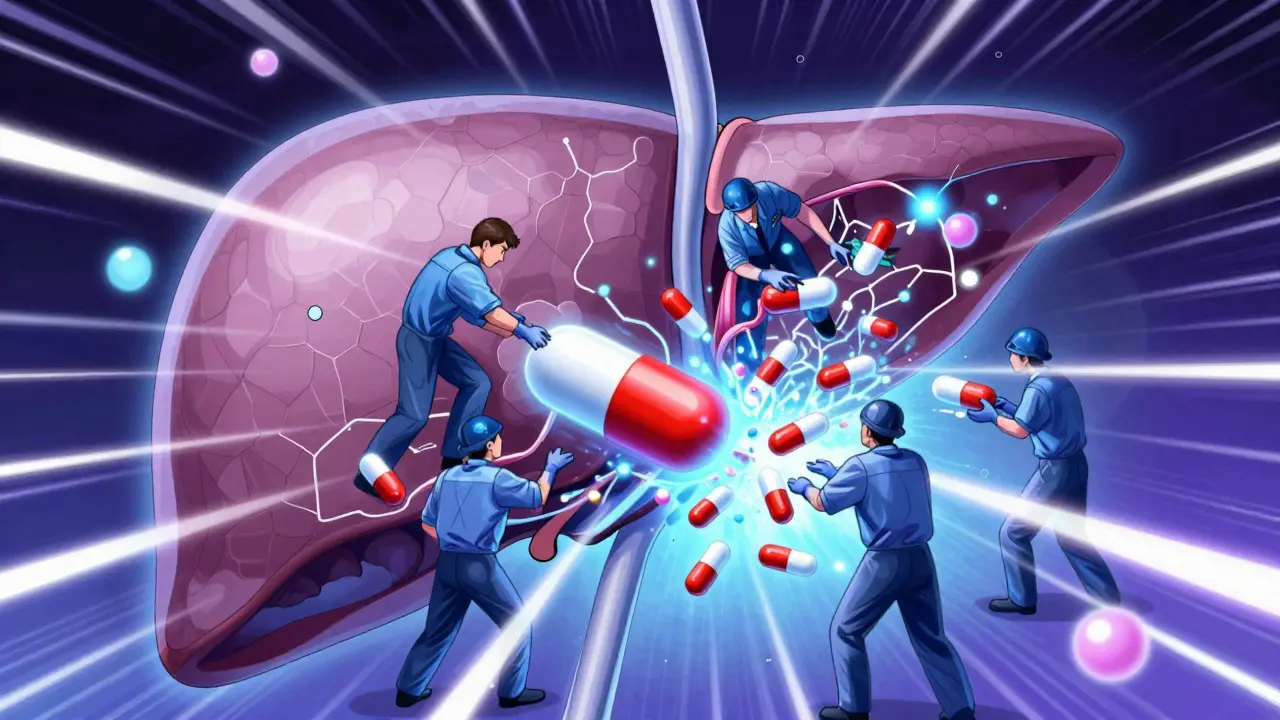
The main culprit inside the plant is a compound called hyperforin is the primary active constituent of St. John's Wort responsible for the induction of liver enzymes . When you take SJW, hyperforin activates a receptor in your body (PXR) that tells your liver to produce *more* CYP3A4 enzymes. Think of it like adding ten more workers to a demolition crew; your body becomes incredibly efficient at breaking down and clearing out medications. If the drug is cleared too quickly, it never reaches the therapeutic level needed to treat your condition.
It doesn't stop at the liver. SJW also ramps up P-glycoprotein is a transport protein that pumps foreign substances and some drugs out of cells and back into the gut or bloodstream . By increasing this "pump," your body may reject a drug before it's even absorbed into your system.
High-Risk Medications: What to Avoid
Not every drug interaction is a crisis, but some are catastrophic. The most dangerous interactions occur with "narrow therapeutic index" drugs-medications where a tiny change in blood concentration can be the difference between health and toxicity.
One of the most alarming examples involves cyclosporine is a potent immunosuppressant used to prevent organ rejection after a transplant . In a stark case from 2020, two heart transplant patients experienced acute organ rejection because SJW lowered their cyclosporine levels so drastically that their bodies began attacking the new organs. Similarly, kidney transplant patients using tacrolimus have faced organ failure after starting SJW.
Then there are the "silent" failures. For women on oral contraceptives, SJW can induce the metabolism of estrogen and progestogen, effectively neutralizing the pill. This has led to numerous reports of unintended pregnancies. If you are using the pill for birth control, combining it with SJW is a gamble you shouldn't take.
| Medication Type | Example Drug | What Happens? | Clinical Result |
|---|---|---|---|
| Immunosuppressants | Cyclosporine / Tacrolimus | Lower drug levels in blood | Organ transplant rejection |
| Contraceptives | Combined Oral Pill | Faster hormone breakdown | Unintended pregnancy |
| Anticoagulants | Warfarin | Reduced efficacy | Blood clots / Stroke risk |
| Antivirals | HIV Protease Inhibitors | Decreased drug concentration | Treatment failure / Viral load spike |
| Pain Relief | Oxycodone / Tramadol | Faster metabolism | Reduced pain management |
The Danger of "Serotonin Syndrome"
While most SJW issues are about making other drugs *weaker*, combining it with other antidepressants does the opposite. This is where things get dangerous in a different way. St. John's Wort increases the levels of serotonin in your brain. If you mix it with SSRIs is Selective Serotonin Reuptake Inhibitors, a class of antidepressants like Prozac or Zoloft or MAO inhibitors, you can end up with too much serotonin.
This can trigger Serotonin Syndrome is a potentially life-threatening condition caused by an excessive accumulation of serotonin in the body . It usually starts with agitation, shivering, and sweating, but can quickly escalate to high fever, seizures, and muscle rigidity. If you're already on a prescription antidepressant, adding an over-the-counter herbal "booster" can be a recipe for a hospital visit.
SJW vs. Other Herbal Alternatives
If you're looking for a natural way to handle mild depression, you might wonder why St. John's Wort is so much more problematic than other options. When compared to alternatives like SAM-e is S-adenosyl-methionine, a naturally occurring compound that helps produce and regulate hormones in the brain or 5-HTP, the difference is night and day.
SAM-e has very few documented drug interactions, primarily limited to MAO inhibitors. St. John's Wort, however, has over 50 significant documented interactions. While SJW is highly effective for mild to moderate depression-often performing better than placebos in clinical trials-its risk profile is more like a prescription drug (such as rifampin) than a simple herb.
For most people, the trade-off isn't worth it if they are already taking other medications. However, for someone taking zero other prescriptions, SJW can be a gentle and effective tool. The key is knowing which camp you fall into.

Practical Steps for Safe Use
If you're considering St. John's Wort, don't just trust the label. In the US, the FDA doesn't require the same pre-market approval for supplements as it does for drugs, meaning some labels may be vague about interaction risks.
Here is a realistic approach to using it safely:
- The Pharmacist Audit: Your pharmacist is the best resource for checking the CYP3A4 pathway. Give them a full list of every medication, including birth control, supplements, and vitamins.
- The "Lag" Period: Be aware that SJW doesn't start or stop working instantly. It takes about 10 days to fully ramp up those liver enzymes, and the effect can linger for up to two weeks after you stop taking the herb.
- Monitoring: If you absolutely must take both a prescription drug and SJW, your doctor should monitor your blood levels every two weeks for the first month. This allows them to adjust your prescription dose to compensate for the herb's effect.
- Check Hyperforin Levels: Look for standardized extracts. Some newer research suggests that "low-hyperforin" versions of the extract might reduce the risk of drug interactions by up to 90%, though these are less common in big-box stores.
Common Pitfalls and Misconceptions
A common mistake is assuming that "natural" equals "safe." People often think that because a plant grows in a field, it can't possibly interfere with a chemical pill. In reality, the chemistry of St. John's Wort is specifically designed to interact with biological systems-which is exactly why it works for depression and why it wreaks havoc on other meds.
Another pitfall is the "delayed reaction." You might feel great for the first week, but as the CYP3A4 enzymes build up in your liver, your other medication slowly loses its punch. You don't notice a sudden crash; you notice a slow decline in effectiveness. By the time a patient realizes their blood thinner isn't working or their transplant meds are low, they may already be in a critical state.
Can I take St. John's Wort with my birth control pill?
It is strongly recommended that you do not. St. John's Wort increases the breakdown of the hormones in oral contraceptives, which can make the pill fail and lead to unplanned pregnancy. If you choose to use SJW, you should use a non-hormonal backup method of contraception, such as condoms.
How long does it take for SJW to affect other medications?
The effect is not immediate. It typically takes about 10 days of consistent use for the liver enzymes (CYP3A4) to reach maximal induction. Conversely, once you stop taking St. John's Wort, it can take up to two weeks for your enzyme levels to return to normal.
Is St. John's Wort safe for everyone with depression?
While it's effective for mild to moderate depression, it's not safe for everyone. Specifically, people taking immunosuppressants, anticoagulants, antidepressants, or certain HIV medications should avoid it. Always consult a healthcare provider to check for contraindications.
What are the signs of Serotonin Syndrome?
Early signs include agitation, restlessness, confusion, rapid heart rate, and shivering. More severe cases can involve muscle rigidity, high fever, and seizures. This is a medical emergency and requires immediate treatment.
Does the dose of St. John's Wort matter for interactions?
Yes. The degree of interaction is directly linked to the amount of hyperforin in the product. Higher concentrations of hyperforin generally lead to stronger induction of the CYP3A4 enzyme, which means a more significant reduction in the effectiveness of your other medications.