
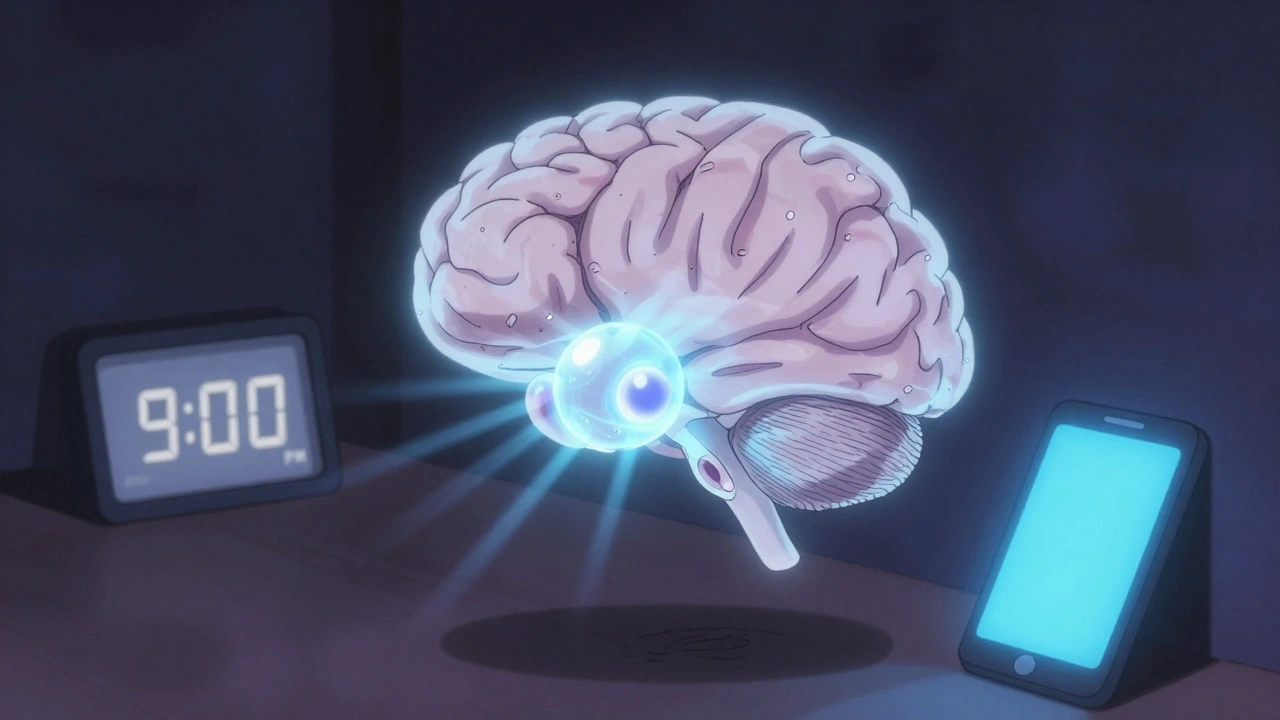
Most people think melatonin is a sleeping pill. It’s not. It’s a signal. A quiet, natural message your body sends when it’s time to wind down. If you’ve ever taken it and felt nothing, or woke up groggy like you’d been hit by a truck, you weren’t using it right. You were treating it like Ambien when it’s more like a sunrise alarm clock that only works if you set it at the right time.
What Melatonin Actually Does
Melatonin is made by your pineal gland - a tiny pea-sized structure deep in your brain. It doesn’t knock you out. It tells your body, "It’s dark. Time to prepare for sleep." Your body naturally produces it every night, starting around 9 PM, peaking between 2 and 4 AM, then dropping off before sunrise. That’s why you feel sleepy at night and alert in the morning - it’s not luck, it’s biology.
Light, especially blue light from phones and screens, shuts melatonin production down. That’s why scrolling in bed makes it harder to fall asleep. Your brain thinks it’s still daytime. Even a dim nightlight can interfere. This is why melatonin supplements only work if you use them to mimic nature - not to force sleep.
Why People Take It (And Why It Often Fails)
Melatonin works best for circadian rhythm problems - when your internal clock is out of sync. That includes:
- Jet lag - especially flying east. Your body thinks it’s still 3 hours behind.
- Delayed sleep phase syndrome - where you naturally fall asleep at 2 AM and can’t wake up before noon.
- Shift work - when your sleep schedule clashes with your body’s natural rhythm.
But for regular insomnia - lying awake at 1 AM with racing thoughts - melatonin does almost nothing. A 2013 Cochrane review found it only cuts sleep onset time by about 7 minutes on average. That’s less than a cup of tea. Prescription sleep drugs like zolpidem cut it by 20-30 minutes. But they come with grogginess, dependence, and memory issues. Melatonin doesn’t. That’s why it’s popular.
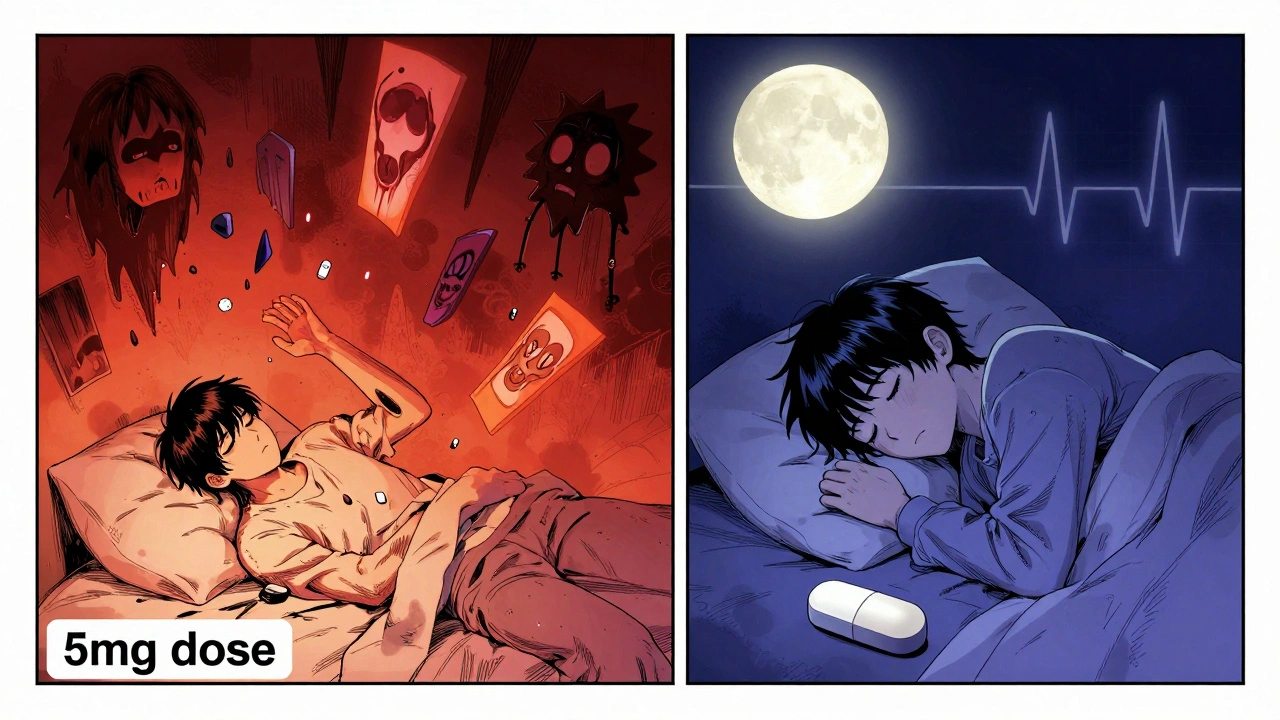
Here’s the catch: most people take it wrong. They pop a 5mg or 10mg tablet at 11 PM, hoping for instant sleep. That’s like turning on a floodlight when you’re trying to dim the room. Your body only needs about 0.3mg to 0.5mg to trigger the signal. Anything higher doesn’t help - it just increases side effects.
The Right Dose and Timing
Start with 0.3mg to 0.5mg. Yes, that’s less than a grain of salt. Most store-bought pills are 3mg, 5mg, or even 10mg - way too high. You can find low-dose options online or ask a pharmacist for 0.5mg tablets.
Take it 2 to 3 hours before your target bedtime. Not when you’re already in bed. Not at midnight. Two to three hours before. Why? Because melatonin doesn’t work like a sedative. It takes time to shift your internal clock. If you take it at 11 PM but you don’t want to sleep until 1 AM, you’re delaying your rhythm instead of advancing it.
For jet lag:
- Flying east? Take melatonin at your destination’s bedtime for 2-3 days before you leave and after you arrive.
- Flying west? Take it at bedtime after you land. No need to start early.
For delayed sleep phase:
- Take 0.5mg at 4 PM if you normally fall asleep at 2 AM. Gradually move it earlier by 15-30 minutes every few days.
- Pair it with morning sunlight - go outside for 15 minutes right after waking. This reinforces the new schedule.

What the Research Really Says
Studies show melatonin shifts your internal clock by about 1 to 2 hours when timed correctly. For people with delayed sleep phase, it can move bedtime up by 40 minutes and shift melatonin production earlier by over an hour. That’s huge for someone who can’t get up for work.
But here’s the problem: not all studies agree. Why? Because people use different doses, different times, and different types of melatonin. Some use immediate-release pills. Others use slow-release. Some take it with food. Some don’t. That’s why you’ll see conflicting reviews.
A 2023 review in the Journal of Pineal Research found that doses above 1mg offer no extra benefit. In fact, higher doses may cause your receptors to become less sensitive over time. That’s why some users report melatonin stops working after a few weeks.
Side Effects and Risks
Melatonin is safe for short-term use. But it’s not harmless.
- Next-day drowsiness - happens in 28% of users, especially with doses over 1mg.
- Vivid dreams or nightmares - reported by 22% of users. Your brain is more active during REM sleep when melatonin is active.
- Headaches - affects about 15%.
- Lowered body temperature - melatonin naturally drops your core temp by 0.3-0.5°C to help you sleep. That’s normal. But if you’re already cold, it might make you uncomfortable.
Long-term safety data is limited. Most studies only look at a few weeks or months. There’s no evidence it causes addiction like benzodiazepines, but your body might get used to the signal. That’s why experts recommend using it only when needed - not every night.
The Supplement Problem
In the U.S., melatonin is sold as a dietary supplement. That means the FDA doesn’t test it for purity, potency, or accuracy. A 2022 ConsumerLab analysis found that melatonin supplements contained anywhere from 83% to 478% of the amount listed on the label. One pill labeled 3mg had 11.7mg. Another had only 0.8mg.
That’s why low-dose options are rare. Most brands assume you want the highest dose possible. If you’re trying to use 0.5mg, you’re stuck cutting pills or buying from specialized brands that offer micro-doses.
In Europe, melatonin is a prescription drug. Only one formulation - Circadin, a 2mg slow-release tablet - is approved for insomnia in people over 55. That’s because regulators demand quality control. In the U.S., you’re on your own.
Who Should Avoid It
Melatonin isn’t for everyone:
- Pregnant or breastfeeding women - not enough safety data.
- People with autoimmune diseases - melatonin affects immune function.
- Those on blood thinners, diabetes meds, or antidepressants - possible interactions.
- Children under 12 - only use under a doctor’s supervision.
If you’re taking other medications, talk to your doctor. Melatonin isn’t just a harmless herb. It’s a hormone. And hormones talk to everything else in your body.
What’s Next for Melatonin
Scientists are working on better versions. Agomelatine, approved in Europe, combines melatonin action with an antidepressant effect. Tasimelteon, approved in the U.S., helps blind people regulate sleep. These are precision tools - not over-the-counter guesses.
Future use will likely be personalized. Imagine a simple blood test or wearable device that measures your natural melatonin rise (called DLMO - dim light melatonin onset). Then you’d know exactly when to take it. Stanford researchers are already testing this.
Right now, melatonin is a blunt instrument. But it’s the best tool we have for resetting your body clock - if you use it right.
Real User Experiences
On Reddit’s r/sleep, users report:
- "Took 0.5mg at 8:30 PM for 3 weeks. Went from sleeping at 2 AM to 12 AM. No grogginess. Life changed." - u/SleepyScientist, June 2023
- "Flew from NYC to Tokyo. Took 1mg at local bedtime. Adjusted in 2 days. Without it, I’d have been a mess for a week." - Verified Amazon review, April 2023
- "Took 5mg every night for a month. Woke up exhausted. Stopped. Now I take 0.5mg at 7 PM. Works perfectly." - ConsumerLab review, January 2023
Those who succeed aren’t taking more. They’re taking less - and at the right time.
Is melatonin addictive?
No, melatonin is not addictive. Unlike prescription sleep drugs, it doesn’t cause physical dependence or withdrawal. But your body may become less responsive if you take high doses every night for weeks. That’s not addiction - it’s receptor desensitization. The solution is to use the lowest effective dose and only when needed.
Can I take melatonin every night?
You can, but you shouldn’t. Melatonin is designed to reset your rhythm, not replace it. If you’re taking it nightly for months, you’re likely masking a deeper issue - poor sleep hygiene, stress, or light exposure problems. Use it for short-term fixes: jet lag, shift changes, or resetting your schedule. Then let your body take over.
Why does melatonin make me dream more?
Melatonin increases REM sleep - the stage where dreams happen. Higher melatonin levels mean more time in REM. That’s normal. Vivid dreams aren’t dangerous, but they can be unsettling. If they bother you, lower your dose. Most people find 0.3-0.5mg reduces dream intensity without losing effectiveness.
Is melatonin safe for older adults?
Yes, and it’s often more effective. As we age, our natural melatonin production drops - sometimes by 80%. That’s why older adults often wake up too early. Low-dose melatonin (0.5-1mg) taken 2-3 hours before bedtime can help reset their rhythm. The European Medicines Agency even approved a slow-release 2mg tablet (Circadin) for insomnia in people over 55.
Does melatonin help with anxiety or depression?
Not directly. But poor sleep makes anxiety and depression worse. If your mood issues stem from irregular sleep, fixing your rhythm with melatonin can help. Some antidepressants like agomelatine combine melatonin action with serotonin regulation, but over-the-counter melatonin alone won’t treat depression. Don’t use it as a mood booster.
What’s better: melatonin or magnesium for sleep?
They do different things. Melatonin tells your body it’s nighttime. Magnesium helps relax your muscles and calm your nervous system. If you can’t fall asleep because your mind won’t shut off, magnesium might help. If you’re awake at 2 AM because your body thinks it’s still daytime, melatonin will help. Many people use both - melatonin at night, magnesium earlier in the evening.
Can I take melatonin with alcohol?
No. Alcohol suppresses melatonin production and disrupts sleep architecture. Taking melatonin after drinking might make you feel drowsy, but you’ll still wake up unrefreshed. Alcohol also increases the risk of next-day grogginess and nightmares. Skip the wine if you’re using melatonin.
If you’ve tried melatonin and it didn’t work, don’t give up. You probably just used the wrong dose or the wrong time. Start low. Take it early. Be patient. Your body knows how to sleep. Melatonin just reminds it.
12 Responses
Man, I wish I’d read this three years ago. I was popping 10mg like candy, wondering why I felt like a zombie the next day. Started with 0.5mg at 7:30 PM - no more 3 AM scrolling, no more guilt. Now I sleep like a baby, wake up refreshed, and actually enjoy mornings. It’s not magic, it’s just biology working right. Seriously, stop treating it like a party pill. Less is more, folks.
OH MY GOD. This is the most *elegant* breakdown of melatonin I’ve ever encountered. It’s not a sedative - it’s a *chronobiological whisper* that your pineal gland sends into the synaptic ether like a lullaby from the evolutionary past. Blue light? That’s the digital vampire sucking your circadian soul dry. And the dose? 0.5mg? That’s not a supplement - it’s a *hormonal key* to unlock your natural rhythm. I’m printing this out and framing it next to my sunrise lamp. 🌅✨
Of course it works if you do it right. But most people are too lazy to read. They want a magic bullet, not a biological reset. That’s why America’s sleeping worse than ever. We treat our bodies like broken appliances - slap on a patch, crank the dial, and hope. Melatonin isn’t the problem. The culture is. Stop blaming the supplement. Start fixing your damn screen time.
so i took 5mg at 11 and woke up at 4 feeling like i got hit by a bus. then i read this and tried 0.5 at 7. and now i sleep like a champ. wtf why did no one tell me this before?? also why do these pills even come in 5mg?? someone’s makin’ bank off dumb people
This is exactly why I stopped recommending melatonin to my clients until I taught them the timing and dosage. Most health coaches skip the science and just say ‘take a pill.’ But this? This is precision medicine. The 0.3–0.5mg range, taken 2–3 hours before bed - that’s the sweet spot. And pairing it with morning light? Game changer. I’ve seen people shift from 3 AM to 11 PM sleepers in under two weeks. It’s not a quick fix. It’s a reset. And it’s beautiful when done right.
Wow. A 15-sentence article that doesn’t say ‘just sleep better.’ Who even are you? 🤭
Our bodies are not machines to be fixed with pills. They are rhythms to be honored. Melatonin is not a remedy - it is a reminder. A gentle nudge from nature, asking us to remember the dark. To slow down. To breathe. To return to the cycle that once guided us before the glow of screens stole our night. Let us not mistake the signal for the solution. The solution is still in the quiet.
Just tried 0.5mg at 7:30 PM after reading this - holy crap, I fell asleep at 10:45 PM. No phone, no Netflix, just me and the darkness. 😊 I used to think I was a night owl. Turns out I was just stupid. Thanks, stranger on the internet! 🙌
Bro, you’re overcomplicating it. Just take a pill before bed. If it works, great. If not, you’re just a bad sleeper. Why do you need all this science? I took 5mg for 6 months and didn’t die. That’s all I care about.
Did you know the FDA doesn’t regulate melatonin? That means your ‘0.5mg’ pill could be laced with rat poison or government tracking chips. 😈 I read a blog that said Big Pharma is hiding the truth because they make billions off zolpidem. Also, your pineal gland is your third eye. Melatonin is the key to opening it. 🕯️👁️
Thank you for this meticulously researched and clinically grounded exposition. The distinction between circadian entrainment and sedation is critical, and yet perpetually misunderstood in public discourse. The recommendation to administer low-dose melatonin two to three hours prior to desired sleep onset is not merely prudent - it is biologically imperative. I shall be citing this in my next lecture on chronopharmacology.
Life is a wave. Melatonin is the tide. We fight the tide, thinking we are the shore. But we are not the shore. We are the sand, shifting. The pill is not the answer. The silence between heartbeats is. 🌊