
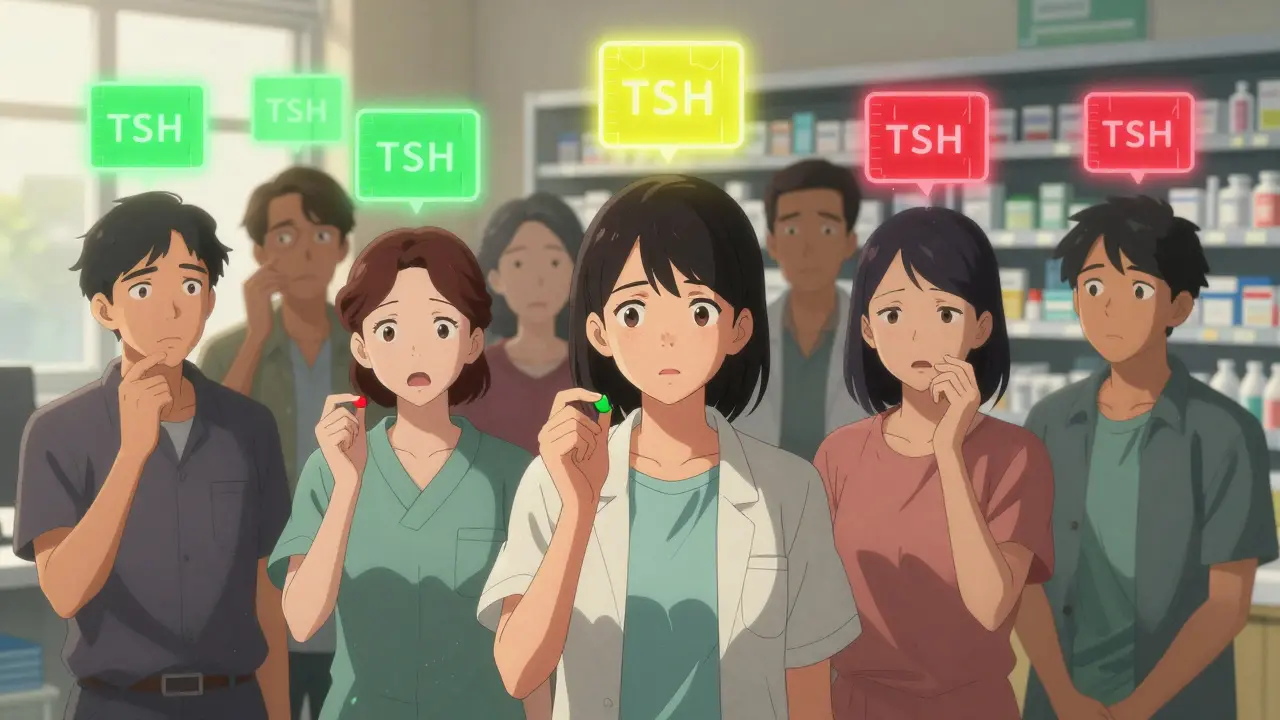
Switching between different brands of levothyroxine generics isn’t just a pharmacy routine-it can affect how you feel. For millions of people taking thyroid hormone replacement, the question isn’t whether generics work, but whether switching between them requires a blood test to check TSH levels. The answer isn’t simple, and it’s changed a lot in the last few years.
Why Levothyroxine Is Different
Levothyroxine isn’t like taking an ibuprofen or a vitamin. It’s a narrow therapeutic index (NTI) drug, meaning tiny changes in blood levels can cause big shifts in how your body functions. The goal is to keep your TSH-thyroid-stimulating hormone-between 0.4 and 4.0 mIU/L. For most people, that’s it. But if your TSH drops below 0.1 or climbs above 10, you could feel exhausted, jittery, or gain weight without reason.Even though the FDA says all approved generics are bioequivalent, the margin for error is razor-thin. A 5% difference in absorption might not matter for most drugs, but for levothyroxine, it can push someone from a perfect TSH of 2.1 to an abnormal 5.8. That’s why doctors used to insist on retesting after every switch.
What the FDA Says Now
The FDA has been clear since 2021: approved generic levothyroxine products meet strict bioequivalence standards. They must show that their absorption (AUC) and peak concentration (Cmax) fall within 80-125% of the brand-name version. That’s the same standard used for hundreds of other drugs.In February 2022, a major study of over 15,000 patients in the Kaiser Permanente system found no meaningful difference in TSH levels between people who switched generics and those who didn’t. The average TSH was 2.7 in both groups. The rate of dangerously high or low TSH was nearly identical-10.1% for switchers, 10.0% for non-switchers. That’s not a fluke. It’s data from real-world use.
By January 2024, the FDA updated its labeling to say: “For most patients, switching between different levothyroxine products does not require additional TSH monitoring beyond routine follow-up.” That’s a big shift from the old advice.
Why Some Doctors Still Recommend Monitoring
Despite the evidence, some guidelines still say to check TSH six weeks after a switch. The American Thyroid Association (ATA) and American Association of Clinical Endocrinologists (AACE) published that recommendation in 2014. Back then, they were worried about inconsistent absorption between manufacturers.That concern wasn’t baseless. Some patients do react. In the UK, over 1,200 adverse reaction reports were tied to levothyroxine switches between 2015 and 2021. Fatigue, heart palpitations, and unexplained weight changes were common. On Reddit’s r/Hashimotos, dozens of users report TSH spikes after switching from Mylan to Teva or Sandoz.
One patient wrote: “Switched from Mylan to Teva-my TSH jumped from 1.8 to 7.2 in eight weeks. I had to increase my dose.” Another said: “I’ve switched three times. No change. My doctor says I’m in the 70% who don’t care.”
So why the split? Because not everyone is the same. A small group-maybe 8-12%-seems to be sensitive to differences in fillers, dyes, or manufacturing processes. These are the people who need consistency.
Who Really Needs a TSH Test After a Switch?
You don’t need to check TSH every time you refill your prescription. But you should if you fall into one of these groups:- Thyroid cancer patients-They need tight control (TSH often below 0.1). Even small shifts can matter.
- Pregnant women-Thyroid needs rise during pregnancy. Unstable levels can affect fetal brain development.
- People over 65 with heart disease-Too much thyroid hormone can trigger arrhythmias.
- Those who’ve had TSH instability before-If your levels bounced around after past switches, stick with the same product.
- Anyone who feels different after switching-Fatigue, anxiety, weight gain, or heart racing? Get your TSH checked.
For everyone else-healthy adults with stable hypothyroidism-routine TSH testing after a generic switch isn’t needed. Your annual check-up is enough.

What’s in the Pill? Why It Might Matter
All levothyroxine generics contain the same active ingredient: levothyroxine sodium (C15H11I4NNaO4, molecular weight 798.86 g/mol). But the inactive ingredients? They vary.Some brands use lactose, others use corn starch. Some have dyes like FD&C Yellow No. 6. A 2022 BMJ Open study found that 1.7% of patients reported symptoms linked to excipient intolerance. That’s rare, but it’s real.
There’s also emerging science around genetics. About 0.8% of people have a variant in the DIO2 gene, which affects how their body converts T4 to active T3. These individuals may be more sensitive to absorption changes. Testing for this isn’t routine yet-but it might be in the future.
What the Experts Are Saying Now
Dr. David S. Cooper from Johns Hopkins led the landmark 2022 study. He says: “Switching generics doesn’t cause clinically meaningful TSH changes in the vast majority of patients.”Meanwhile, the UK’s Commission on Human Medicines (CHM) took a middle path: “Generic prescribing is appropriate for most, but if symptoms appear after a switch, test thyroid function.”
The American College of Endocrinology’s 2023 guidelines now say routine monitoring isn’t needed for average-risk patients. The ATA is updating its guidelines this year, and early signals suggest they’ll follow the same path.
Cost vs. Convenience
The push for generics isn’t just about science-it’s about money. In 2022, levothyroxine cost $1.2 billion in the U.S. Synthroid (brand name) made up only 15% of prescriptions but 42% of the cost. A 90-day supply of brand-name 100 mcg pills? Around $45.72. The generic? $4.37.Because of this, pharmacy benefit managers like Express Scripts now require generic substitution unless a doctor writes “dispense as written.” Over 89% of prescriptions are filled with generics now, up from 72% in 2015. That’s saved billions.
But if every switch meant a blood test, those savings could vanish. A single TSH test costs $30-$60. Multiply that by 20 million patients, and you’re talking about $600 million a year in extra testing.

What Should You Do?
Here’s your practical guide:- If you’re stable, feel fine, and your last TSH was normal-no need to test after a switch.
- If you’re pregnant, have heart disease, or have thyroid cancer-check TSH 6-8 weeks after any change.
- If you feel worse after switching-get tested. Don’t wait. Fatigue, palpitations, or unexplained weight gain aren’t normal.
- If you’ve switched before and had issues-ask your doctor to prescribe a specific brand or generic consistently.
- Keep your pharmacy informed. If you’ve had a bad reaction to a certain maker (like Mylan or Teva), ask them to note it in your profile.
You don’t need to panic every time your pill looks different. But you also shouldn’t ignore your body. The science says most people can switch safely. But your body knows best.
What’s Next?
Researchers are now looking at ways to identify the small group who truly need consistency. Genetic tests for DIO2 variants, blood markers for hormone conversion, and even AI models that predict sensitivity based on past TSH patterns could soon help doctors personalize prescriptions.For now, the rule is simple: monitor if you’re high-risk or if you feel off. Otherwise, trust the data-and your doctor’s judgment.
Do I need to check my TSH every time I switch generic levothyroxine brands?
No, not for most people. If you’re healthy, stable, and feel fine, routine TSH testing after a switch isn’t necessary. The FDA and major medical groups now agree that generic-to-generic switches don’t cause clinically significant changes in TSH for the majority. Only check if you’re in a high-risk group (like thyroid cancer, pregnancy, or heart disease) or if you notice symptoms like fatigue, palpitations, or weight changes after switching.
Why do some people have problems switching generics but others don’t?
A small percentage of people-estimated at 8-12%-may be sensitive to differences in inactive ingredients like fillers, dyes, or manufacturing processes. Some have genetic variations (like in the DIO2 gene) that affect how their body converts T4 to T3. Others may have low thyroid reserve or an intolerance to lactose or other excipients. For these individuals, even minor changes in absorption can push TSH out of range. Most people, however, absorb levothyroxine consistently regardless of brand.
Can I ask my pharmacist to always give me the same generic brand?
Yes. If you’ve noticed symptoms after switching, or if your doctor recommends consistency, you can ask your pharmacist to dispense the same generic each time. You can also ask your doctor to write “dispense as written” or “do not substitute” on your prescription. This isn’t common, but it’s allowed and often covered by insurance if medically justified.
Is brand-name Synthroid better than generics?
For most people, no. Large studies show no difference in TSH control between Synthroid and approved generics. The main difference is cost: generics cost about 10% of the price. Brand-name Synthroid is only recommended if you’ve had consistent problems with generics or if you’re in a high-risk group and your doctor prefers it. Insurance often requires trying generics first.
What symptoms should I watch for after switching levothyroxine?
Watch for signs your thyroid levels may be off: unusual fatigue, unexplained weight gain or loss, heart palpitations, anxiety, hair thinning, or feeling colder than usual. These aren’t normal side effects-they may indicate your TSH has shifted. If they appear within 4-8 weeks of switching, get your TSH checked. Don’t assume it’s just stress or aging.
15 Responses
Interesting breakdown. I’ve been on levothyroxine for over a decade and switched generics five times without issue. My TSH has stayed rock solid at 2.3. I think the fear around switching is overblown for most people. The data supports this.
For those of us who feel fine and have stable labs, this is a relief. I used to stress every time my pill looked different. Now I just grab whatever’s cheapest at the pharmacy. If your body’s not screaming, don’t fix it. Your wallet will thank you.
I love how this post balances science and real life. Not everyone needs a blood test after every switch. But if you feel off? Listen to yourself. Your body knows before the lab does. Also, props to the pharmacist who remembers your history-those people are heroes.
Oh please. ‘Most people’ don’t care? That’s what they said about gluten too. Wake up. The FDA doesn’t care about your symptoms-they care about profit margins. I switched from Mylan to Teva and spent 3 months feeling like a zombie. You think that’s normal? It’s not. It’s corporate negligence dressed up as science.
bro i switched to teva and my heart was racing like i drank 5 espressos 🤯 why is this so complicated? why can’t they just make one pill that works for everyone? 🤦♂️
i switched generics last year and felt so tired i thought i was dying but my doctor said it was fine and i should wait… turns out my tsh was 8.2. i should’ve trusted myself. dont wait. get tested if you feel weird. even if its just a little
As someone who moved from India to the U.S. and had to navigate this system, I’m amazed at how much better informed patients are here. In my home country, no one even knows what TSH is. This post is a gift. Thank you for making it clear and human.
...I’ve been on the same generic for 7 years... I switched once... and I swear... I felt like I was slowly drowning... my TSH went from 1.9 to 6.7... I cried... I called my doctor... I got retested... and I’m back on the same one... I just... I don’t understand why it’s so hard for people to believe this happens...
This is a dangerous oversimplification. The FDA’s standards are laughably lax. Bioequivalence of 80-125% is not a guarantee of safety-it’s a loophole for pharmaceutical corporations to profit off vulnerable populations. You are being manipulated into believing that your suffering is insignificant. You are not a statistic. You are a person.
my tsh was fine after switching but i felt off so i got tested anyway turns out it was off by 0.5 and my doc adjusted my dose. no big deal. listen to your body thats all
Don’t test unless you feel off. Simple.
my cousin in delhi takes levothyroxine and never checks her tsh. she’s fine. maybe we overthink this too much? the body adapts. let it breathe.
oh my god i switched from mylan to sandoz and i lost 12 pounds in 3 weeks and my hair fell out and my boyfriend left me and now i hate all generics and i’m going to start a petition to ban teva forever i swear to god this is the worst thing that ever happened to me
I’ve been in the same boat as many of you. Switched, felt weird, got tested, adjusted. It’s not scary-it’s just part of managing a chronic condition. The key is awareness, not fear. Thank you for the thoughtful post.
So let me get this straight: we’re being told to trust the FDA’s 80-125% window... but if your pill has a different dye, you might turn into a zombie? And the only way to know is to pay $50 for a blood test? Brilliant. The real drug here is anxiety.