

Taking medication every day feels like a chore. You forget. You get busy. You feel fine, so you skip it. Then you wonder why you’re still not better. The truth? It’s not about willpower. It’s about behavior. If you want to stick with your meds long-term, you don’t need to remember more-you need to make taking them automatic. And that’s where behavioral tricks come in.
Why Your Willpower Keeps Failing
Most people think missing meds is about being lazy or forgetful. But research shows it’s deeper than that. Nearly half of people with chronic conditions don’t take their pills as prescribed. That’s not because they don’t care. It’s because their brains aren’t wired to treat medicine like brushing teeth or drinking coffee-things we do without thinking. The National Institutes of Health found that non-adherence causes 125,000 preventable deaths every year in the U.S. alone. And it costs the system between $100 and $300 billion annually. The problem isn’t just patients-it’s systems that treat adherence like a personal failure instead of a behavioral challenge. The fix? Stop relying on memory. Start building habits.Anchor Your Meds to an Existing Habit
Your brain loves routines. If you already do something every day without thinking-like brushing your teeth, making coffee, or checking your phone-you can piggyback your medication onto it. This is called habit stacking. A 2020 study in Patient Preference and Adherence showed that people who paired their meds with an existing daily habit improved adherence by 15.8%. Why? Because the cue (brushing teeth) triggers the behavior (taking pills), not your conscious effort. Try this: Right after you brush your teeth in the morning, grab your pill bottle. Do it the same way every day. Don’t think about it. Just do it. After a few weeks, your brain will link the two. You’ll feel something’s off if you skip the pills after brushing. Same goes for evening meds. Take them right after you turn off the TV. Or right before you get into bed. Pick a cue that’s already solid in your day. Don’t create a new one.Simplify Your Regimen
The more pills you have to take, the harder it gets. A 2011 meta-analysis of over 21,000 patients found that switching from multiple pills to a single-pill combination boosted adherence by 26%. That’s not magic-it’s physics. Fewer decisions mean fewer chances to fail. Talk to your doctor. Ask: Can I combine my meds? Can I switch to once-daily versions? Are there long-acting options? For example, if you’re taking three pills for blood pressure, cholesterol, and diabetes, ask if any can be merged into one pill. Many new medications now combine two or three drugs in a single tablet. If your doctor says no, ask why. Sometimes it’s just habit on their end-not medical necessity. Even small reductions help. Going from four doses a day to two cuts your chance of forgetting in half.Use Visual Reminders That Work
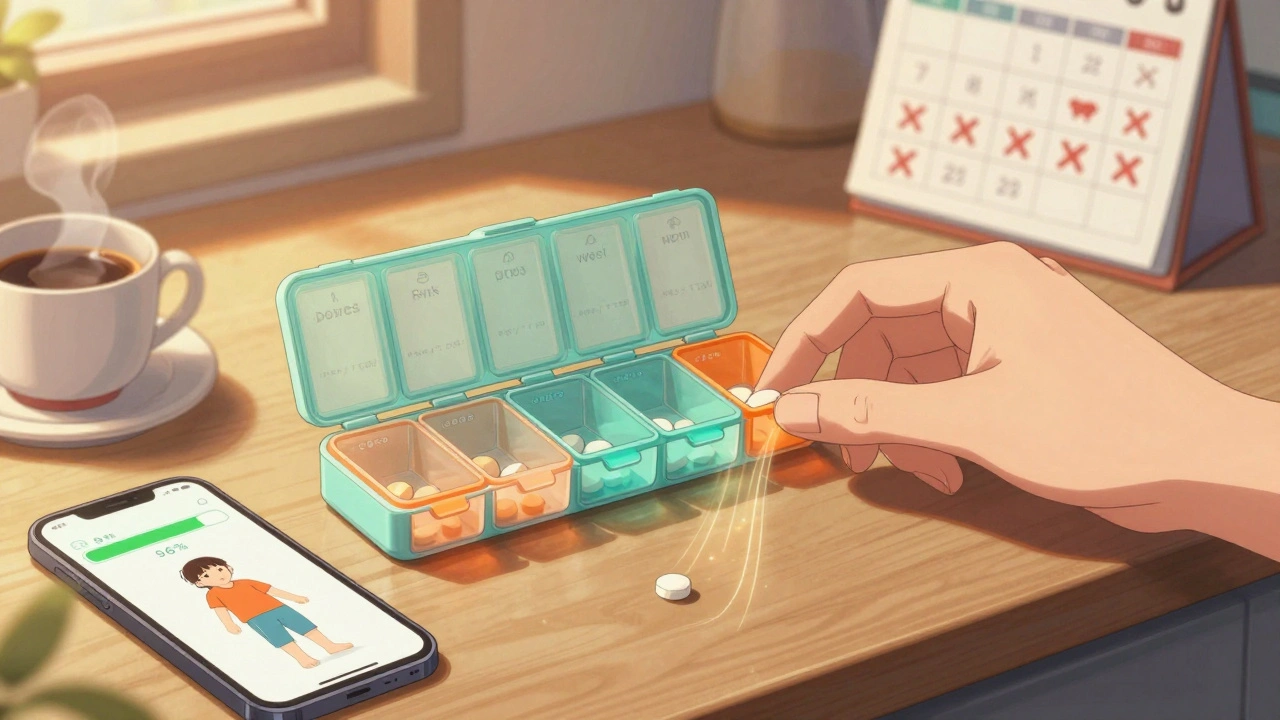
Generic alarms? They get ignored. Your phone buzzes, you swipe it off, and you forget five minutes later. Better options:- Weekly pill organizers: A 2021 study in the Journal of the American Geriatrics Society found they reduced missed doses by 27% in older adults. Use one with compartments for morning, afternoon, evening, and night. Fill it every Sunday. Seeing an empty slot is a visual cue you can’t ignore.
- Smart pill dispensers: Devices like MedMinder or Hero dispense pills at the right time and send alerts to your phone or family members if you miss a dose.
- Sticky notes in key spots: Put a note on your bathroom mirror, fridge, or coffee maker. Not “Take meds.” Write “After coffee = pills.” Specificity matters.
Track Progress, Not Just Pills
People who track their medication use are more likely to stick with it. But not because they’re being monitored. Because they see progress. A 2005 study by Cochran showed that bipolar patients who kept a daily medication chart improved adherence by 19.3%. Why? Tracking turns abstract effort into visible success. Try this: Get a simple calendar. Mark an X for every day you take your meds. No fancy apps needed. After a week, you’ll have a chain of X’s. Your brain doesn’t want to break a streak. That’s the Seinfeld Strategy-don’t break the chain. If you miss a day, don’t guilt-trip yourself. Just restart. One slip doesn’t ruin the habit. Abandoning it does.Make It Easier Than Skipping
Behavioral science says: People choose the path of least resistance. So make taking your meds the easiest option.- Keep your pill bottle next to your toothbrush.
- Set up automatic refills with your pharmacy. A 2022 study showed this improved continuity by 33.4%.
- If cost is a barrier, ask about generic versions or patient assistance programs. A 2022 study in Health Affairs found financial incentives boosted persistence by 34.2%.
- For elderly or cognitively impaired users, pair meds with a daily ritual-like eating breakfast-and use large-print labels or color-coded bottles.
Use Motivation, Not Pressure
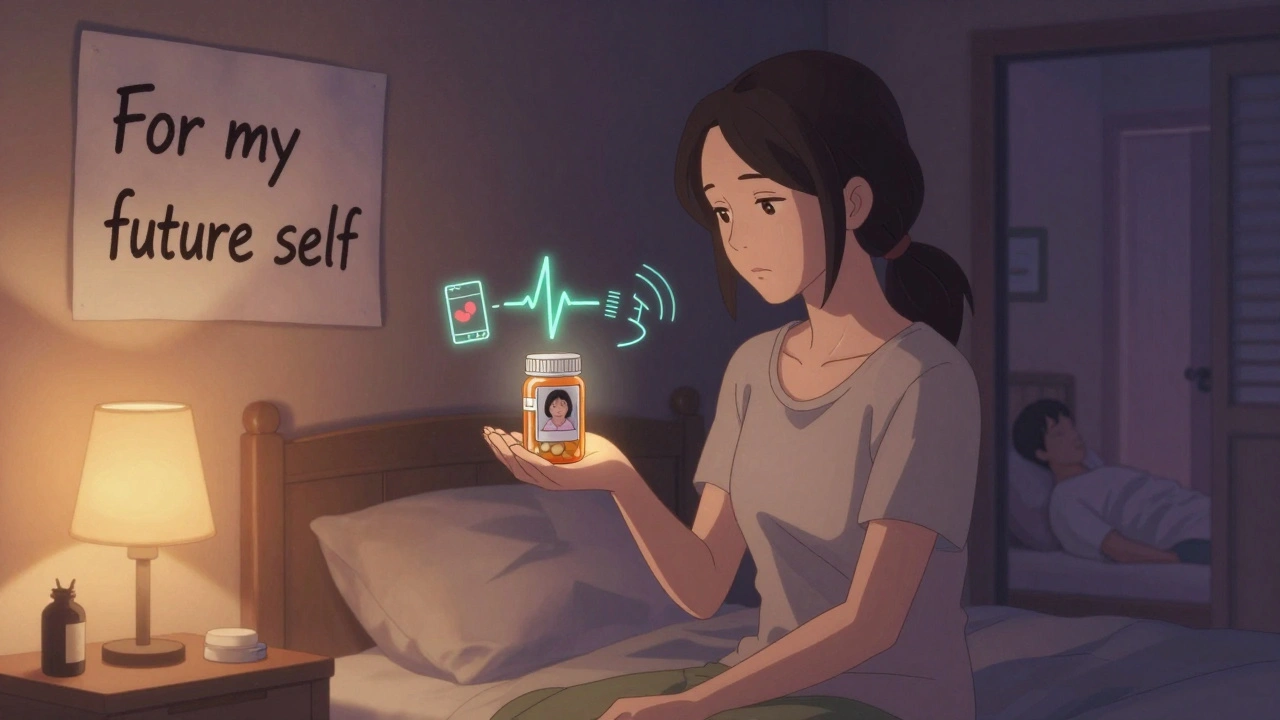
Telling yourself “I have to take this” doesn’t work. But asking “Why does this matter to me?” does. Motivational interviewing isn’t therapy-it’s a conversation you can have with yourself. Ask:- What do I want to be able to do in six months that I can’t do now?
- How will I feel if I stick with this?
- What’s the real cost of skipping?
Get Help That Sticks
You don’t have to do this alone. Team-based care-where your doctor, pharmacist, and nurse all give you the same message-boosts adherence to 68%, according to a 2018 study in Patient Preference and Adherence. That’s 19 points higher than fragmented care. Ask your pharmacist: Can you call me when my refill is due? Can you explain how each pill works in simple terms? Ask your doctor: Can we review my meds every three months to simplify them? If you’re on mental health meds, consider a therapist trained in CBT or dialectical behavioral therapy. A 2023 study showed these approaches helped patients accept their meds as part of self-care, not a sign of weakness.What Doesn’t Work
Not all “helpful” tools actually help.- Pill organizers alone: They improve adherence by only 8.4%. Why? Because they don’t change behavior-they just store pills. If you don’t take them out, they sit there.
- Generic reminders: “Take your meds” texts get ignored. Personalized ones (“Your BP is still high. Your pill helps.”) work better.
- Shaming: “You’re making your doctor mad” doesn’t motivate. It isolates.
Real-Life Example: Sarah’s Story
Sarah, 58, had high blood pressure and diabetes. She took seven pills a day. She forgot half the time. Her doctor gave her a pill organizer. Nothing changed. Then she tried this:- She switched to a once-daily combo pill for her blood pressure.
- She paired her diabetes pill with her morning coffee.
- She filled a weekly organizer every Sunday and put it on the kitchen counter.
- She set a photo of her grandson’s first steps as her phone wallpaper with the note: “For him, I stay healthy.”
- She signed up for auto-refills.
Start Small. Stay Consistent.
You don’t need to fix everything at once. Pick one trick. One habit. One change. Maybe it’s taking your pill right after you brush your teeth. Maybe it’s filling your pill box every Sunday. Maybe it’s turning off your phone’s generic alarm and setting a custom one that says, “You’re doing this for your future self.” The goal isn’t perfection. It’s consistency. One day at a time. One habit at a time. Your body doesn’t care how smart you are. It only cares if you show up.What’s the most effective behavioral trick for medication adherence?
The most effective trick is habit stacking-pairing your medication with an existing daily routine like brushing your teeth or drinking coffee. Studies show this improves adherence by up to 15.8%. It works because it turns a conscious task into an automatic behavior, removing the need for willpower.
Can smartphone apps really help me take my pills?
Yes, but only if they’re designed well. Generic alarms don’t work. Apps that let you track progress visually, send personalized messages, and sync with your health records improve adherence by up to 28.7%. Look for apps with progress charts and reminders tied to your routine, not just time-based alerts.
Why do I keep forgetting even when I know it’s important?
Your brain prioritizes immediate rewards over long-term benefits. Taking a pill gives no instant feeling-it’s invisible. But skipping feels easy right now. Behavioral tricks work by making the action easier, more visible, and linked to something you already do daily. You’re not lazy-you’re human.
Is it better to take meds at the same time every day?
Yes. Taking your medication at the same time every day creates a strong routine cue. A 2020 study found this simple change improved adherence by 15.8%. Consistency trains your brain to expect the behavior, making it automatic over time.
What if I can’t afford my meds?
Cost is one of the biggest barriers to adherence. Even the best behavioral tricks fail if you can’t pay. Talk to your pharmacist about generics, patient assistance programs, or mail-order options. A 2022 study showed financial incentives improved persistence by 34.2%. Your health shouldn’t depend on your bank account.
Should I use a pill organizer?
Only if you use it correctly. A pill organizer alone improves adherence by just 8.4%. But if you fill it weekly, keep it visible, and check it daily, it becomes a powerful visual cue. Pair it with habit stacking-for example, filling it after Sunday dinner-and it becomes part of your routine.
Can I stop taking meds if I feel fine?
Never stop without talking to your doctor. Many medications work behind the scenes-like those for blood pressure or cholesterol. You won’t feel symptoms when they’re working, which makes skipping tempting. But stopping can cause serious rebound effects. Behavioral tricks help you stick with them even when you feel fine.
10 Responses
Let’s be real-habit stacking is the only thing that works. Everything else is just noise. Brushing teeth? Perfect cue. Alarms? Useless. Pill organizers? Only if you actually open them. The real hack is making it subconscious. Your brain doesn’t care about your willpower-it cares about patterns. Stop overthinking. Just do it after you spit out the toothpaste. That’s it.
This is so needed. I’ve seen so many people struggle with meds-not because they don’t care, but because they’re drowning in complexity. I work with elderly patients in rural areas and the simplest fix is often pairing meds with breakfast or bedtime. One guy started taking his BP pill right after he poured his coffee-now he hasn’t missed in 18 months. No app. No alarm. Just coffee → pills. Human behavior isn’t complicated. Systems are.
Bro, I live in Lagos and we don’t have smart dispensers or auto-refills. But we have *community*-my auntie checks on me every morning when she sees me leave the house. She doesn’t say ‘take your pills’-she says ‘you still alive?’ and I just nod and grab them. Sometimes the best system isn’t tech-it’s someone who notices you’re gone.
OK but have you seen the corporate greed behind this? Pharma companies WANT you to take 7 pills a day because it’s more profitable. They don’t want you on one combo pill. They pay doctors to keep prescribing separate meds. And now they’re selling you $200 smart pill boxes like it’s a miracle cure. Wake up. The real solution is systemic change-not personal hacks. They’re selling you a Band-Aid while the whole damn hospital is on fire.
Ugh. I’ve been doing the Seinfeld chain thing for 87 days. One missed day. I cried. I felt like a failure. Then I realized-why am I punishing myself for being human? This isn’t about perfection. It’s about showing up. Even if you miss a day, you still did 86. That’s not failure. That’s resilience. 🙌
Everyone’s missing the point. This isn’t about behavior. It’s about control. The medical-industrial complex doesn’t want you to be autonomous. They want you dependent. That’s why they push ‘habits’ and ‘routines’-to make you think the problem is you. But what if your meds are unnecessary? What if your diagnosis was wrong? What if you’re being drugged to keep you docile? The real question isn’t how to take your pills-it’s why you were given them in the first place. Question everything. Trust no one. Especially not the doctor who told you to ‘just take it daily’.
I love how this breaks it down without shaming anyone. I’ve been a caregiver for my mom for 5 years and the thing that changed everything? We put her pills next to her slippers. Every morning, she puts on her slippers → sees the bottle → takes them. No thinking. No stress. We also started using a big calendar with stickers-she loves picking the color each day. It’s not about discipline. It’s about making it feel like part of her routine, not a chore. Small wins matter.
Just wanted to say thank you for writing this. I’ve been on antidepressants for 12 years and I used to feel like a failure every time I missed a dose. This post made me realize-I’m not broken. My brain just needs better design. I started pairing my pill with my morning tea and now I don’t even think about it. I also switched to a once-daily version last year. Best decision ever. You’re not alone. We got this.
While I appreciate the behavioral framing, I must emphasize the statistical outliers: 28.7% improvement via apps is not statistically significant when baseline adherence is under 40%. Furthermore, the ‘Seinfeld Strategy’ lacks peer-reviewed validation outside of self-reported data. The real issue is pharmacokinetic variability and polypharmacy risks, which are completely unaddressed here. Also, emojis are unprofessional. 🤔
i just wanted to say… i missed my meds for 3 days last week. i felt awful. but i read this and i didn’t beat myself up. i just filled my pillbox again this sunday. and tomorrow i’ll take it after my coffee. it’s not perfect. but i’m trying. and that’s enough.