
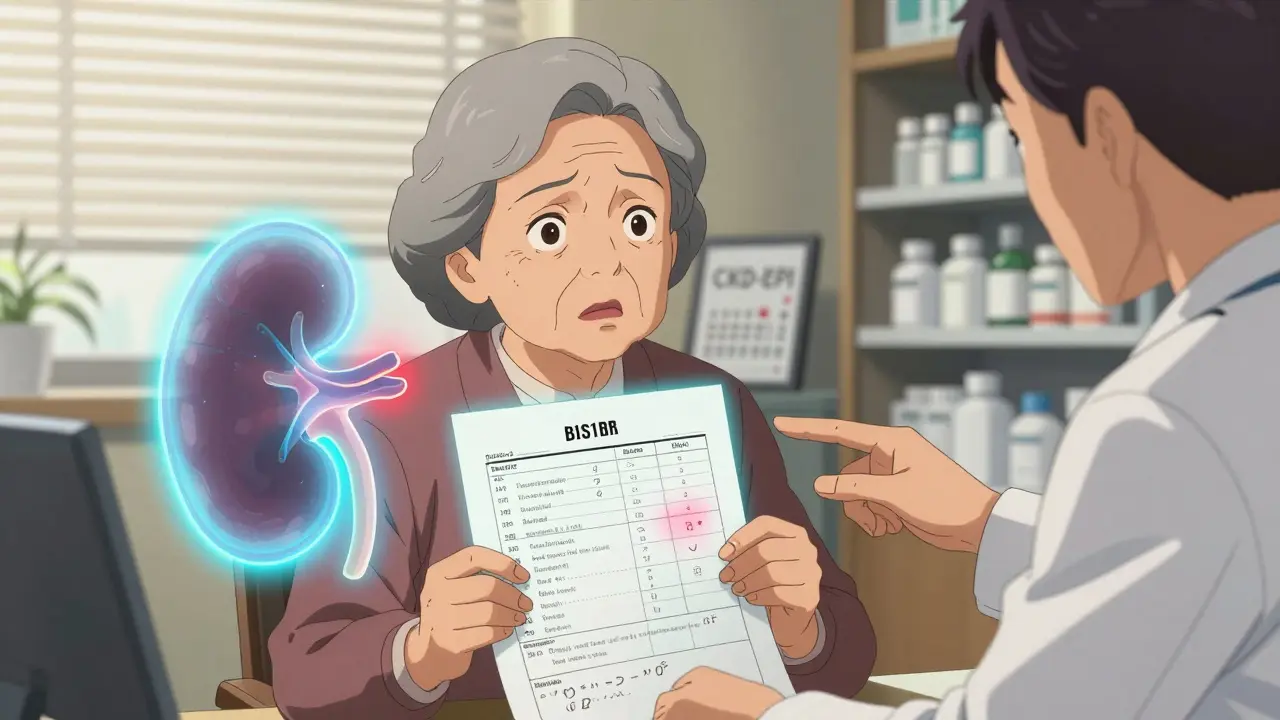
When you’re over 70, taking a pill isn’t just about swallowing it. It’s about making sure your kidneys can handle it. As we age, our kidneys don’t work like they used to. On average, a 75-year-old has about 35% less kidney function than a 30-year-old. That’s not a disease - it’s just biology. But if you keep giving the same dose of blood pressure medicine, antibiotics, or painkillers as you did at 50, you’re putting yourself at risk. Toxicity. Confusion. Falls. Hospital stays. All preventable - if you know how to check kidney function the right way.
Why Standard Kidney Tests Don’t Work for Seniors
Most doctors still rely on a simple blood test: serum creatinine. It’s cheap, fast, and everywhere. But here’s the problem: creatinine comes from muscle. As we get older, we lose muscle mass - even if we don’t look thin. A frail 82-year-old woman might have the same creatinine level as a healthy 45-year-old man. But her kidneys? They’re barely keeping up. That’s why using creatinine alone to estimate kidney function often gives false reassurance. It says "normal" when it’s actually "dangerously low."That’s why guidelines have changed. The old standard - the Cockcroft-Gault formula - was designed in 1976. It’s still used, but only if you adjust it correctly. Many EHR systems still default to using actual body weight. That’s a mistake. For seniors who are underweight or frail, that overestimates kidney function by 20% or more. For obese seniors, it can underestimate it. Neither is safe.
The Three Equations You Need to Know
There are three main equations used to estimate kidney function. But not all are equal for seniors.- Cockcroft-Gault (CG): Calculates creatinine clearance. Formula: [(140 - age) × weight (kg) × (0.85 if female)] / (72 × serum creatinine). The key? Use ideal body weight, not actual weight. Studies show this cuts dosing errors by 25% in older adults. If your doctor uses CG, ask: "Did you use ideal body weight?" If they don’t know what that is, it’s time to ask for help.
- CKD-EPI: Now the most common equation in EHRs. It’s better than the old MDRD formula. But in seniors over 75 - especially those with low muscle mass, malnutrition, or chronic illness - it still overestimates kidney function. In one study, CKD-EPI misclassified 40% of frail elderly patients as having stage 2 kidney disease when they were actually at stage 3. That means they got full doses of drugs like rivaroxaban or dabigatran when they should’ve gotten half.
- BIS1 and FAS: These are the new kids on the block. Designed specifically for older adults. BIS1, developed by researchers in Berlin, performs better in people over 80. It accounts for age, sex, creatinine, and body size in a way that matches real kidney function more closely. In a 2023 study, switching from CKD-EPI to BIS1 reduced medication-related hospitalizations by 18% in patients over 80.
There’s no single "best" equation. But if you’re over 75, frail, or have diabetes and heart failure, BIS1 or FAS should be your starting point - not CKD-EPI.
What About Cystatin C?
Cystatin C is a newer blood marker. Unlike creatinine, it’s not affected by muscle mass. It’s more accurate for seniors with low muscle tone - the very people most at risk. But it’s not in every lab. It costs $50-$75 more than a creatinine test. Still, if your eGFR from CKD-EPI is between 45 and 59 mL/min/1.73 m² - and you have no signs of kidney damage like protein in your urine - a cystatin C test can tell you if your kidneys are really okay or if you’re being misled.Dr. Sophie Dupont at the University of Michigan recommends this approach: Start with BIS1. If the result is borderline, order cystatin C. If it still looks unclear, do a 24-hour urine collection for creatinine clearance. That’s the gold standard - and it’s worth it when you’re prescribing something like vancomycin or colistin, where a small dosing error can be deadly.

What Happens When You Get It Wrong?
A 2024 study in Frontiers in Medicine followed 1,200 seniors on anticoagulants. Those dosed using CG with actual body weight had 25% more bleeding events than those dosed with CG using ideal body weight. Another study in JAMA Internal Medicine found that 38% of dosing errors in nursing homes came from using the wrong weight in the Cockcroft-Gault formula.One real case: an 88-year-old man with dementia was prescribed vancomycin for a UTI. His EHR used CKD-EPI and showed an eGFR of 58 - "mild kidney impairment." He got the full dose. Three days later, he stopped responding. His creatinine spiked. He had acute kidney injury from drug toxicity. Switching to BIS1 showed his true eGFR was 31. He needed a 50% dose reduction. He survived. But he spent 11 days in the hospital. That’s preventable.
What Your Doctor Should Be Doing
Most primary care doctors don’t know which equation to use. A 2022 survey found that 65% of them feel confused. Many just rely on what their EHR auto-selects. That’s dangerous. Epic and Cerner now offer age-based defaults - Epic automatically uses BIS1 for patients over 75. But not all systems do. And even then, you need to check.Here’s what a safe process looks like:
- Check serum creatinine and cystatin C (if available) at least once a year - more often if you’re on multiple medications.
- Use BIS1 or FAS if you’re over 75, especially if you’re frail, underweight, or have multiple chronic conditions.
- Use Cockcroft-Gault with ideal body weight if BIS1 isn’t available. Don’t use actual weight.
- If your eGFR is 45-59 and you have no protein in your urine, ask for a cystatin C test.
- For high-risk drugs (anticoagulants, antibiotics, NSAIDs, seizure meds), confirm with a 24-hour urine collection if possible.
Pharmacists in senior care settings are already doing this. A 2023 survey found that 78% of geriatric pharmacists use BIS1 for frail patients and CG with ideal weight for obese ones. But doctors? Only 22% of community practices use BIS1. That gap is costing lives.

What You Can Do Right Now
You don’t need to be a doctor to protect yourself. Here’s how to take charge:- Ask your doctor: "Which equation did you use to calculate my kidney function?" If they say "eGFR," ask: "Is that CKD-EPI or BIS1?"
- If you’re over 75 and taking more than three medications, ask for a medication review with a pharmacist who specializes in seniors.
- Keep a list of all your meds - including OTC painkillers and supplements. Bring it to every appointment.
- If your doctor says your kidneys are "fine" but you’re still feeling tired or confused, push back. Ask: "Could my meds be too strong?"
- Use the National Kidney Foundation’s free eGFR calculator (updated November 2023) to check your own numbers. Input your age, sex, race, and creatinine. See what BIS1 says compared to CKD-EPI.
There’s no magic bullet. But knowing which test to ask for - and when - can mean the difference between staying at home and ending up in the ER.
The Future Is Personalized
The FDA now requires drug makers to provide dosing guidance using multiple equations for drugs with narrow safety margins. The National Institute on Aging is funding a $4.2 million project to build point-of-care kidney tests that adjust for age and muscle loss. AI tools are being tested to pick the right equation based on your body type, diet, and other meds.But right now? The best tool you have is information. Don’t assume your doctor knows. Don’t assume your EHR got it right. Ask. Push. Verify. Your kidneys are working harder than ever to keep you safe. The least you can do is make sure they’re not being asked to do the impossible.
What’s the best equation for kidney function in seniors over 75?
For seniors over 75 - especially those who are frail, underweight, or have chronic illness - the BIS1 or FAS equations are more accurate than CKD-EPI or MDRD. These were designed specifically for older adults and account for age-related muscle loss. If BIS1 isn’t available, use the Cockcroft-Gault formula with ideal body weight, not actual weight. Avoid using CKD-EPI alone in very old or malnourished patients - it often overestimates kidney function.
Why does muscle mass matter for kidney function tests?
Most kidney tests rely on creatinine, a waste product made by muscles. As we age, we naturally lose muscle - even if we don’t lose weight. A senior with low muscle mass may have normal creatinine levels, but their kidneys could be functioning at only 40% of what they used to. That’s why creatinine-based estimates like CKD-EPI often give false reassurance. Cystatin C, which isn’t affected by muscle, is a better marker in these cases.
Should I get a cystatin C test if I’m over 70?
If your estimated GFR from CKD-EPI is between 45 and 59 mL/min/1.73 m² and you have no signs of kidney damage (like protein in urine), a cystatin C test is worth asking for. It helps determine if your kidneys are truly impaired or if your creatinine level is misleading because of low muscle mass. It’s not needed for everyone, but it’s critical for frail seniors on multiple medications.
Can I trust my EHR’s kidney function calculation?
Not always. While newer systems like Epic now auto-select BIS1 for patients over 75, many still default to CKD-EPI or use actual body weight in Cockcroft-Gault. Always ask your doctor or pharmacist which equation was used. If you’re on high-risk meds like anticoagulants or antibiotics, don’t assume the system got it right. Double-check.
Which medications are most dangerous for seniors with reduced kidney function?
Drugs eliminated mostly by the kidneys include anticoagulants (dabigatran, rivaroxaban), antibiotics (vancomycin, aminoglycosides), NSAIDs (ibuprofen, naproxen), seizure meds (phenytoin), and diabetes drugs (metformin). Even common painkillers like acetaminophen can build up if kidneys are weak. Always check dosing guidelines for seniors - and ask your pharmacist to review your list.
How often should kidney function be checked in seniors?
At least once a year for all seniors over 65. If you’re on multiple medications, have diabetes, high blood pressure, or heart failure, check every 3-6 months. After any hospital stay or major illness, retest immediately - acute kidney injury is common in older adults and can change dosing needs overnight.
11 Responses
lol so now even my kidneys are being surveilled by Big Pharma? next they'll be charging us for breathing right. i've been taking ibuprofen since i was 16 and my gfr's still higher than my ex's self-worth. they just want you to buy more tests so they can bill your insurance into oblivion. #cystatincscam
this is so important ❤️ my dad was almost hospitalized last year because they used his actual weight in the CG formula. he’s 81, 110 lbs soaking wet, and they gave him full-dose rivaroxaban. thank you for writing this - i’m printing it out and handing it to his doctor tomorrow. you’re a real one.
the real tragedy here isn’t just the math - it’s the institutional inertia. we’ve got AI models that can predict supernovas but can’t adjust a kidney equation for a 78-year-old woman who lost 20% of her muscle mass after her hip fracture. the system doesn’t care about your biology - it cares about what’s easiest to code. BIS1 isn’t just a better formula - it’s a moral argument written in numbers. if we treat aging like a bug to be patched, we’re already losing.
I’ve seen this before. The FDA approves drugs based on trials with 30-year-olds. Then they slap on a tiny footnote: "Use with caution in elderly." No real data. No real testing. Just profit-driven laziness. And now they want you to pay $75 for cystatin C so they can keep selling you the same toxic pills? Wake up. This isn’t medicine - it’s corporate exploitation dressed in white coats.
The utilization of creatinine-based estimations of glomerular filtration rate in geriatric populations remains a persistent clinical challenge, despite the availability of more accurate biomarkers such as cystatin C and novel equations such as BIS1. The persistence of outdated algorithms in electronic health record systems reflects a systemic failure to integrate evidence-based updates into routine practice, thereby perpetuating iatrogenic risk.
My uncle in Delhi got sick from painkillers. Doctor said kidneys fine. But he was thin, weak. Now he’s better. Please tell doctors: old body = different rules. No need for big words. Just listen.
Ah yes, the classic "BIS1 is better" narrative. Let’s ignore the fact that it’s only validated in a handful of European cohorts with limited diversity. CKD-EPI has been tested across 12 countries, 300,000 patients, and 18 ethnic groups. BIS1? A niche model built on a convenience sample of Berlin retirees. You’re advocating for a statistical outlier as a global standard. That’s not medicine - that’s academic wishful thinking.
Let’s be real. This whole post is just a way for geriatric pharmacists to feel superior. Most seniors don’t need BIS1. They need to stop taking 12 pills a day. The real problem isn’t the equation - it’s polypharmacy. Stop blaming the algorithm and start blaming the doctors who prescribe like they’re stocking a pharmacy. Also, cystatin C? That’s a $$$ money grab. We don’t need another test. We need fewer prescriptions.
I’ve been thinking about this a lot since my mom had that near-fatal reaction to vancomycin last year. I went back and looked at her old labs - CKD-EPI said 54, BIS1 said 33. She was given the full dose. I spent weeks digging through papers, calling nephrologists, begging the pharmacy to recalculate. They said "it’s not our job." But it is. If you’re prescribing something that can kill someone in 48 hours, you owe it to them to use the most accurate tool available. It’s not about being a genius - it’s about not being lazy. And honestly? If your EHR doesn’t auto-pick BIS1 for someone over 75, you should be embarrassed.
We’re treating aging like a malfunction instead of a natural process. We measure kidneys like they’re a car engine that needs tuning - but the body isn’t a machine. It’s a story. Every muscle lost, every organ slowed, every pill swallowed - it’s all part of a life lived. The equations are just numbers trying to capture a soul. Maybe the real question isn’t which formula to use - but why we keep trying to quantify something that’s inherently unquantifiable. Still… I’ll take BIS1 over CKD-EPI any day.
I just shared this with my 79-year-old mom and she cried - not because she’s scared, but because she finally feels seen. For years, she’s been told her kidneys are "fine" even though she’s tired all the time and her ankles swell. She didn’t know to ask about BIS1 or cystatin C. Now she’s printing this out and taking it to her next appointment. Thank you for giving us the words to speak up. 💪❤️ And hey - if your doctor doesn’t know what BIS1 is? Tell them to google it. Or better yet - ask for a pharmacist to review your meds. They’re the real heroes in this game.