
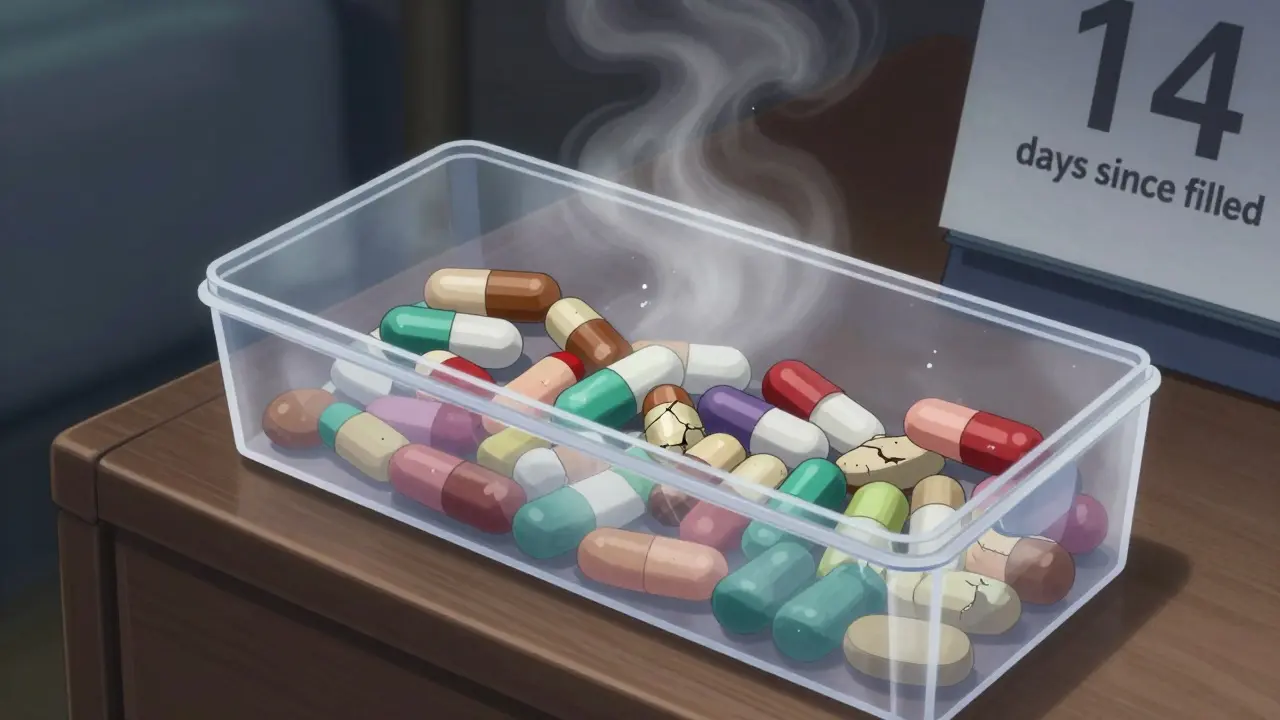
When you take your pills out of the original bottle and put them into a pillbox or a pharmacy-repackaged vial, you might think you’re just making life easier. But you’re also changing the medicine’s environment-and that can change how long it stays safe and effective. The expiration date on the bottle? That doesn’t apply anymore. And if you don’t know why, you could be taking medicine that’s lost potency-or even turned harmful.
Why Repackaging Changes Everything
Original medication containers aren’t just plastic or glass. They’re engineered systems. Think of them like a sealed food package with a vacuum seal, moisture barrier, and light protection-all designed to keep the drug stable for years. When a pharmacy transfers pills into a prescription vial or a weekly pill organizer, that protection is gone. The new container might let in moisture, oxygen, or light. And when you combine multiple drugs in one pillbox, you’re creating a chemical environment no manufacturer ever tested.Take albuterol sulfate tablets. In their original HDPE bottle with a desiccant, they lose just 3.2% of potency after 90 days. In a standard pharmacy vial? That number jumps to 15.7%. That’s not a small difference-it’s enough to affect how well your asthma inhaler works. The same goes for antibiotics like amoxicillin. Moisture causes them to break down faster. If you store them in a humid bathroom or a non-sealed pillbox, they may not kill the infection you need them to.
What Degradation Actually Looks Like
Medications don’t just expire like milk. They degrade in specific, measurable ways:- Hydrolysis: Water breaks down chemical bonds. This hits drugs like aspirin, penicillin, and nitroglycerin hardest. You won’t always see it-but the pill might taste bitter or crumble easily.
- Oxidation: Oxygen reacts with active ingredients. Drugs like nifedipine (a blood pressure med) turn from yellow to brown when exposed to air. That’s not just discoloration-it’s chemical change.
- Physical changes: Pills can cake together, stick to each other, or change shape. In pillboxes, this happens when multiple drugs interact. A 2022 study found that 18.7% of combined medications in pill organizers showed physical changes within two weeks.
- Light exposure: Some drugs, like warfarin or riboflavin, break down under UV light. Amber bottles help, but clear pillboxes? They offer zero protection.
These changes aren’t always visible. A pill might look fine but have lost 30% of its potency. That’s why you can’t rely on appearance alone.
What the Rules Actually Say
The FDA is clear: if a drug leaves its original container, the manufacturer’s expiration date no longer applies. That’s not a suggestion-it’s a regulation. In 2023, the FDA issued a warning letter to a major pharmacy chain for failing to assign new expiration dates to repackaged meds. The result? A 45-day shutdown.Most states have rules too. 41 out of 50 limit repackaged medications to 6 months or less. Seventeen states go further, capping it at 30 to 90 days for high-risk drugs. The U.S. Pharmacopeia (USP) and the American Society of Health-System Pharmacists (ASHP) both say: you must establish your own expiration date based on testing, not guesswork.
And here’s the kicker: the FDA’s own lab tests show that 22% of repackaged medications tested past 90 days had degradation beyond acceptable limits. Only 3% of original-packaged drugs did. That’s a seven-fold difference.
How to Actually Test Stability
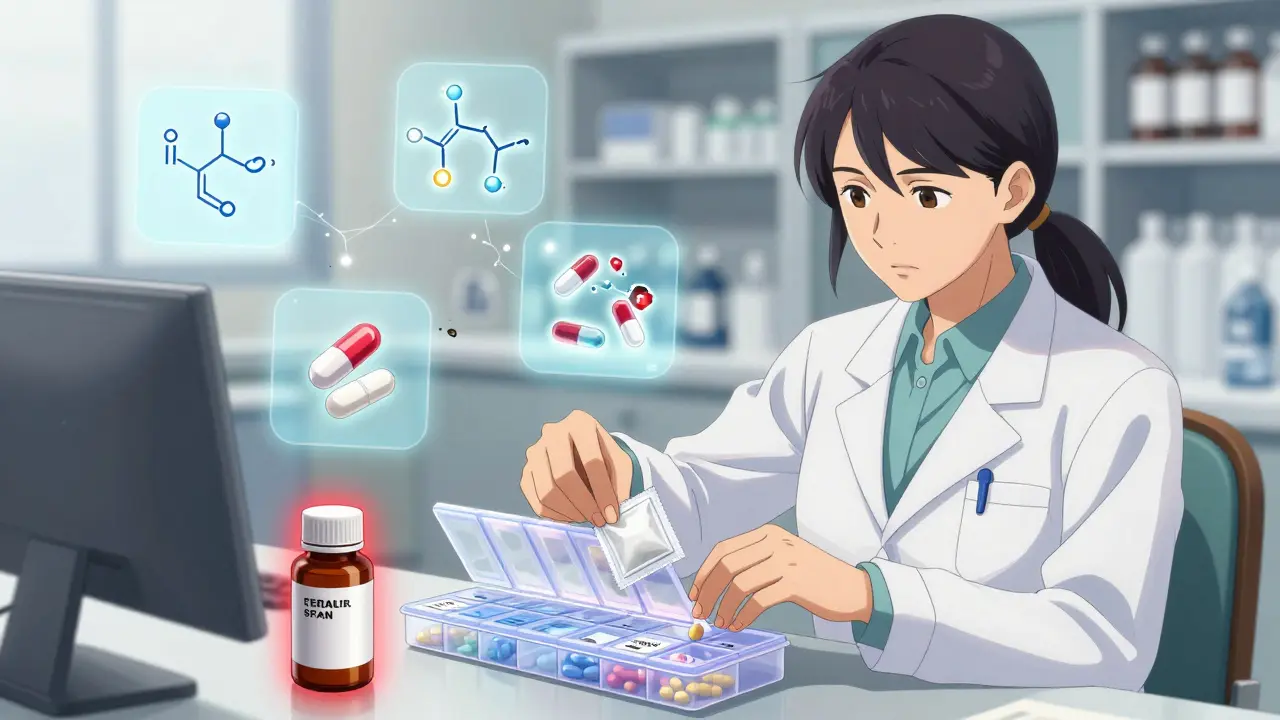
You don’t need a lab to make smart decisions-but you do need a system.For high-risk drugs: These include blood thinners (warfarin), seizure meds (phenytoin), thyroid meds (levothyroxine), and chemotherapy agents. These have narrow therapeutic windows-meaning even a 10% drop in potency can cause serious harm. For these, formal stability testing is non-negotiable. That means HPLC (high-performance liquid chromatography) to measure active ingredient levels. Most hospitals do this. Most pharmacies don’t.
For lower-risk drugs: If you’re repackaging something like atenolol or simvastatin, you can use a tiered approach. Start with accelerated testing: store a few pills at 40°C and 75% humidity for 14 days. If they show discoloration, caking, or odor changes, they’re unstable. Then apply conservative expiration dates based on known data:
- 30 days: Hygroscopic drugs (amoxicillin, doxycycline, furosemide)
- 60 days: Light-sensitive drugs (nifedipine, chlorpromazine)
- 90 days: Stable drugs (atenolol, lisinopril, metformin)
These aren’t guesses. They’re based on published studies from the Parenteral Drug Association and the University of Florida’s Stability Database, which tracks real-world results from over 1,800 repackaged meds.
Pillboxes Are a Special Risk
Putting multiple meds in one organizer is convenient-but dangerous. Each drug has its own stability needs. A pillbox might be plastic, non-sealed, and left on a windowsill. That’s a perfect storm for degradation.Drugs that are hygroscopic (like metformin) can pull moisture from the air-and then cause other pills to stick or dissolve. Light-sensitive drugs can degrade if the organizer is clear. And when you mix drugs, you create new chemical interactions that weren’t studied.
The solution? Use individual blister packs for each drug. Or, if you must use a pillbox:
- Choose opaque, airtight containers
- Never store them in bathrooms or near windows
- Use desiccant packs inside the box (they reduce moisture by up to 47%)
- Label each compartment with the date you filled it
- Replace every 14 days for mixed meds
What Pharmacies Should Do
If you’re a pharmacist or work in a pharmacy, you’re legally responsible for the stability of repackaged meds. Here’s what you need:- A written policy that defines how expiration dates are assigned
- Training for staff on degradation signs and storage conditions
- Access to stability data (like the University of Florida’s database)
- Desiccant packs for moisture-sensitive drugs
- Regular audits to check storage conditions
Since January 2024, the Pharmaceutical Compounding Accreditation Board requires 8 hours of annual stability training for pharmacists overseeing repackaging. If your pharmacy isn’t doing this, you’re out of compliance.
What You Can Do as a Patient
You don’t need a chemistry degree to protect yourself. Here’s how:- Ask your pharmacist: “What’s the expiration date for these pills in this container?”
- Never assume the bottle’s date still applies.
- Store pillboxes in a cool, dry place-like a bedroom drawer, not the bathroom.
- If pills look different-discolored, cracked, sticky-don’t take them.
- Use a pill organizer with individual compartments and a tight seal.
- Replace your pillbox every two weeks if it holds multiple drugs.
And if your pharmacy won’t give you a new expiration date? Find another one. This isn’t about inconvenience-it’s about safety.
The Bottom Line
Repackaging isn’t evil. It’s necessary for many people. But it’s not magic. It’s science. And science says: changing the container changes the medicine. Ignoring that puts lives at risk.There’s no shortcut. No app. No “it looks fine” rule. The only way to know if your repackaged meds are still good is to follow evidence-based guidelines-and treat them like the fragile, life-saving substances they are.
If you’re taking any of these meds, especially if they’re in a pillbox: check the date. Check the condition. Ask your pharmacist. And if you’re unsure-don’t take it. Better safe than sorry.
Can I still use my repackaged meds after the original expiration date?
No. The original expiration date only applies if the medication stays in its manufacturer’s container with its original closure and desiccant. Once it’s repackaged, that date is invalid. You must assign a new expiration date based on stability testing or accepted guidelines-usually 30 to 90 days, depending on the drug.
How do I know if my pill has degraded?
Look for visible changes: discoloration (yellowing, browning), crumbling, sticking together, unusual odor, or a change in texture. Some drugs, like nitroglycerin, may lose potency without visible signs-so if you’re unsure, don’t risk it. Use a reliable expiration date instead.
Are pillboxes safe for all medications?
No. Pillboxes are risky for hygroscopic drugs (like amoxicillin), light-sensitive drugs (like nifedipine), and narrow-therapeutic-index drugs (like warfarin). They’re also unsafe when multiple drugs are mixed, as interactions can cause caking or chemical breakdown. Use individual blister packs or sealed containers for these.
Why do pharmacies repack medications if it’s risky?
Repackaging helps patients take meds correctly, especially those on multiple daily pills. It improves adherence and reduces errors. The risk isn’t in repackaging itself-it’s in doing it without proper stability protocols. Pharmacies that follow guidelines and use desiccants, proper containers, and short expiration dates reduce the risk significantly.
Can I use a desiccant pack in my pillbox?
Yes-and you should, especially for moisture-sensitive drugs. Desiccant packs absorb humidity and can extend stability by up to 47%. You can buy small silica gel packets online or ask your pharmacy to include them. Just make sure they’re sealed inside the container and not directly touching the pills.
What’s the safest way to store repackaged meds at home?
Keep them in a cool, dry, dark place-like a bedroom drawer. Avoid bathrooms, kitchens, or windowsills. Use opaque, airtight containers. Label each container with the fill date and expiration date. Replace pillboxes every 14 days if they contain multiple drugs. Never store them in extreme heat or humidity.
12 Responses
I used to toss all my meds into a plastic box like it was candy. Then my grandma had a seizure because her phenytoin turned to dust in her pillbox. I didn’t even know that could happen. Now I use amber containers with desiccant packs and label everything. It’s a pain, but I’d rather be safe than sorry.
Per USP <800> and ASHP guidelines, repackaged solid oral dosage forms require stability testing per ICH Q1A(R2) if beyond 6 months. The 30/60/90-day windows are empirically derived from accelerated degradation models (40°C/75% RH) and validated via HPLC. If your pharmacy doesn't provide a beyond-use date (BUD), they're violating 21 CFR 211.137. Non-compliance = Class I recall risk.
OMG I JUST REALIZED I’VE BEEN TAKING MY WARFARIN OUT OF THE BOTTLE FOR 6 MONTHS 😭 I’M GONNA DIE. MY PHARMACY NEVER TOLD ME. I’M SO STUPID. WHY DOESN’T ANYONE WARN YOU ABOUT THIS?? I’M CRYING RIGHT NOW. 🥲💔
It’s funny how people treat medicine like it’s a snack. You wouldn’t leave a battery in the rain and expect it to work. Why do you think pills are any different? The science is clear. The FDA isn’t playing. And yet, we still ignore it because ‘it looks fine.’
My cousin in India takes all her pills out of bottles because she says it’s easier to remember. She doesn’t even have a pillbox-just a tin box on her windowsill. I told her this and she laughed. Now I’m scared for her. People need to wake up.
Just wanted to say I started using those little silica packs from Amazon (the ones that say ‘do not eat’) and put them in my pillbox. Made a huge difference. My metformin doesn’t stick together anymore. Also, I write the date on the box with a sharpie. It’s not fancy, but it works. 🙏
There’s a deeper truth here: we’ve outsourced responsibility for our own health to institutions-pharmacies, doctors, manufacturers-because it’s easier than thinking. But medicine isn’t a product you buy and forget. It’s a living chemical system. To treat it as inert is to misunderstand life itself. We don’t just risk potency-we risk our relationship with healing.
My pharmacist gave me a sealed blister pack for my levothyroxine last week. It cost $3 extra, but I cried. No one ever told me how dangerous my old pillbox was. I’m telling everyone now. This is life or death. 💔💊
Why is the government letting pharmacies get away with this? We pay for original packaging, then they dump it into plastic junk and call it ‘convenient.’ This is corporate greed disguised as care. If you’re not using the original bottle, you’re being scammed.
People who use pillboxes without desiccants are basically playing Russian roulette with their meds. I don’t care if you’re ‘busy’ or ‘don’t have time.’ Your life isn’t a suggestion. Stop being lazy. This isn’t hard.
As a pharmacist in the UK, we’re legally required to assign BUDs based on CEPI guidelines. We use opaque, child-resistant containers with silica gel for all repackaged meds. We also train patients: ‘If it looks different, don’t take it.’ Simple. Effective. And frankly, it’s our duty.
You know what’s worse than repackaging? Not knowing you’re doing it wrong. I used to think expiration dates were like ‘best by’ labels. Now I know better. I’ve changed my habits. I’ve taught my parents. I’ve told my friends. This isn’t just science-it’s love. Love for your body. Love for your future self. Don’t wait for a tragedy to wake up.