

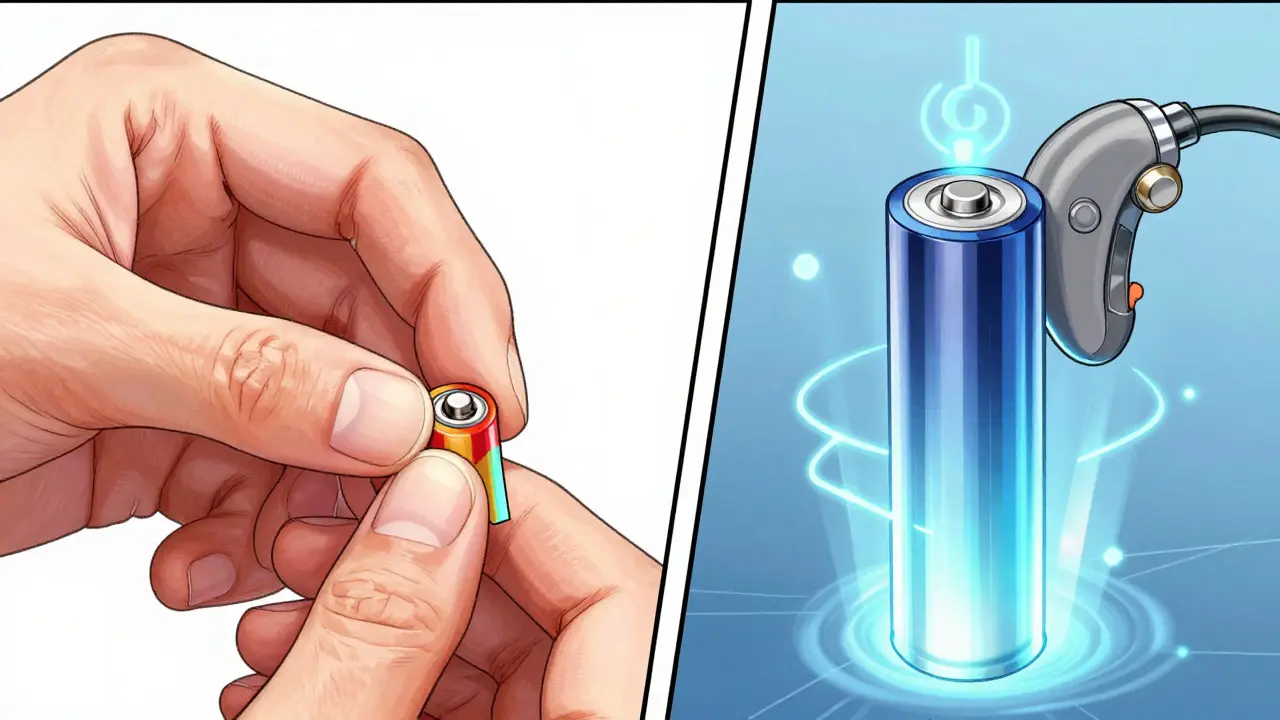
Picking the right power source for your hearing aids isn't just about cost-it's about how you live your life. If you struggle with arthritis, fumbling with a tiny battery can be a daily nightmare. On the other hand, if you spend your weekends hiking in the wilderness, a charging dock is useless. The choice between hearing aid batteries is the power source used to operate hearing assistive devices, available in disposable zinc-air or rechargeable lithium-ion formats and a built-in rechargeable system usually comes down to a trade-off between total convenience and absolute reliability.
Most people expect a simple "one is better than the other" answer, but the reality is that your lifestyle and the style of hearing aid you wear dictate the winner. While the market is shifting heavily toward rechargeables, disposable batteries still hold a critical place for specific users. Let's break down the actual pros and cons to help you decide.
The Traditional Route: Disposable Zinc-Air Batteries
For decades, the gold standard has been the zinc-air battery. These are small, single-use cells that activate when you peel off a sticky tab, allowing oxygen to enter the battery and create a chemical reaction. They are incredibly reliable because if your hearing aid dies, you don't have to wait for a plug-you just swap in a fresh one in seconds.
One of the biggest perks here is portability. You can carry a dozen spares in your wallet, meaning you're never stranded in a dead-zone without power. They are also the only option for completely-in-canal (CIC) hearing aids, which are too small to house a rechargeable cell and charging circuitry. If you prioritize a nearly invisible device, disposables are your only choice.
However, the downside is the physical struggle. Many users, especially those over 70, deal with fine motor challenges. Trying to remove a tiny tab and seat a battery perfectly into a small slot can be frustrating. Plus, there's the waste; a typical user might throw away 100 to 200 of these every year, which adds up to a significant environmental footprint.
The Modern Shift: Rechargeable Lithium-Ion Systems
Enter the lithium-ion battery. Instead of swapping cells, you simply place your devices in a charging dock at night. This "set it and forget it" approach has led to a massive surge in popularity, now accounting for about 65% of new sales in North America. The biggest win here is for anyone with dexterity issues-no more squinting at tiny batteries or using tweezers to fish them out of the device.
Beyond convenience, rechargeables often provide a more stable experience. Unlike zinc-air batteries, which can see a gradual drop in voltage as they die (sometimes causing the sound to fade), lithium-ion batteries tend to maintain a consistent power output until they are nearly depleted. This means your hearing aid performs exactly the same at hour 20 as it did at hour 1.
The trade-off is the "charging anxiety." If you forget to plug them in, you're stuck. While some high-end models offer quick charges-like getting 8 hours of power from a 30-minute charge-you are still tethered to a power outlet. Furthermore, these batteries don't last forever. After about 300 to 500 charge cycles (roughly 1 to 1.5 years), the battery capacity drops, and you'll need a professional to replace the internal cell.
| Feature | Disposable (Zinc-Air) | Rechargeable (Lithium-Ion) |
|---|---|---|
| Convenience | Low (manual swaps) | High (nightly dock) |
| Portability | Excellent (spare packs) | Moderate (requires charger) |
| Device Fit | All styles (including CIC) | BTE, RIC, and some ITE |
| Lifespan | 5-16 days per cell | ~24 hours per charge |
| Eco-Impact | High waste | Low waste |
Breaking Down the Costs
At first glance, disposables seem cheaper. You don't have to pay for an expensive charging station, and a 6-pack of batteries usually costs between $5.99 and $8.99. But if you look at the annual spend, the math changes. Depending on your usage, you could be spending anywhere from $30 to $150 a year just on batteries for both ears.
Rechargeable systems have a higher upfront cost, but they eventually pay for themselves. Most data shows that these systems become more cost-effective after about 18 to 24 months of use. You stop buying packs of batteries and instead focus on the long-term maintenance of the internal cell. For most users, the peace of mind and the lack of recurring costs make the initial investment worth it.

Which One Should You Choose?
Still undecided? It usually comes down to these three scenarios:
- Choose Disposables if: You travel frequently to remote areas, you use completely-in-canal (CIC) devices, or you have a very erratic schedule where you can't commit to a nightly charging routine.
- Choose Rechargeables if: You have arthritis or limited hand dexterity, you prefer a simplified daily routine, or you want to reduce your environmental impact.
- The Middle Ground: If you're torn, look for Receiver-in-Canal (RIC) models. These are the most versatile and often come in both power versions, giving you a bit more flexibility in your choice.
It's also worth noting that technology is moving fast. We're seeing the rise of wireless charging and batteries that can handle extreme temperatures better, meaning the "weak points" of rechargeables are shrinking every year. Some labs are even working on hybrid systems that use replaceable rechargeable micro-batteries to give you the best of both worlds.
How long do disposable hearing aid batteries actually last?
It depends entirely on the size and your usage. A Size 10 (yellow tab) might last 80-100 hours, while a Size 675 (blue tab) can go for over 300 hours. In real-world terms, this usually translates to anywhere from 5 to 16 days of use before you need a swap.
Do rechargeable batteries wear out over time?
Yes. Lithium-ion batteries have a limited number of charge cycles. Most hearing aid batteries maintain full capacity for about 300 to 500 cycles (roughly 1 to 1.5 years). Once the capacity drops below 80%, you'll notice they don't last a full day, and you'll need to have the battery professionally replaced by your audiologist.
Can I use rechargeable batteries in any hearing aid?
No. Because of the space required for the battery and the charging coil, rechargeables aren't available for completely-in-canal (CIC) models. They are primarily found in behind-the-ear (BTE), receiver-in-canal (RIC), and some in-the-ear (ITE) styles.
Are disposable batteries dangerous for the environment?
While modern zinc-air batteries are mercury-free, they still contain zinc and manganese. If thrown in the regular trash, these can leak into the soil. Many U.S. states actually require them to be disposed of separately from household waste to prevent environmental contamination.
What happens if I forget to charge my hearing aids?
You'll simply have no sound until they are charged. To mitigate this, many modern devices offer "rapid charging," where a 30-minute charge can give you several hours of use. However, unlike disposables, there is no way to instantly "swap" the power source if you're away from your charger.