
You've probably noticed that some medications stay expensive for years, and then suddenly, a cheaper version appears on the pharmacy shelf. It seems like a simple switch-the patent ends, and the generic arrives. But in reality, the gap between a patent expiring and you actually saving money is a complex tug-of-war between law, science, and corporate strategy. While a patent might officially end on a specific date, the actual generic drug availability often lags behind by months or even years.
The Foundation: How the Hatch-Waxman Act Changed Everything
To understand why generics don't appear overnight, we have to look at the Hatch-Waxman Act is a 1984 US law that created a legal shortcut for generic drugs to enter the market without repeating expensive clinical trials . Before this, generic companies had to prove a drug was safe and effective from scratch, which was too costly to be practical.
Under this framework, generic makers use the Abbreviated New Drug Application (also known as an ANDA) to show the FDA that their version is "bioequivalent" to the original. This means the generic works in the body exactly like the brand-name version. If the FDA agrees, the generic can be approved. However, approval doesn't always mean they can start selling. That's where the patent minefield comes in.
The Layered Shield: Patents vs. Regulatory Exclusivity
Most people think a drug has one patent that lasts 20 years. In the pharmaceutical world, it's more like an onion-there are layers of protection. A company doesn't just patent the active molecule; they often patent the specific formulation, the way it's manufactured, and even the specific way it's used to treat a disease. These are often called "patent thickets." According to research from UC Hastings, some brand-name drugs have an average of 14.2 patents listed in the Orange Book, making it incredibly hard for a generic competitor to find a legal opening.
Beyond patents, there is "regulatory exclusivity." This is a separate protection granted by the FDA. For example, a New Chemical Entity (NCE) typically gets 5 years of exclusivity, meaning the FDA won't even approve a generic during that window, regardless of patent status. Other protections include 7 years for Orphan Drug Exclusivity (for rare diseases) and an extra 6 months for pediatric studies. When you stack these on top of the original patents, the "effective" window of exclusivity is often much shorter than 20 years-usually around 7 to 12 years-because the time spent in clinical trials eats up a huge chunk of the patent's life.
| Protection Type | Duration | Primary Purpose |
|---|---|---|
| New Chemical Entity (NCE) | 5 Years | Protects entirely new molecules |
| Orphan Drug Exclusivity | 7 Years | Encourages research into rare diseases |
| New Clinical Investigation | 3 Years | Rewards new findings on existing drugs |
| Pediatric Exclusivity | 6 Months | Encourages testing in children |

The "Paragraph IV" Battle and the 30-Month Stay
Generic companies don't always wait for the clock to run out. Some try to launch early by filing a "Paragraph IV certification." This is essentially a legal challenge where the generic maker claims the brand-name patent is either invalid or doesn't apply to their version. This starts a high-stakes game of legal chess.
If the brand-name company sues the generic maker within 45 days of this notice, it triggers a "30-month stay." This is a legal pause button that prevents the FDA from approving the generic for 30 months while the court decides who is right. While this sounds like a fixed timeline, the reality is messier. Many companies settle these lawsuits out of court. These "reverse payment" settlements can push back generic entry by years, costing consumers billions. In fact, FTC data suggests these settlements can delay entry by a median of 2.1 years beyond the earliest possible date.
The Race for 180-Day Exclusivity
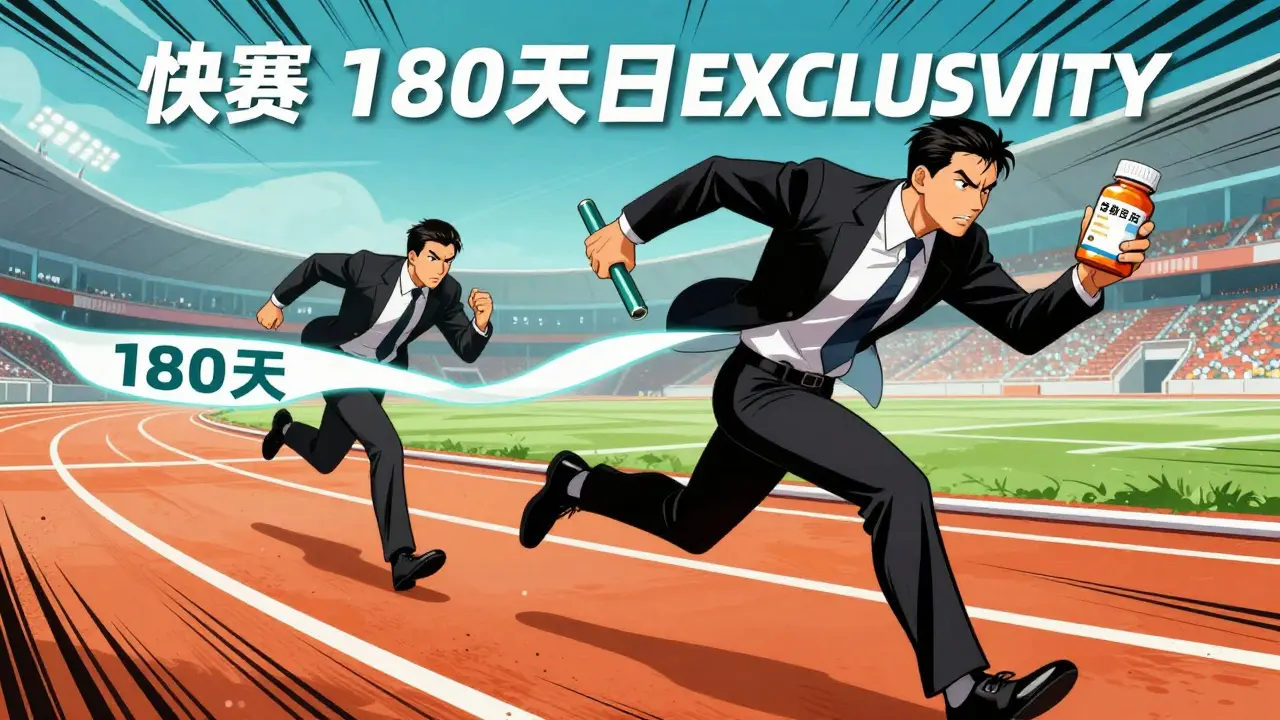
Why would a generic company go through the stress of a Paragraph IV lawsuit? Because of the reward: 180-day exclusivity. The first generic company to successfully challenge a patent and get FDA approval gets to be the only generic on the market for six months. During this window, they can capture a huge share of the market and set their pricing before other generic competitors flood in.
This creates a frantic race. First-filers are under immense pressure to launch within 75 days of approval to keep this privilege. If they hit a manufacturing snag or a quality control issue, they risk losing that exclusive window. It's a gamble where the winner earns millions, and the loser might find themselves in a crowded market with razor-thin profit margins.
Why Some Drugs Take Longer Than Others
Not all drugs are created equal. A simple "small molecule" drug-like a basic pill-usually sees generic competition within 1.5 years of patent expiration. But biologics are a different story. These are complex proteins grown in living cells, not mixed in a lab. Because they are so hard to copy, they follow the Biologics Price Competition and Innovation Act (BPCIA) pathway. This leads to "biosimilars" rather than exact generics, and the delays here are much longer, often averaging 4.7 years.
Therapeutic area also matters. For instance, cardiovascular drugs often face longer delays (around 3.4 years post-patent) compared to dermatology products (about 1.2 years). This is usually because heart medications are high-revenue drivers, prompting brand-name companies to build thicker "patent walls" to protect their profits.
The Bottom Line: What This Means for Patients
The gap between a patent ending and a generic launch is where the most money is lost. The CBO has estimated that a single year's delay for a top-10 drug can cost Medicare $1.2 billion annually. Even with newer laws like the CREATES Act, which stops companies from blocking samples to generic makers, the system is still slow. As of 2024, the median time from patent expiration to actual availability is still around 18 months.
Looking ahead, things might speed up. The FDA is exploring AI for bioequivalence testing, which could cut development timelines by 25%. Additionally, the Orange Book Transparency Act is making patent listings clearer, reducing the number of frivolous disputes. Until then, the journey from a patent's end to a cheaper prescription remains a long and winding road.
Why isn't a generic drug available the day the patent expires?
Patent expiration is only one part of the process. A generic company still needs FDA approval via an ANDA, which requires proving bioequivalence. Additionally, other "secondary patents" on the drug's formula or manufacturing process may still be active, and regulatory exclusivity periods may prevent the FDA from granting approval until a later date.
What is a "patent thicket"?
A patent thicket occurs when a brand-name company files numerous overlapping patents on a single drug-covering the active ingredient, the delivery method, the dosage, and the manufacturing process. This creates a dense web of legal protections that generic companies must challenge one by one, significantly delaying their entry into the market.
How does the 180-day exclusivity period benefit consumers?
While it sounds counterintuitive to give a generic company a mini-monopoly, this incentive encourages them to take the massive legal and financial risk of challenging a brand-name company's patents. Without this reward, few generic makers would spend the millions of dollars required to fight a Paragraph IV legal battle, meaning many drugs would stay expensive until the very last patent expired.
What is the difference between a generic and a biosimilar?
Generics are exact chemical copies of small-molecule drugs. Biosimilars, however, are derived from living organisms and are so complex that an exact copy is impossible. Instead, they are designed to be "highly similar" with no clinically meaningful differences in safety or effectiveness. Because the development process is harder, biosimilars usually take much longer to reach the market after a patent expires.
Can a generic drug be launched before the patent expires?
Yes, but only if the generic company successfully challenges the patent through a Paragraph IV certification. They must prove in court that the patent is invalid or that their specific version does not infringe upon it. If they win the lawsuit before the patent's official end date, they can launch their product early.