
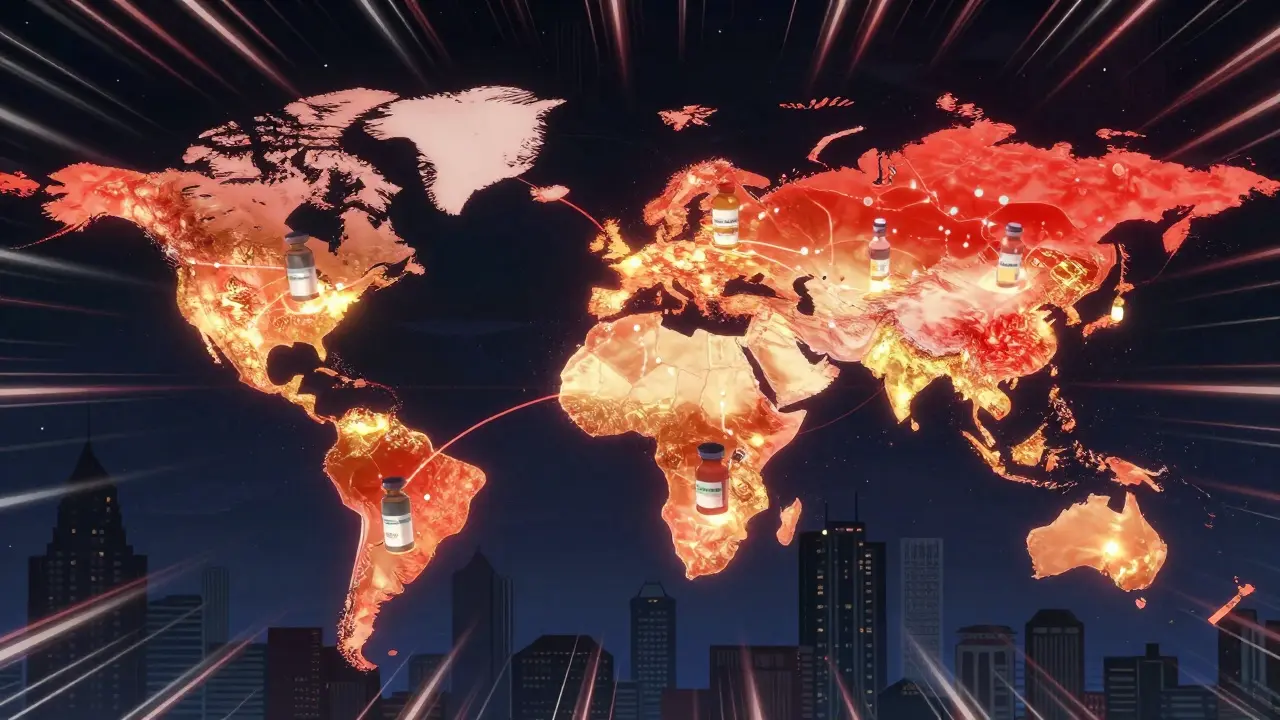
By 2030, more than half of all prescriptions filled worldwide will be for generic drugs. That’s not just a prediction-it’s already happening. In 2024, the global market for generic medications hit between $488 billion and $491 billion. By the end of this decade, it could be worth over $700 billion. This isn’t a slow, steady climb. It’s a surge driven by expired patents, aging populations, and healthcare systems scrambling to cut costs without cutting care.
Why Generic Drugs Are Suddenly Everywhere
Generic drugs aren’t new. They’ve been around since the 1980s, when the U.S. passed the Hatch-Waxman Act to let companies copy branded drugs once patents expired. But today’s market is different. The volume of drugs losing exclusivity is unprecedented. Between 2025 and 2030, drugs with combined annual sales of $217 billion to $236 billion will go off-patent. That’s more than the entire GDP of countries like Portugal or New Zealand. And it’s not just small pills. Many of these are high-revenue drugs for diabetes, cancer, and autoimmune diseases.Take ustekinumab and vedolizumab. These are blockbuster biologics used for psoriasis and Crohn’s disease. Their patents start expiring in 2025. Within four years, biosimilars-generic versions of biologic drugs-could capture $25 billion in sales. That’s not just cheaper alternatives. It’s a complete reshaping of how these treatments are priced and accessed.
The Asia Pacific Surge: India and China Lead the Charge
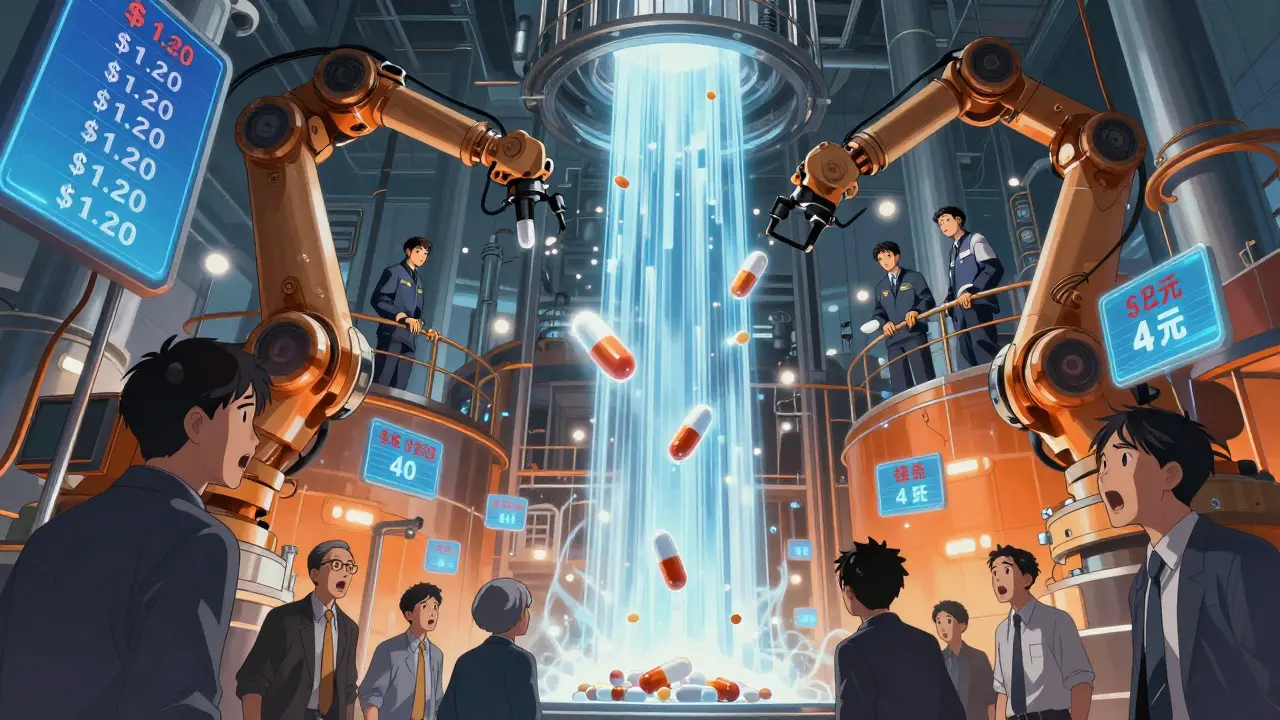
While the U.S. and Europe are big buyers, the fastest growth is happening in Asia. India alone supplies 20% of the world’s generic drugs and 60% of its vaccines. It’s not just about volume. It’s about cost. Indian manufacturers have built entire supply chains around producing high-quality, ultra-low-cost medicines. They’re not cutting corners-they’re optimizing.China is doing something even more disruptive: volume-based procurement. Instead of negotiating price per pill, the government bids for entire drug categories. The lowest bidder wins the entire market. In 2023, a single tender for a diabetes drug cut its price by 96%. That’s not a typo. One pill went from $1.20 to 4 cents. That sent shockwaves through global pricing. Now, every manufacturer-whether in Germany, the U.S., or Brazil-has to adjust. If you can’t match China’s prices, you lose the contract.
But it’s not just about price. Asia is also investing in quality. Indian firms now supply 40% of the U.S. generic market. Their manufacturing facilities meet FDA standards. That’s not luck. It’s decades of focused investment.
Biosimilars: The Fastest-Growing Segment
Not all generics are the same. Traditional generics copy small-molecule drugs-simple chemical compounds. Biosimilars are different. They copy complex biologic drugs made from living cells. Think insulin, monoclonal antibodies, or growth hormones. These used to be impossible to replicate. Now, they’re not just possible-they’re profitable.By 2030, the biosimilars market is expected to grow at an 8.2% annual rate-faster than traditional generics. Why? Because the drugs they’re replacing are expensive. A single dose of Dupixent or Skyrizi can cost over $30,000 a year. Once biosimilars hit the market, prices drop by 30-50% almost immediately. And with regulatory agencies in the EU and Japan speeding up approvals, the race is on.
Companies that win aren’t just the cheapest. They’re the most reliable. Early entrants are investing in pharmacovigilance systems, dual-source manufacturing, and regional fill-and-finish plants. In Southeast Asia, new procurement pilots are awarding contracts to suppliers with redundant production sites. It’s not just about cost anymore-it’s about trust.
Where the Money Is: Oncology, Diabetes, and Inflammation
The biggest opportunities aren’t random. They’re clustered in three areas: cancer, diabetes, and inflammatory diseases.Oncology leads the pack. Even though branded drugs like Ozempic and Wegovy are raking in billions, the real future is in chemo drugs and targeted therapies. Over $300 billion in oncology drug sales is projected by 2030-and nearly half of that will be generic or biosimilar. The same goes for diabetes. Drugs like liraglutide and semaglutide are going off-patent in the next 3-5 years. Once they do, the market could explode.
And don’t forget inflammation. Dupixent and Skyrizi are still under patent, but their time is coming. When they expire, we’ll see a flood of biosimilars. These aren’t niche drugs. They’re used by millions. That’s why analysts are betting big on this segment.
The Pressure Cooker: Pricing, Profit, and Politics
Growth sounds great-until you look at the margins. In the U.S., generic drug prices have fallen 60% over the last decade. In Europe, government price controls are tighter than ever. And in China, as we saw, prices can drop overnight.Manufacturers can’t just make more pills. They have to make smarter ones. That means investing in automation, AI-driven quality control, and streamlined supply chains. Some are moving production closer to markets-building fill-and-finish plants in Mexico for the U.S. or in Poland for the EU. Others are partnering with tech firms to build digital adherence tools. If patients take their meds consistently, refills go up, and revenue stays stable.
But the biggest wildcard? Patent litigation. Big pharma still fights hard to extend exclusivity. Lawsuits can delay generics for years. In 2028, over $100 billion in drug sales will be at risk of legal challenges. That’s not just a number-it’s a gamble. Companies that win the legal battles will delay competition. Those that lose? They’ll see market share vanish overnight.
What Comes Next: Complexity, Consolidation, and Control
The future of generic drugs isn’t about more pills. It’s about smarter, more complex ones. The easy wins are over. The next wave includes multi-component injectables, inhalers with precise dosing, and transdermal patches with timed release. These aren’t simple to copy. They require deep technical expertise.That’s why consolidation is happening. Smaller players are getting bought out. Teva, Viatris, Sandoz, and Amneal are snapping up niche manufacturers. The goal? Control the pipeline. Own the technology. Lock in supply chains before the next patent cliff hits.
Meanwhile, governments are pushing harder for transparency. India and China are building digital tracking systems to trace every batch. The EU is mandating real-time pricing data. Even the U.S. is exploring drug importation from Canada and other low-cost markets.
This isn’t a market in decline. It’s a market in transformation. The companies that survive won’t be the ones with the biggest factories. They’ll be the ones with the best data, the tightest supply chains, and the deepest understanding of regulatory systems.
Why are generic drugs so much cheaper than branded ones?
Generic drugs cost less because they don’t need to repeat expensive clinical trials. Once a branded drug’s patent expires, manufacturers can prove their version is bioequivalent using existing data. They skip the $1 billion+ R&D costs and focus on production. That’s why a $500 branded pill can become a $2 generic.
Are generic drugs as safe and effective as branded ones?
Yes. In the U.S., the FDA requires generics to have the same active ingredient, strength, dosage form, and route of administration as the original. They must also show they’re absorbed into the bloodstream at the same rate and extent. Studies show generics perform just as well in real-world use. The only differences are in inactive ingredients-like color or filler-which don’t affect how the drug works.
Which countries are leading the generic drug market?
India is the top supplier by volume, providing 20% of global generics and 60% of vaccines. China leads in price-setting through aggressive government tenders. The U.S. and Germany are the largest buyers, with the U.S. importing over 40% of its generic drugs from India. The EU has the most advanced regulatory system for biosimilars.
What’s the difference between generics and biosimilars?
Generics copy small-molecule drugs made from chemicals. Biosimilars copy biologics-large, complex proteins made from living cells. Biosimilars are harder to replicate, require more testing, and cost more to develop. But they’re also more valuable, with higher margins and faster growth. The biosimilars market is growing at 8.2% per year-twice the rate of traditional generics.
Will generic drug prices keep falling?
In markets with heavy price controls-like China, Germany, and Canada-yes. In the U.S., prices have stabilized in recent years as manufacturers consolidate and shift to complex generics. But the trend isn’t over. As more biosimilars enter, especially for high-cost drugs like cancer treatments, prices will drop again. The real question isn’t whether prices will fall, but how fast and how far.
How will AI and automation affect the generic drug market?
AI is already being used to predict patent expirations, optimize manufacturing schedules, and detect contamination in real time. Robotic process automation cuts production time by 30%. Predictive analytics helps companies forecast demand spikes, especially for drugs going off-patent. Companies using these tools are seeing 20% higher margins and 40% faster time-to-market. It’s no longer optional-it’s essential.
12 Responses
Let me guess - this whole 'generic drug revolution' is just Big Pharma’s way of offloading toxic, low-quality pills to the poor while they pocket billions from biosimilar patents. You think India’s making safe meds? Nah. They’re dumping shit that fails FDA inspections 30% of the time and calling it 'cost-effective.' And don’t even get me started on China’s 96% price cuts - that’s not market efficiency, that’s state-sponsored drug poisoning. They’re cutting fillers to the bone and shipping it to the U.S. under 'bioequivalent' labels. Wake up, sheeple.
Actually, the data shows FDA-approved Indian generics have failure rates under 1.2% - lower than the domestic U.S. market. The real issue isn’t safety, it’s consolidation. As more players get bought out by Teva and Sandoz, innovation slows. The companies building AI-driven QA systems and dual-source fill-finish plants? They’re the ones keeping quality up while prices drop. It’s not magic. It’s engineering.
Oh wow. So we’re just supposed to trust the system? The same system that let a $30,000/year drug become a $15,000 biosimilar - and then the insurer raises premiums because 'now it’s cheaper, so we can afford to cover more people.' Classic neoliberal trap. The real cost isn’t the pill. It’s the loss of innovation. When every drug becomes a commodity, who funds the next breakthrough? The answer: no one. We’re trading long-term survival for short-term savings. And that’s not progress - it’s surrender.
I’ve been on a generic diabetes med for 5 years. Same pill, same results. No side effects. No weird reactions. My doctor said it’s bioequivalent. I don’t care if it’s made in India or Iowa - as long as it works. The panic over 'quality' is just fear dressed up as expertise. People get scared of things they don’t understand. This isn’t a conspiracy. It’s capitalism working.
There’s something deeply human about how we’ve come to view medicine - as either a sacred trust or a market commodity. But in reality, it’s both. We want life-saving drugs to be affordable, yet we refuse to accept that affordability requires trade-offs. The genius of the generic system isn’t that it lowers prices - it’s that it forces us to confront what we value. Is it profit? Control? Access? Or just the illusion of choice? The answer changes depending on whether you’re in a village in Bihar or a boardroom in Basel.
So China cuts a drug from $1.20 to 4 cents… and suddenly everyone’s like 'WOW AMAZING' 😍 But what about the workers? The factories? The environmental cost? We’re not saving lives - we’re outsourcing suffering. 🤔 Maybe we should ask: at what cost is 'affordable' really affordable?
u/7931 you’re wrong. Indian factories have like 40% failure rates in the EU. I read it on a forum. Also, biosimilars are just copies so they’re not as good. My cousin’s aunt took one and got sick. Also, why is the FDA even allowed to approve this? Someone should sue.
It is a matter of considerable scholarly interest that the structural transformation of pharmaceutical markets, precipitated by the expiration of intellectual property rights, constitutes not merely an economic phenomenon but a sociopolitical recalibration of therapeutic access. The commodification of biologics, while ostensibly increasing equity, simultaneously erodes the epistemic authority of clinical innovation. One must therefore interrogate whether affordability, in isolation, constitutes a sufficient metric for pharmaceutical justice.
My mom’s in her 70s and takes three generics. She’s alive, stable, and happy. She doesn’t care where it’s made. She cares that she can afford it. The real villain isn’t India or China - it’s the U.S. system that lets drug companies charge $500 for a pill that costs $2 to make. Let’s stop blaming the suppliers and start blaming the buyers who won’t fix the system.
So we’re all just supposed to be thrilled that a life-saving drug dropped from $30k to $15k? Congrats, we’ve turned healthcare into a discount bin. Next up: generic cancer treatments sold in 5-packs with a free keychain. 🙄
u/7948 you’re missing the point. The price drop isn’t the problem - it’s that we let prices get to $30k in the first place. This isn’t about cheap pills. It’s about fixing a broken system that let one company own a monopoly on a drug for 20 years. Now that competition’s here, the market’s finally working. That’s not sad - it’s beautiful.
Generics saved my life. No drama. No conspiracy. Just science, scale, and a lot of hard work by people who don’t get headlines. Keep making them.