
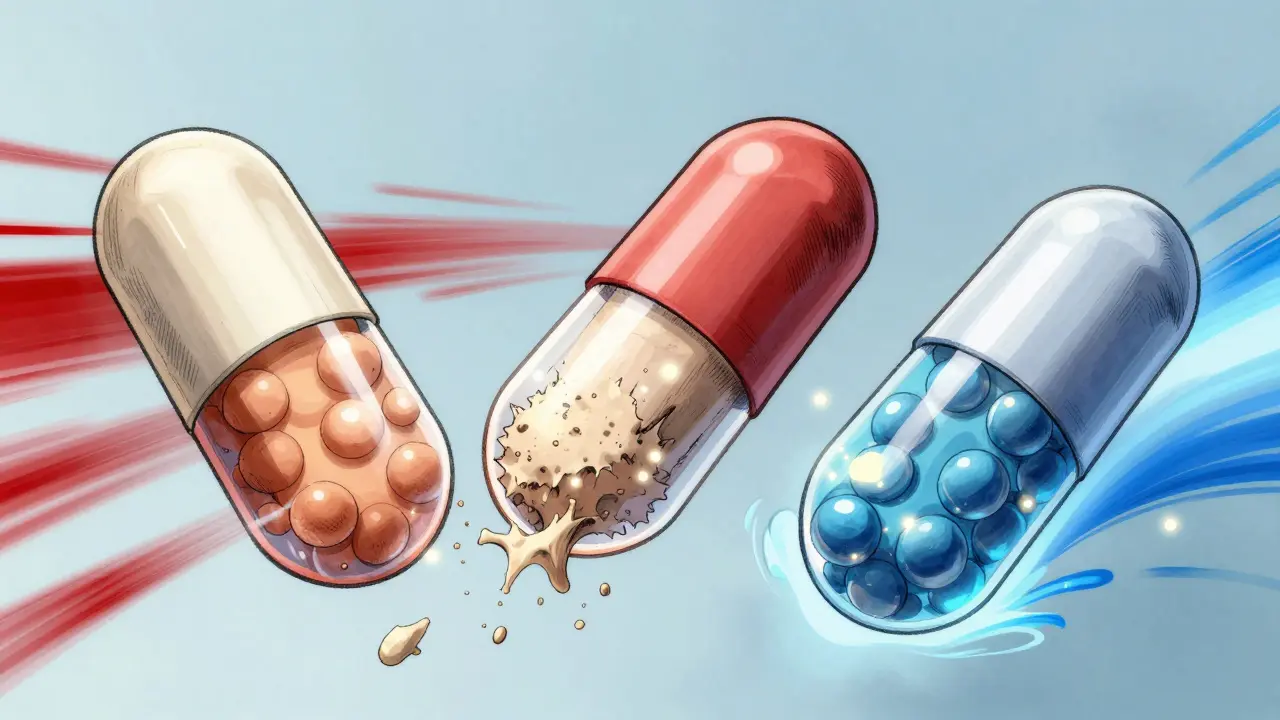
When you pick up a prescription, you might not think twice about whether it’s a tablet, capsule, or extended-release version. But the difference isn’t just in shape or size-it changes how your body absorbs the medicine, how often you need to take it, and even what side effects you might feel. Many people don’t realize that switching from an immediate-release tablet to an extended-release capsule can cut nausea in half-or make it worse if the formulation doesn’t work for their body.
How Tablets, Capsules, and Extended-Release Forms Work Differently
Immediate-release tablets dissolve in your stomach within 30 to 60 minutes. The drug hits your bloodstream fast, peaking in about 1 to 2 hours. That’s why you might feel side effects like dizziness or nausea right after taking them. Capsules usually dissolve even faster-20 to 30% quicker than tablets-because the powder inside doesn’t need to break down as much. But they’re less stable. A tablet can sit on your shelf for 3 years without losing potency. A capsule? Maybe 1 to 2 years.
Extended-release (ER, XR, or XL) formulations are built differently. They’re not magic. They use special coatings or matrix systems to let the drug leak out slowly over 12 to 24 hours. Think of it like a sponge soaking up water and releasing it drop by drop. Some use hydrophilic polymers like HPMC that swell in stomach fluid. Others use insoluble shells that act like a barrier, slowing how fast the drug escapes. There are even osmotic systems that use pressure to push the medicine out through a tiny laser hole.
These aren’t just fancy pills. They’re engineered to keep drug levels steady. Immediate-release versions can cause spikes and drops-like a rollercoaster. ER versions smooth that out. Peak-to-trough fluctuations drop from 4:1 to as low as 1.5:1. That’s why doctors prefer them for conditions like epilepsy, depression, or high blood pressure. Less fluctuation means fewer side effects tied to high peaks.
Side Effects: Why ER Formulations Often Feel Better
Side effects aren’t random. They’re often linked to how high the drug spikes in your blood. Take bupropion, used for depression and smoking cessation. The immediate-release version causes nausea in about 19% of users. The extended-release version? Only 13%. That’s a 30% drop. Venlafaxine XR cuts dizziness by 22% and nausea by 18% compared to the regular kind. Why? Because the drug doesn’t flood your system all at once.
A 2017 review of 15 studies found that ER versions of antiepileptic drugs reduced concentration-dependent side effects by 25 to 40%. That’s not a small difference. For people who stopped taking their meds because of dizziness or stomach upset, switching to extended-release often meant they could stay on treatment.
But ER doesn’t eliminate side effects-it changes them. Instead of sudden nausea, you might get constipation or a headache that lingers all day. Some people report feeling “flat” or “zombie-like” because the drug never peaks. That’s not always a bad thing. For mood disorders, steady levels can mean fewer emotional swings. But it’s different for everyone.
The Hidden Problems with Extended-Release Pills
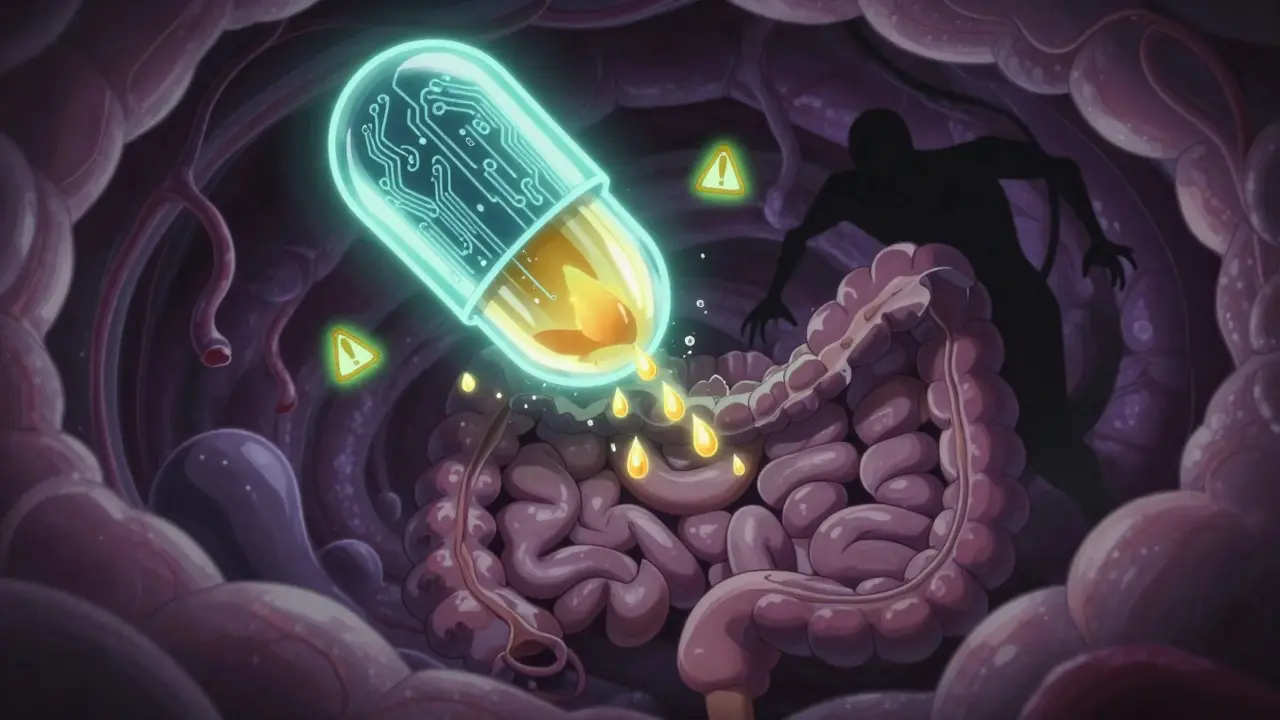
Extended-release isn’t perfect. One big issue: if your gut doesn’t move normally, the pill might not release properly. In 5 to 10% of people with gastroparesis, IBS, or after gastric surgery, the drug gets stuck or passes through too fast. That’s called “dose dumping”-and it can be dangerous. Imagine taking a slow-release opioid and suddenly getting the full dose all at once. That’s a real risk.
Another problem: you can’t crush or split them. A lot of elderly patients or those with swallowing issues can’t handle big ER tablets. One 2022 Mayo Clinic survey found that 27% of negative reviews from older adults mentioned difficulty swallowing. Some manufacturers make smaller ER versions, but not all. And if you break one open, you’re basically turning it into an immediate-release pill-risking overdose.
Food can mess with ER formulations too. High-fat meals can change how much drug gets absorbed by 20 to 35% in some cases. That’s why some ER meds say “take on an empty stomach.” If you eat a greasy burger right before your dose, you might get too much-or too little-medication.
Cost, Convenience, and Compliance
Extended-release versions cost more. A lot more. Generic immediate-release bupropion runs about $15 a month. Wellbutrin XL? Around $185. That’s why some people stick with the cheaper version and take it three times a day-even though it’s harder to remember. But here’s the catch: better compliance often means better outcomes. A case study from UPM Pharmaceuticals showed a bipolar patient went from 65% adherence with three daily doses to 92% with one daily ER dose. Over 12 months, that led to 47% fewer mood episodes.
On Drugs.com, ER formulations average 4.2 out of 5 stars. Immediate-release? 3.8. The top reason people give for liking ER? “I only have to take it once a day.” The second? “I don’t feel as sick.”
But cost isn’t the only barrier. Prescribers struggle with dosing flexibility. Most ER pills come in fixed strengths. If you need to lower your dose by 25%, you might have to switch brands or take a different formulation entirely. A 2022 AMA survey found that 38% of doctors found it hard to titrate ER meds for older patients or those with kidney issues.
What the Labels Don’t Tell You
Not all “extended-release” is the same. You’ll see SR (sustained-release), ER, XR, XL, CR (controlled-release), and DR (delayed-release). They’re not interchangeable. DR means the pill doesn’t dissolve until it hits the intestine-like enteric-coated aspirin. SR might release over 8 hours. ER can last 24. If you’re switching from one to another, your doctor needs to know the difference.
And if your pill has a strange shape-like a capsule with two halves, or a tablet with a groove-it’s probably designed to release in stages. Rytary, for example, releases levodopa in three pulses over the day. Crushing it ruins that design.
Who Should Use Extended-Release? Who Should Avoid It?
Extended-release is best for chronic conditions where steady levels matter: depression, epilepsy, ADHD, high blood pressure, Parkinson’s, and chronic pain. If you’re on a medication that causes side effects when you take it multiple times a day, ER might help.
But avoid it if you have:
- Gastroparesis or slow gut motility
- Recent bowel or stomach surgery
- Severe swallowing problems
- Need to adjust doses frequently (like with thyroid meds)
- History of dose dumping or unexpected reactions
The American College of Clinical Pharmacy recommends ER for daily meds when side effects limit dosing. But they warn against using it in patients with GI disorders where absorption is unpredictable.
The Future of Medication Delivery
Pharma companies are getting smarter. New ER systems can target specific parts of the intestine, release drugs in pulses, or even stick to the stomach lining for 24 hours. Clinical trials are testing gastric-retentive HIV meds that could replace daily pills with weekly ones. But there’s a dark side: polymer coatings from these pills are showing up in wastewater. A 2022 study found them in 78% of samples tested in Toronto.
By 2030, nearly half of all oral pills will be extended-release. That’s not because they’re perfect. It’s because they work better for most people. Less frequent dosing, fewer side effects, better adherence. The trade-off? Higher cost, less flexibility, and a need for more careful prescribing.
If you’re on a medication that causes side effects, ask your pharmacist: “Is there an extended-release version?” Don’t assume it’s the same. And never break, crush, or chew an ER pill unless your doctor says it’s safe.
Can I split an extended-release tablet?
No, unless the pill is specifically scored and labeled as splittable. Most extended-release tablets are designed to release medication slowly over time. Cutting or crushing them can cause the entire dose to be released at once, which may lead to overdose or serious side effects. Always check the prescribing information or ask your pharmacist before altering the pill.
Why does my extended-release pill look the same in the stool?
It’s normal. Many extended-release pills have a non-digestible shell or matrix that passes through your system intact. What you see isn’t the drug-it’s the empty carrier. The medication has already been absorbed. Don’t assume the pill didn’t work just because you see it in the toilet. This is especially common with osmotic systems like Osmotica or Concerta.
Are extended-release medications better for the elderly?
Often, yes. Older adults benefit from fewer daily doses, which improves adherence and reduces the chance of missed or double doses. However, if they have slow digestion, swallowing issues, or kidney problems, ER formulations can be risky. A once-daily pill that doesn’t release properly due to reduced gut motility can cause under-dosing-or worse, sudden release. Always discuss GI health with your doctor before switching.
Can food affect how extended-release meds work?
Yes. High-fat meals can speed up or slow down absorption in up to 35% of extended-release formulations. Some need to be taken on an empty stomach. Others work better with food. Always follow the label instructions. If you’re unsure, ask your pharmacist for the specific food effect profile of your medication.
What’s the difference between XR, ER, and SR?
They’re often used interchangeably, but there are technical differences. SR (sustained-release) usually means release over 8-12 hours. ER (extended-release) and XR (extended-release) typically mean 12-24 hours. CR (controlled-release) implies precise, programmed release. DR (delayed-release) means the drug doesn’t start releasing until it reaches the intestine. Always check the specific product’s labeling-don’t assume they’re the same.
Is it safe to switch from immediate-release to extended-release?
Only under medical supervision. The dosing isn’t always a 1:1 swap. For example, switching from immediate-release bupropion (100 mg three times a day) to XR (300 mg once daily) is safe because the total daily dose is the same. But with some drugs, the ER version has a different total dose or release pattern. Never switch on your own-your doctor needs to calculate the right equivalent dose.
What to Do Next
If you’re taking a medication with side effects, ask your pharmacist: “Is there an extended-release version?” Then ask your doctor: “Would switching help?” Bring your pill bottle or a photo. Look at the label for ER, XR, SR, or XL. Don’t assume all versions are the same.
Keep a side effect journal. Note when symptoms happen-right after taking the pill? All day? Only after eating? That info helps your doctor decide if formulation change is the fix.
And if cost is a barrier, ask about generics. Many ER versions now have generic equivalents. You might pay $30 instead of $185. That’s still more than immediate-release-but it’s a lot less than a hospital visit from a missed dose or overdose.
9 Responses
So let me get this straight-you’re telling me I can just swap my 3x-a-day pills for one big pill and magically stop feeling like a zombie? Sign me up. I’ll take the $185 version if it means I don’t have to remember to take meds during my Zoom meetings.
I switched from immediate-release venlafaxine to XR last year after months of nausea and dizziness. It didn’t fix everything, but the difference in my morning anxiety? Night and day. I still get the occasional headache, but it’s manageable. If you’re struggling with side effects, talk to your pharmacist-they know more than you think.
omg i had no idea that the weird capsule thing i see in my poop is normal?? i thought my body was just rejecting it 😅 i’ve been Googling this for months. turns out the pill’s just doing its job and leaving the shell behind. thanks for this!!
ER formulations reduce peak-to-trough fluctuations from 4:1 to 1.5:1, which minimizes concentration-dependent side effects. Pharmacokinetic stability improves adherence and therapeutic index. Not all patients are candidates-GI motility disorders contraindicate osmotic and matrix-based systems.
I’ve been on bupropion XL for 2 years. No more afternoon crashes. No more nausea after breakfast. I used to take three pills a day and still felt like I was on a rollercoaster. Now? One pill. One routine. One less thing to stress about. If you’re on a med that’s wrecking your life, ask about XR. Seriously. It’s not magic-but it’s close.
My dad tried switching to an ER version of his blood pressure med after years of dizziness. He couldn’t swallow the big pill, so he ended up crushing it-because he thought it was just a ‘bigger tablet.’ Turned out to be a controlled-release. He ended up in the ER. Don’t assume anything. Always ask. Always check the label. And if you’re helping an older loved one, don’t let them wing it.
Extended-release? More like extended-profit. Big Pharma’s way of making us pay $200 for the same damn drug we used to get for $15. If you’re not rich, just take the cheap version three times a day. It’s not rocket science. Stop buying the hype.
I live in India and my ER med is not available here. I take immediate-release and split the dose. It’s hard, but I do it. Maybe one day generics will be cheaper here too.
Let’s be real-this whole ‘steady levels’ thing is just another way to make us dependent on pills we don’t need. What if the body’s natural fluctuations are the problem? What if we’re medicating away normal human rhythms? Maybe the real side effect is believing that biology needs to be controlled like a factory machine.