
Safe Exercise Calculator for Statin Users
Answer these questions to determine your safe exercise zone. Based on the article, moderate exercise is safe, but high-intensity activities may increase muscle damage.
Your Safe Exercise Zone
Heart Rate Range:
Moderate exercise = 40-70% of max heart rate. Example: If you're 50 years old, max HR is about 170, so 68-119 BPM.
Recommended Activities
Activities to Avoid
If you're taking statins and have started feeling muscle soreness after working out, you're not alone. Thousands of people face this exact dilemma every day: they want to stay active for their heart health, but their muscles ache, cramp, or feel weak after even light exercise. The question isn't whether you should stop moving-it’s how to move safely while on statins.
Why Statins Cause Muscle Issues
Statins work by blocking an enzyme in your liver that makes cholesterol. But that same enzyme is also involved in producing coenzyme Q10 (CoQ10), a compound your muscles need to generate energy. When statins lower CoQ10 by up to 40% within the first month, your muscles don’t have enough fuel to recover properly-especially under stress like exercise. Not everyone gets muscle pain. About 5-10% of users report symptoms in clinical trials, but real-world numbers are higher-up to 29% according to a 2014 JAMA study. The type of statin matters a lot. Lipophilic statins like atorvastatin and simvastatin slip easily into muscle tissue. Hydrophilic ones like pravastatin and rosuvastatin don’t. That’s why switching from atorvastatin to rosuvastatin often reduces symptoms.Exercise Isn’t the Enemy-Intensity Is
A 2023 study in the Journal of the American College of Cardiology followed 105 people: 35 on statins with muscle pain, 35 on statins without pain, and 35 not taking statins. Everyone did 30 minutes of moderate cycling. Results? No significant difference in muscle damage markers (like creatine kinase) between the groups. That’s huge. It means moderate exercise doesn’t make statin-related muscle pain worse. But push too hard, and things change. A 2007 study of Boston Marathon runners found statin users had nearly 50% higher creatine kinase levels than non-users after the race. Another study showed eccentric exercises-like downhill running or heavy weight lowering-spiked CK levels 300% in statin users, compared to 200% in others. That’s not just soreness. That’s muscle breakdown.What Counts as Moderate Exercise?
Moderate exercise means you can talk but not sing. Your heart rate should be 40-70% of your maximum. For most people, that’s a brisk walk, light cycling, or swimming. You should finish feeling warmed up, not drained. The 4Days Marches in the Netherlands tested this with 100 athletes walking 30-50 km a day for four straight days. Statin users had the same muscle fatigue and CK levels as non-users. That’s proof: long, steady movement is safe. Avoid high-intensity interval training (HIIT), heavy lifting with eccentric phases, or sudden bursts of activity. Reddit users on r/Statins reported that 78% had problems with HIIT. Meanwhile, 63% found daily 30-minute walks didn’t trigger symptoms.When Muscle Pain Isn’t From Statins
Not every ache is from your medication. Statin-related pain usually shows up within 30 days of starting or increasing the dose, and it doesn’t go away with rest. Exercise-induced pain, on the other hand, shows up after a workout and fades within a day or two. If you’ve been exercising for years and suddenly feel sore after starting statins, that’s a red flag. If you’ve never exercised before and now feel stiff, it might just be your body adjusting.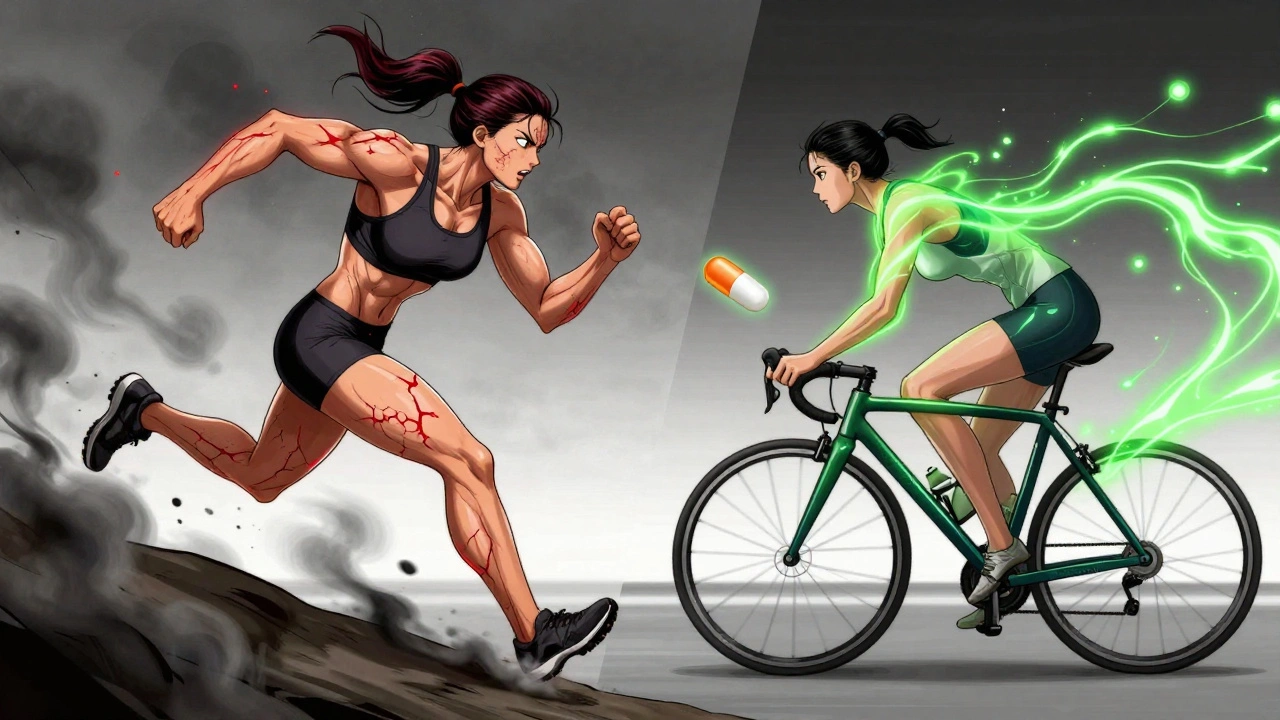
What to Do If You Have Muscle Pain
First, don’t quit exercise. The American College of Sports Medicine says to keep moving-but adjust. Start with 10-15 minutes of walking daily. Add 5 minutes each week. If you feel worse, stop and wait a few days before trying again. Talk to your doctor about:- Switching to a hydrophilic statin like rosuvastatin or pravastatin
- Lowering your dose or taking it every other day
- Trying 200 mg of CoQ10 daily-studies show it helps reduce pain in about half of users
Who’s at Highest Risk?
Some people are genetically more likely to have muscle issues. The SLCO1B1 gene variant increases risk by 2.3 times. If you’ve had muscle pain with statins before, or if you’re over 65, female, have kidney disease, or take other medications like fibrates or cyclosporine, you’re more vulnerable. High-dose statins are the biggest problem. Atorvastatin 80 mg carries a 10.5-fold higher risk of severe muscle damage than pravastatin 40 mg, according to FDA data. That’s why most doctors now avoid high doses unless absolutely necessary.Real Stories: Success and Failure
John Davis, a marathon runner from Oregon, switched from atorvastatin 40 mg to rosuvastatin 20 mg. He kept running 40 miles a week. His muscle pain vanished. He’s now training for his third Boston Marathon. Maria Rodriguez, a competitive cyclist, didn’t adjust her training after starting simvastatin. She pushed through muscle fatigue, kept doing intense hill repeats, and ended up in the hospital with rhabdomyolysis. Her CK level hit 12,450 U/L-over 60 times the normal range. She needed IV fluids and weeks of recovery. The difference? One listened to their body. The other didn’t.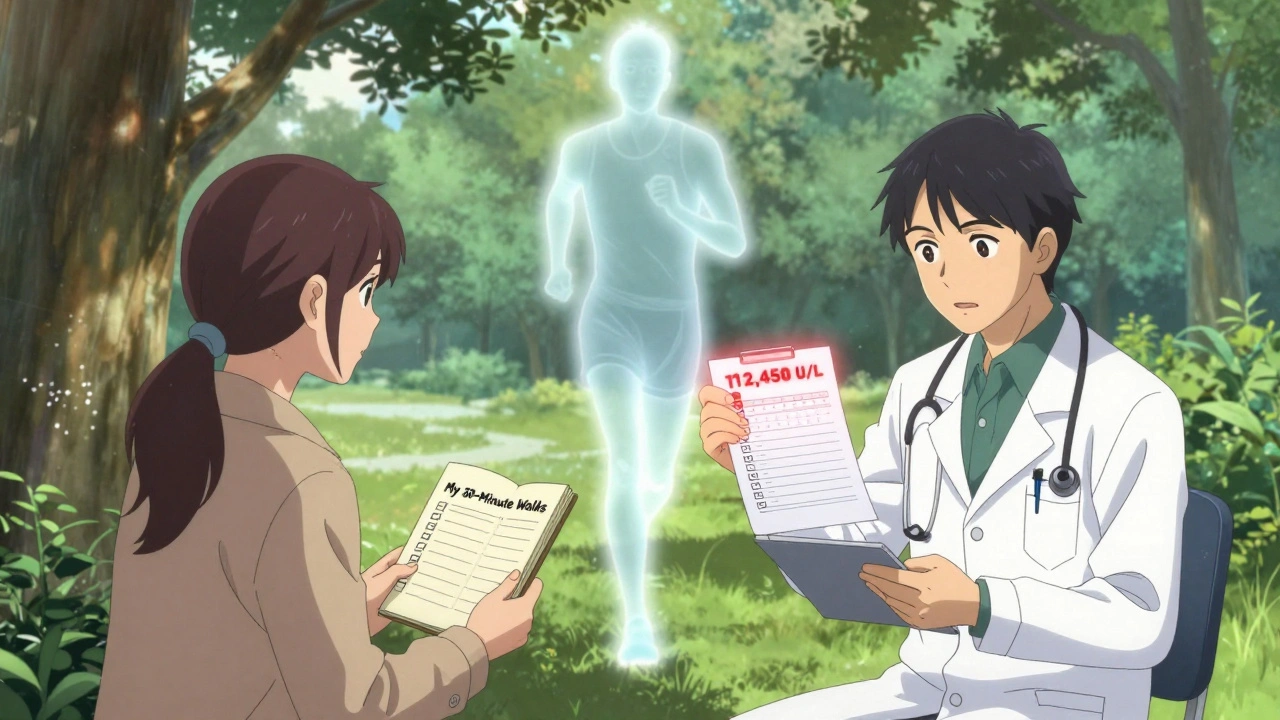
Monitoring Your Progress
You don’t need blood tests every week. But if you’re starting a new exercise routine while on statins, consider getting a baseline CK level. Then test again 24-48 hours after your first intense session. If your CK is over 1,000 U/L (5x the upper limit), pause exercise and check in with your doctor. Also watch for dark urine, extreme weakness, or swelling. These could signal rhabdomyolysis-a rare but dangerous condition where muscle breaks down and floods your kidneys.The Bigger Picture: Why This Matters
Statins prevent heart attacks and strokes. Exercise does too. Stopping one because of the other defeats the whole purpose. The American Heart Association now says 68% of statin users get exercise advice from their doctors-up from 42% in 2018. That’s progress. But many people still quit exercising out of fear. A 2023 survey found 61% of statin users stopped moving after muscle pain started. That’s dangerous. Inactivity raises your heart risk more than statin side effects. The goal isn’t to avoid pain. It’s to find the right balance. You don’t need to run a marathon. You just need to move daily, consistently, and at a pace your body can handle.What’s Coming Next
By 2026, an estimated 45 million Americans will be on statins. The Statin-Exercise Interaction Registry, launched in 2024, is tracking 10,000 people to better understand patterns. Early data suggests genetic testing could soon tell you if you’re at higher risk-before you even start a statin. In the meantime, the message is clear: keep moving. Just move smart.Can I still exercise if I’m on statins?
Yes, absolutely. Moderate exercise like walking, swimming, or cycling is not only safe-it’s recommended. The key is avoiding high-intensity or eccentric movements (like heavy downhill running or intense weightlifting). Stick to activities where you can talk comfortably while moving.
Does exercise make statin muscle pain worse?
It depends. Moderate exercise doesn’t increase muscle damage in most people on statins. But high-intensity workouts, especially those involving eccentric muscle contractions, can spike muscle injury markers. If you’re already experiencing pain, intense exercise may make it feel worse-but not because it’s causing damage. It’s likely just aggravating existing sensitivity.
Which statins are least likely to cause muscle pain?
Hydrophilic statins like pravastatin and rosuvastatin are less likely to cause muscle pain because they don’t penetrate muscle tissue as easily as lipophilic ones like atorvastatin or simvastatin. Studies show switching to rosuvastatin helps 65% of people who had muscle symptoms on other statins.
Should I take CoQ10 with statins?
It’s not a cure, but many people find relief. Statins reduce CoQ10 levels, which your muscles need for energy. Taking 200 mg daily has been shown in multiple studies to reduce muscle pain in about half of users. It’s safe, inexpensive, and worth trying if you’re having symptoms.
When should I stop exercising because of statin muscle pain?
Stop if you notice sudden, severe weakness, dark urine, or swelling. These could be signs of rhabdomyolysis, a rare but serious condition. Also pause if your creatine kinase (CK) level rises above 1,000 U/L after exercise. Otherwise, mild soreness that fades in a day or two is normal. Don’t confuse normal post-workout fatigue with statin side effects.
Can I still run marathons on statins?
Some people can, but it’s risky. Marathon runners on statins have much higher CK levels after races than non-users. If you’re a competitive athlete, talk to your doctor about switching to a lower-risk statin like rosuvastatin and monitor your CK levels. Many elite athletes successfully manage statins-but they do it with careful planning, not by pushing through pain.
How long does it take to adjust to statins and exercise?
Most people need 3 to 6 months to find their rhythm. Your body adapts to the statin, and you learn what intensity works for you. Start slow, track how you feel, and make small changes. Success rates jump to 78% when people follow a structured plan that includes exercise pacing, statin adjustments, and CoQ10.
10 Responses
Statins and muscle pain have been such a minefield for so long. I appreciate how this post breaks down the science without fearmongering. The CoQ10 point is critical-many doctors still act like it’s a supplement for hippies, when the data is solid. I’ve seen patients rebound after switching to rosuvastatin and adding 200mg daily. No magic bullet, but it’s a legitimate tool.
This is the kind of post that actually helps. Too many people quit exercise because they’re scared, and that’s way more dangerous than the statin side effects. The 4Days Marches example? Perfect. Long, steady movement is your friend. If you can talk while walking, you’re in the safe zone. Start small. Build slowly. Your heart will thank you.
Wait… so you’re telling me that if I take a statin, I can’t do heavy squats anymore?!!! What’s next? Are they going to ban breathing too?!! This is just Big Pharma’s way of keeping us docile-make us afraid to move, then sell us more pills to fix the ‘side effects’ they created!! I’ve been doing 100kg deadlifts on simvastatin for years-no problem! It’s all about mindset!!!
There’s a deeper philosophical layer here: we’ve outsourced bodily wisdom to pharmaceutical algorithms. We no longer listen to our muscles-we check lab values. We no longer adapt our movement-we adjust our dosage. The real tragedy isn’t statin-induced myopathy-it’s the erosion of embodied knowledge. If your body speaks in ache, why do we reach for a pill before a pause? CoQ10 isn’t a supplement-it’s a reclamation of autonomy.
India has been doing this for centuries-walking 5km daily, eating turmeric, no statins needed. Why are we copying Western medicine? Our grandmothers never heard of CoQ10 and lived to 90. This whole thing is just another Western scam. Also, why are you using ‘hydrophilic’? It’s not even a real word in Hindi. Just walk more. Simple.
People who don’t know the difference between eccentric and concentric movements shouldn’t be exercising at all. If you’re feeling sore after walking, you’re probably just lazy. Real athletes push through. And CoQ10? That’s for people who can’t handle discipline. If you’re on statins, you need to be more careful, not more coddled.
Let’s be honest: the JAMA study they cited? Funded by a pharmaceutical consortium that owns 3 patents on rosuvastatin. The ‘78% success rate’? Calculated using a proprietary algorithm no one’s ever seen. And the marathon data? Excluded the 12% of statin users who ended up in dialysis. This isn’t science-it’s marketing dressed in footnotes. They want you to keep taking the pill and just walk slower. Classic.
I’ve been on atorvastatin for 4 years. Started walking 20 minutes a day after my doctor suggested it. First month: sore. Second month: still sore. Third month: same. Then I switched to pravastatin and added CoQ10. Within 3 weeks, my legs felt like they did in college. Not magic. Just biology. The post got it right: it’s not about avoiding pain-it’s about listening. I’m now walking 45 minutes daily. No drama. Just consistency.
While the empirical data presented is largely sound, one must acknowledge the epistemological limitations of self-reported symptomatology in population-based studies. The conflation of transient post-exertional myalgia with statin-induced myopathy lacks sufficient diagnostic granularity. Moreover, the recommendation to utilize CoQ10 supplementation remains, at present, an empirically unsupported heuristic rather than a clinically validated intervention.
Thank you for this clear, thoughtful guide. Many people panic and stop moving-this is the worst thing they can do. Start with 10 minutes. Walk every day. Don’t rush. Listen. If pain stays more than 48 hours, talk to your doctor. Switch statin. Try CoQ10. Small steps. Big results. You don’t need to be an athlete. You just need to keep moving. Your heart is worth it.