
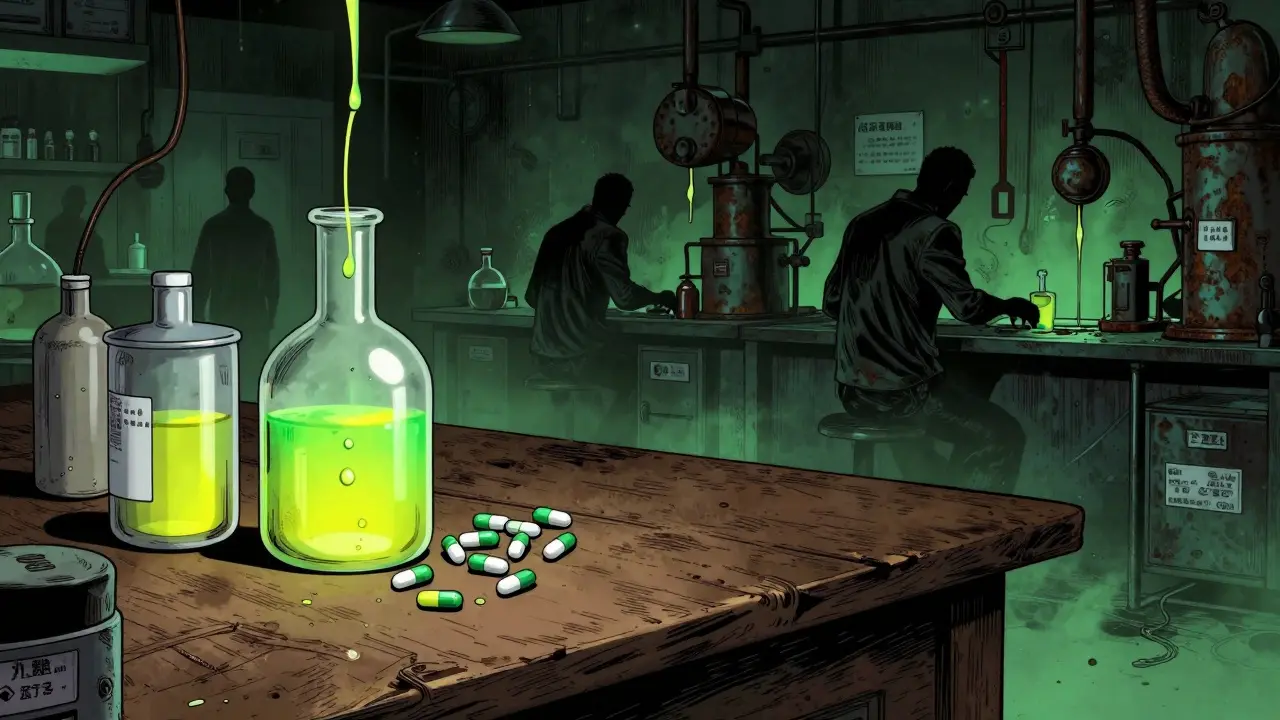
Most people assume the biggest danger of a fake pill is that it simply won't work. You take a medication for a serious condition, it turns out to be a dud, and your illness gets worse. While that's a nightmare scenario, there is a much darker side to the illicit drug trade. Counterfeit drugs are not just "ineffective"; they are often active delivery systems for toxic chemicals, heavy metals, and lethal opioids. We aren't talking about a few impurities here and there-we're talking about industrial solvents and synthetic poisons that can shut down your kidneys or stop your heart in minutes.
The Reality of the Fake Medicine Market
It is a staggering thought, but the World Health Organization is a specialized agency of the United Nations responsible for international public health estimating that about 10.5% of medications globally are either substandard or completely falsified. This isn't just a problem in remote villages; it's a multibillion-dollar global industry. In recent years, the scale has exploded, with the illicit market growing from $75 billion in 2010 to a massive $200 billion today.
When criminals manufacture these drugs, they aren't following any safety protocols. They aren't using pharmaceutical-grade laboratories. Instead, they use whatever fillers and chemicals are cheap and available. This creates a cocktail of contaminants that can cause immediate organ failure or long-term neurological damage. For example, a review of verified incidents showed that contaminated fakes caused over 3,600 deaths across 48 documented events. The danger isn't just that the drug doesn't work-it's that the drug itself is poison.
Chemical Poisons and Industrial Solvents
One of the most terrifying categories of contaminants is industrial solvents. You'll often find these in liquid medications like cough syrups. Ethylene glycol and Diethylene glycol are toxic organic compounds often used as antifreeze or industrial solvents . When these end up in a child's cough medicine, the result is often fatal. In 2022, Gambia saw a tragedy where 66 children died from acute kidney injury after consuming contaminated syrups. These chemicals cause irreversible metabolic acidosis, meaning your blood becomes too acidic for your organs to function.
Then there are the heavy metals. In counterfeit weight-loss products, researchers have found lead, mercury, and arsenic at concentrations over 1,200 parts per million. To put that in perspective, that is 120 times the permissible limit set by health authorities. These metals don't just leave your system; they accumulate in your brain and kidneys, leading to permanent neurological damage and renal failure.
| Contaminant Type | Common Examples | Primary Health Risk | Commonly Found In |
|---|---|---|---|
| Industrial Solvents | Ethylene glycol | Acute Kidney Injury / Death | Cough Syrups |
| Heavy Metals | Lead, Mercury, Arsenic | Neurological Damage | Weight-loss Pills |
| Synthetic Opioids | Fentanyl | Respiratory Arrest / Overdose | Prescription Painkillers |
| Microbial Pathogens | B. cereus, P. aeruginosa | Sepsis / Abscesses | Injectables |
The Fentanyl Crisis in Prescription Pills
Perhaps the most urgent threat today is the deliberate addition of Fentanyl is a potent synthetic opioid that is 50 to 100 times more powerful than morphine to counterfeit prescription pills. This isn't an accidental contaminant; it's a deliberate choice by traffickers to make the drug more addictive or potent. The concentrations are terrifying. Some tablets contain between 0.5mg and 3.2mg of fentanyl, which can be hundreds of lethal doses in a single pill.
Former FDA Commissioner Dr. Margaret A. Hamburg has warned that these laced pills are now the single greatest drug threat in the US, with roughly 6 out of 10 pills containing a potentially lethal dose. In 2022 alone, over 73,000 overdose deaths in the US were linked to these types of counterfeit products. Because these pills look identical to pharmacy-grade medication, users have no way of knowing they are taking a gamble with their lives.
Microbial Hazards and Dangerous Fillers
When a drug is injected, the risks shift from chemical poisoning to systemic infection. Many counterfeit injectables are contaminated with bacteria like Pseudomonas aeruginosa and Bacillus cereus . These aren't just minor impurities; they cause severe sepsis and deep abscesses at the site of injection. An FDA investigation into fake epinephrine vials once led to 17 hospitalizations in Texas due to these microbial contaminants.
Even the "inactive" ingredients in fakes can be deadly. In counterfeit cancer medications, the American Society of Health-System Pharmacists discovered that nearly 28% of samples contained talc or chalk as fillers. While talc is fine in a powder, injecting particulate matter directly into the bloodstream can cause granulomatous disease, where the body creates small areas of inflammation in the lungs or other organs as it tries to wall off the foreign particles.
Spotting the Red Flags
How do you protect yourself when the packaging looks professional? The first rule is to be skeptical of any medication bought outside a regulated pharmacy. The FDA's BeSafeRx program has found that over 96% of websites selling prescription drugs operate illegally. If the price is too good to be true or the site doesn't require a valid prescription, it's almost certainly a risk.
Pharmacists are trained to look for subtle packaging discrepancies-blurred ink, missing batch numbers, or slightly off-color labels. While we can't all carry a Raman spectrometer (the handheld devices experts use to detect chemicals), we can use common sense. Avoid buying "bulk" deals from social media or unverified online vendors. If the pill has a strange texture, a weird smell, or a different color than your usual dose, stop immediately.
The Future of Drug Safety
The battle against contaminated fakes is moving toward technology. Blockchain is a distributed ledger technology that allows for a transparent, tamper-proof record of a product's journey from factory to patient . Pilot programs have already shown that blockchain can reduce counterfeit infiltration by over 70% by verifying every hand-off in the supply chain.
We are also seeing new tools like the CDS-1 sensor from the FDA, which uses non-invasive spectroscopy to identify chemical contaminants with over 97% accuracy. However, technology alone isn't the answer. Until there is international harmony in how we regulate pharmaceuticals, the gap between the law and the criminals will remain. Without stronger global cooperation, some experts predict a 40% increase in contaminant-related deaths by 2027.
What are the most common signs of a counterfeit drug?
Look for packaging errors such as spelling mistakes, blurred printing, or missing expiration dates. Also, pay attention to the pill itself; if the color, shape, or texture is different from your previous prescriptions, it may be falsified. Most importantly, be wary of any pharmacy that doesn't require a prescription or offers prices that seem impossibly low.
Can a fake drug cause a reaction even if it has the right active ingredient?
Yes. Even if the drug contains the correct active ingredient, it can be contaminated with toxic fillers, heavy metals, or industrial solvents used during the illegal manufacturing process. These contaminants can cause everything from kidney failure to severe allergic reactions, regardless of whether the primary drug works.
Why is fentanyl found in fake prescription pills?
Traffickers often add fentanyl to counterfeit pills because it is cheap to produce and highly addictive. It mimics the effects of prescription opioids but is significantly more potent, which increases the drug's "appeal" to users while drastically increasing the risk of a fatal overdose.
What should I do if I suspect my medication is counterfeit?
Stop taking the medication immediately and contact your prescribing doctor or a licensed pharmacist. You should also report the suspected counterfeit to your national health authority (such as the FDA in the US) to help them track the source of the fake drugs and prevent others from being harmed.
Are counterfeit drugs more common in certain countries?
While low- and middle-income countries often face higher rates of substandard medicines due to weaker regulatory oversight, the threat is global. Developed nations are seeing a massive spike in contaminated fakes due to the rise of illegal online pharmacies and the infiltration of synthetic opioids into the illicit market.