
MAOI Medication Safety Checker
Check Your MAOI Safety
This tool determines if your MAOI medication is safe to take with dextromethorphan-based cough medicines. Always consult your doctor before stopping or starting any medications.
Please enter your MAOI medication name to check safety
It’s easy to grab a bottle of cough syrup when you’re feeling under the weather. But if you’re taking an MAOI antidepressant, that simple choice could put your life at risk. Dextromethorphan, the active ingredient in popular cough medicines like Robitussin, Delsym, and NyQuil, can trigger a dangerous-and sometimes deadly-reaction when mixed with monoamine oxidase inhibitors (MAOIs) such as phenelzine, tranylcypromine, or selegiline. This isn’t a rare edge case. It’s a well-documented, high-risk interaction that’s still catching people off guard today.
Why This Interaction Is So Dangerous
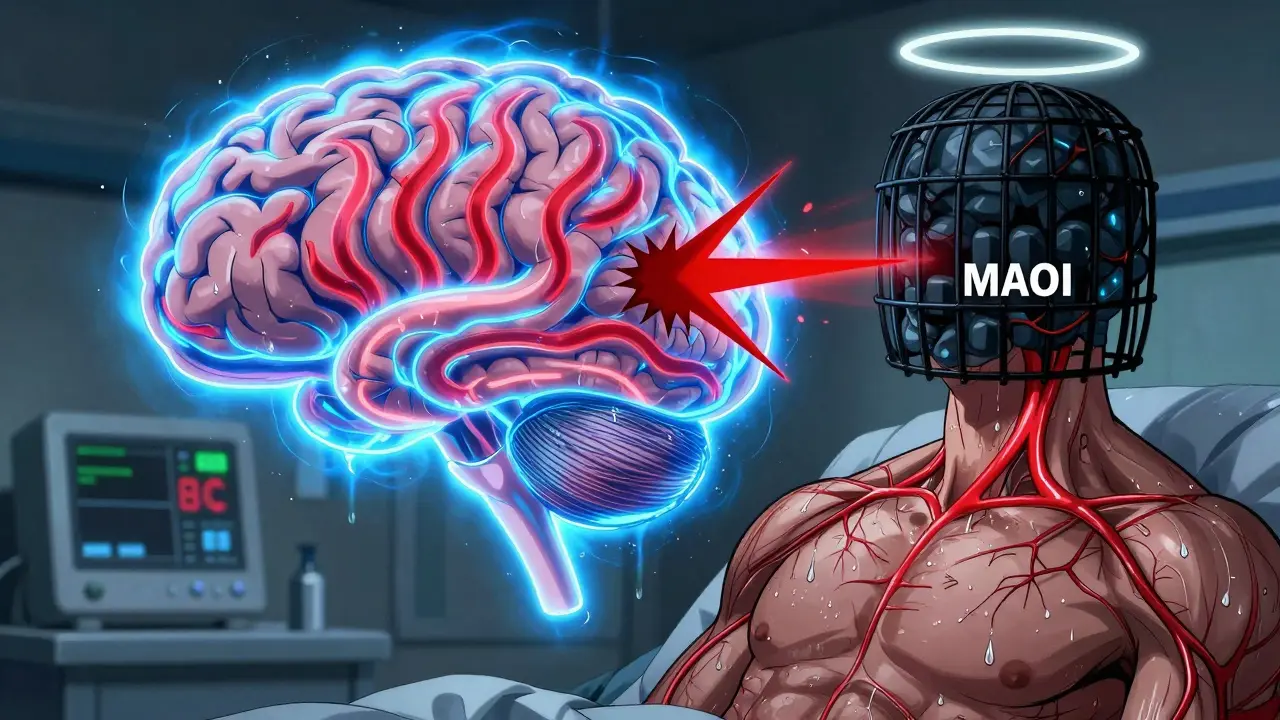
Dextromethorphan works by calming the cough reflex in your brain. But it doesn’t stop there. It also acts as a weak serotonin reuptake inhibitor, meaning it increases serotonin levels in your nervous system. MAOIs do the same thing-only much more powerfully. They block the enzyme that breaks down serotonin, so levels keep building up. When you combine the two, your brain gets flooded with serotonin. That’s not just uncomfortable. It’s life-threatening.
This overload causes serotonin syndrome. Symptoms start quietly: shivering, sweating, restlessness. Then they escalate fast-muscle stiffness, high fever (104°F or higher), confusion, rapid heartbeat, seizures. In severe cases, it leads to organ failure. Studies show that between 2% and 12% of people who develop severe serotonin syndrome don’t survive. And it can happen as quickly as four hours after taking your cough medicine.
The Science Behind the Risk
The danger isn’t just about serotonin. Your liver uses an enzyme called CYP2D6 to break down dextromethorphan. MAOIs slow this process down, causing dextromethorphan to build up in your blood by 300% to 400%. That means even a normal dose becomes toxic. It’s like pouring gasoline on a fire you didn’t know was smoldering.
Some MAOIs are worse than others. Traditional ones like Nardil and Parnate are irreversible-they shut down serotonin breakdown permanently until your body makes new enzymes. That’s why doctors say you must wait at least two weeks after stopping an MAOI before taking dextromethorphan. Newer ones, like moclobemide, are reversible and carry less risk. But unless your doctor tells you otherwise, assume all MAOIs are dangerous with cough medicine.
Real Stories, Real Consequences
People don’t realize they’re at risk until it’s too late. One Reddit user on r/MAOI described waking up with muscle rigidity and a 104°F fever after taking a nighttime cold syrup while on selegiline. Emergency room staff said he was lucky to be alive. Another patient on PatientsLikeMe took Parnate and a cough medicine, then couldn’t speak clearly within four hours. ER doctors told her she’d nearly died.
The FDA’s adverse event database shows 237 reported cases of serotonin syndrome linked to dextromethorphan and MAOIs between 2010 and 2022. Over 40% of those cases needed hospitalization. And these are just the ones that got reported. Many more go unnoticed or are misdiagnosed as the flu or a stroke.
What’s on the Label? Not Enough
All OTC cough medicines with dextromethorphan are supposed to warn about MAOI interactions. But a 2021 review found only 38% of product labels made that warning clear. Most put it in tiny print on the back. Patients aren’t reading it. Even pharmacists miss it sometimes.
Surveys show 78% of people on MAOIs don’t know their cough medicine contains dextromethorphan. They see “cough suppressant” and assume it’s safe. They don’t check the active ingredients. And many doctors don’t ask. A 2019 study found that nearly 8 out of 10 patients never had a conversation about OTC risks when starting MAOI therapy.
What Should You Do?
If you’re on an MAOI, here’s what you need to do right now:
- Check every cough, cold, or flu medicine you own. Look for “dextromethorphan” on the label-even if it’s in the ingredient list under “other ingredients.”
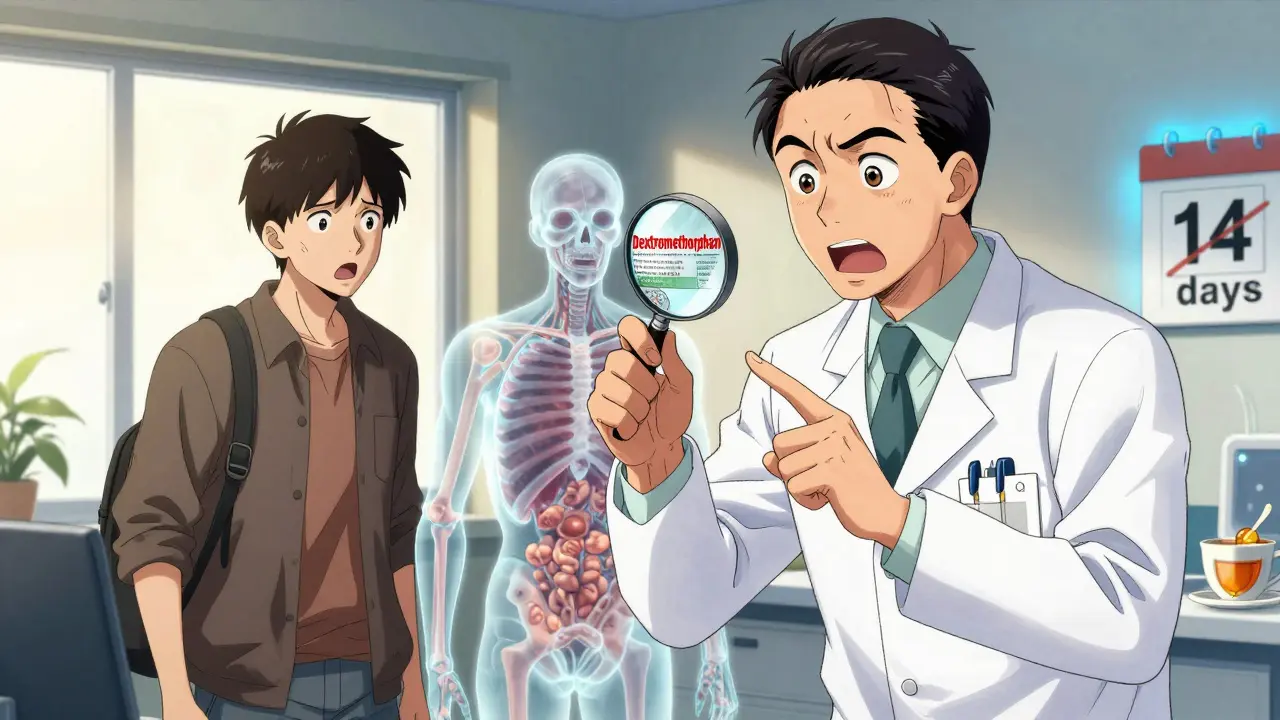
- Never take dextromethorphan if you’ve used an MAOI in the last 14 days. That includes patches like Emsam or pills like Azilect.
- Don’t assume “natural” or “herbal” cough remedies are safe. Some honey-based syrups contain tyramine, which can also interact with MAOIs.
- Ask your pharmacist to review all your medications, including supplements and OTC products. They’re trained to catch these risks.
- Use alternatives: Guaifenesin (an expectorant) is safe with MAOIs. Honey in warm tea can soothe a cough. Steam inhalation and saline nasal sprays help too.
And if you’ve accidentally taken dextromethorphan while on an MAOI? Don’t wait. Call your doctor or go to the ER. Serotonin syndrome doesn’t get better on its own. Delaying care can cost you your life.
What’s Changing?
The FDA is pushing for bigger, bolder warnings on all dextromethorphan products, with new rules expected by late 2024. The European Medicines Agency now requires MAOI prescriptions to come with a printed list of unsafe OTC medicines-including brand names like Robitussin and DayQuil. In Australia, the Therapeutic Goods Administration already requires clear warnings on all packaging.
But technology alone won’t fix this. The real fix is education. Pharmacists who counsel MAOI patients reduce accidental interactions by 67%. Simple conversations-“What cough medicine are you using?”-save lives. More clinics are starting mandatory OTC medication reviews when starting MAOI therapy. But until that becomes standard everywhere, you have to be your own advocate.
Who’s at Risk?
MAOIs aren’t common. Only about 1.2 million Americans use them each year. But they’re often prescribed for treatment-resistant depression, Parkinson’s, or anxiety disorders that didn’t respond to other drugs. These are people who’ve tried everything else. They’re desperate for relief. And they’re being told by society that OTC cough medicine is harmless.
The risk isn’t just for the elderly or those on multiple meds. It’s for anyone taking an MAOI-even if they’re young, healthy, and feel fine. One dose of dextromethorphan is all it takes. No warning signs. No second chances.
Bottom Line
Dextromethorphan isn’t evil. MAOIs aren’t dangerous by themselves. But together, they create a perfect storm. And too many people are walking into it without knowing. If you’re on an MAOI, treat every cough medicine like a loaded gun. Read the label. Ask your pharmacist. When in doubt, skip it. Your life isn’t worth the gamble.
13 Responses
We treat medicine like candy and wonder why people die. It's not the drug, it's the ignorance. We've outsourced thinking to labels and apps. If you can't read a bottle of syrup, maybe you shouldn't be taking anything at all. Simple.
Wait... so you're telling me the government doesn't want us to get better? This is clearly a Big Pharma plot to sell more antidepressants. They *want* you to get serotonin syndrome so you'll need more pills. And don't tell me about the FDA - they're in the tank. I've seen the videos. The syrups are laced. Always has been.
The assertion that dextromethorphan poses a clinically significant risk in conjunction with MAOIs is empirically valid, yet insufficiently contextualized. The pharmacokinetic interaction mediated by CYP2D6 inhibition is not merely additive - it is multiplicative, and the pharmacodynamic convergence upon serotonergic pathways constitutes a bona fide pharmacological emergency. The 2–12% mortality rate is statistically alarming, yet the underreporting bias renders epidemiological estimates profoundly conservative. One must also consider the confounding variable of polypharmacy, which is rarely accounted for in case studies.
In Nigeria, we don't have Robitussin on the shelf like you do. We use ginger, honey, and steam. But I’ve seen people here die from mixing traditional herbs with antidepressants too. The problem isn’t just dextromethorphan - it’s that no one checks. No one asks. Everyone assumes ‘natural’ means ‘safe.’ It doesn’t. Always ask your pharmacist. Always.
I’ve been on an MAOI for five years. I never knew dextromethorphan was in NyQuil until I read this. I’ve taken it twice. I’m lucky. I’m so grateful someone took the time to write this. Thank you.
If you're on an MAOI, you shouldn't be taking *any* OTC meds. Period. The fact that people still think 'a little cough syrup' is harmless shows how out of touch we are with basic biology. Your body isn't a vending machine. You don't get to pick and choose what you put in it. This isn't a warning - it's a necessity.
This is why America is falling apart. We turn every simple thing into a medical emergency. You want to take cough syrup? Go ahead. If you die, you were too dumb to read the label. Stop coddling people. Let evolution do its job. This article reads like a parenting manual for adults who still need bedtime stories.
OMG I just checked my cabinet and I had 3 bottles of DayQuil!!! I took one last week 😭 I’m so scared rn. I’m on selegiline. Should I go to the ER?? I don’t have symptoms but I’m sweating like crazy now. HELP.
Thank you for this meticulously researched and clearly articulated piece. The emphasis on pharmacist involvement as a primary intervention point is both pragmatic and profoundly necessary. I work in clinical pharmacy, and I can confirm that 80% of MAOI patients are never counseled on OTC risks during initiation. This is a systemic failure, not an individual one. Standardizing medication reviews at MAOI initiation should be mandatory - not optional.
I don't trust no medical stuff. They just wanna make money. You think they care if you die? Nah. They just want your insurance. I took Robitussin last week. I'm fine. Stop scaremongering.
I’m on Parnate. I’ve never taken anything with dextromethorphan. But I didn’t know about the liver enzyme thing. That’s wild. I always thought it was just serotonin. I guess I’ve been lucky. I’ll check my meds tonight.
I read this and just cried. I took NyQuil last winter. I didn’t even know what dextromethorphan was. I thought it was just 'cough medicine.' I’m so dumb. I’m so lucky I didn’t die. I’m going to throw out every cold med I have.
I’ve been on MAOIs for ten years. I’ve lost two friends this way. One was 28. He thought it was just a cold. He didn’t even know he was on a drug that could kill him from a cough syrup. I don’t say this to scare you. I say it because I don’t want anyone else to go. Please. Just check the label.