
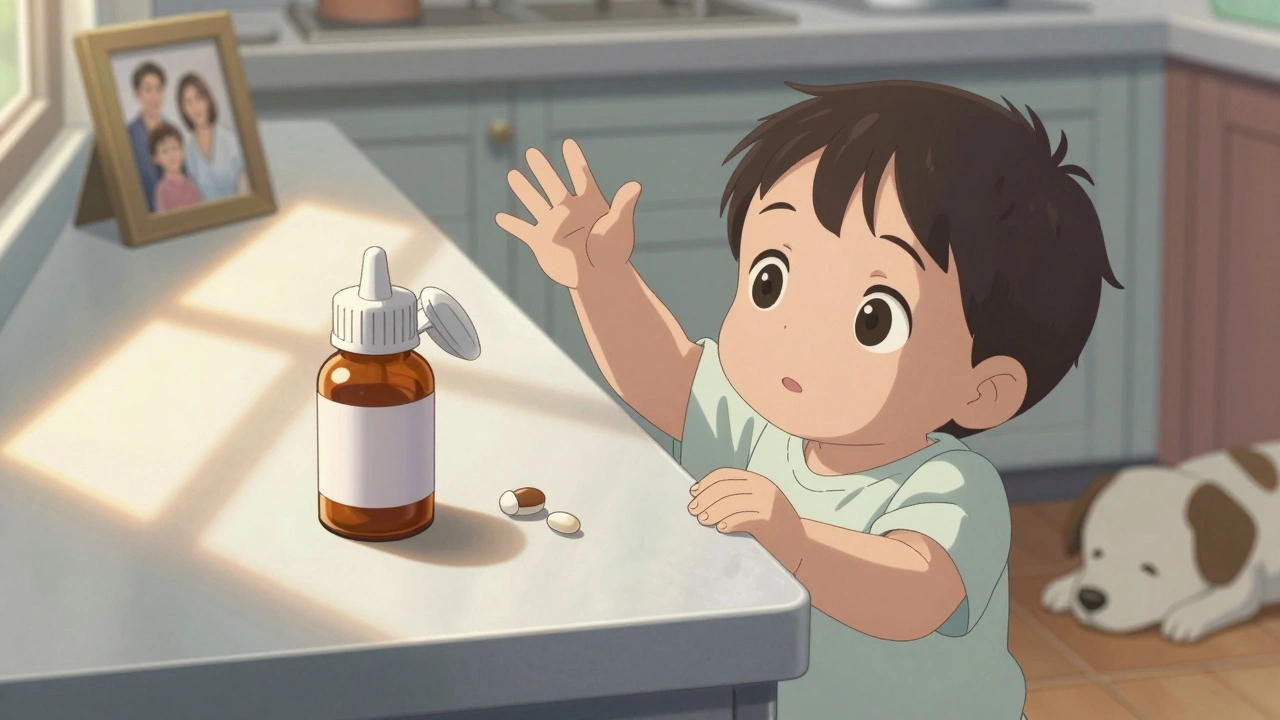
Every year, thousands of children accidentally get into medicines they shouldn’t. It’s not because they’re curious little explorers-it’s because the bottles they find aren’t designed to keep them out. That’s where child-resistant packaging comes in. But here’s the truth: no cap is truly child-proof. It’s not about stopping every child forever. It’s about buying time-those extra minutes a parent needs to intervene.
How Child-Resistant Packaging Actually Works
Child-resistant (CR) packaging isn’t magic. It’s engineering. Under U.S. law, any container holding certain medications must pass strict tests set by the Consumer Product Safety Commission (CPSC). The rules are clear: at least 85% of children between 42 and 51 months old must be unable to open the container within 10 minutes. That’s not a suggestion-it’s a legal requirement.The test doesn’t end there. Kids who fail the first round get a five-minute demonstration. If they still can’t open it after seeing how, the design passes. Meanwhile, seniors aged 50 to 70 must be able to open and re-close the same container in under five minutes. At least 90% of them need to succeed. That’s the balance: keeping kids out without locking out grandparents.
The most common design? The push-and-turn cap. You have to press down firmly while twisting. It’s awkward for small hands but easy for adults with normal grip strength. Other types include squeeze-and-turn caps, where you compress the sides while turning, and interlocking caps that require two different motions at once. These aren’t random ideas-they’re the result of decades of testing and refinement.
What Medications Need CR Packaging?
Not every pill bottle needs a safety cap. The law targets specific risks. Prescription drugs like opioids, antidepressants, and blood thinners almost always require CR packaging. So do many over-the-counter (OTC) medicines with dangerous ingredients-think acetaminophen in high doses, iron supplements, and cough syrups containing dextromethorphan.Some products have special rules. Since 2012, any OTC or prescription medicine with 0.08 milligrams or more of imidazoline (found in some nasal sprays and eye drops) must have CR packaging. Why? Because even a tiny amount can cause life-threatening drops in heart rate and breathing in toddlers.
Nasal sprays and eye drops are tricky. A standard pump doesn’t count as child-resistant. The CPSC says the pump itself or the outer cap must be locked. That’s why some newer nasal sprays come with a twist-lock outer shell you have to remove before pressing the nozzle. Blister packs can work too-if the foil backing requires at least 15 pounds of force to peel through. Most standard blister packs don’t meet that bar.
Why CR Packaging Isn’t Enough
You might think if the bottle says "child-resistant," your kids are safe. That’s a dangerous assumption. Studies show CR packaging loses effectiveness after the first opening. About 15% of the time, adults don’t re-close the cap properly. A loose cap is just a door left ajar.In 2022, over 12,800 incidents were reported where children accessed medications despite CR packaging. Nearly three-quarters of those cases happened because the cap wasn’t fully secured after use. Another 18% involved damaged containers-cracked bottles, torn foil, or caps that had been pried off earlier.
Even the best designs fail sometimes. Consumer Reports tested CR caps from major retailers and found some CVS-branded caps failed child resistance tests 22% of the time. Manufacturer-specific designs, like those from Aptar or Becton Dickinson, performed better, failing only 8% of the time. Brand matters. Generic doesn’t always mean safer.
Who Struggles with CR Caps-and Why
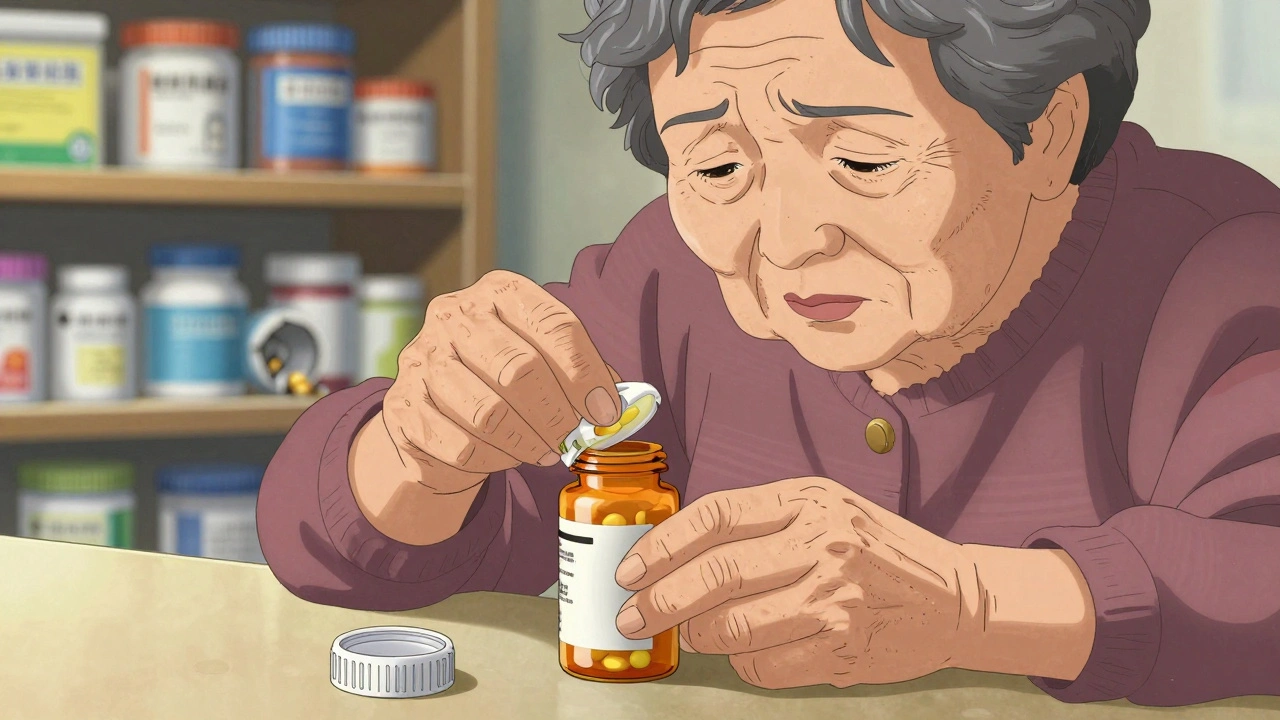
CR packaging wasn’t designed with arthritis in mind. But millions of adults have it. The Arthritis Foundation found that 68% of people with hand impairments struggle to open standard CR caps. The average force needed to open one exceeds 5 pounds-twice what’s recommended for senior-friendly use.Older adults often skip the cap entirely. They’ll leave the bottle open. Or they’ll transfer pills into a weekly pill organizer that has no safety features. That’s how accidents happen. One Reddit user, a nurse with 20 years of experience, shared that three out of every ten of her elderly patients need alternative packaging because they simply can’t open the bottle.
Thankfully, newer designs are changing that. Aptar’s Mini+cr system achieves 92% senior success rates while keeping child access below 8%. Blisterpak’s Easy-Open system has 4.2 out of 5 stars on Amazon, with users praising how their parents can finally open their meds without help. These aren’t luxuries-they’re necessities for aging populations.
The Real Cost of Compliance
Getting a CR cap approved isn’t cheap. Pharmaceutical companies must submit their packaging to CPSC-accredited labs for testing. Each design costs between $8,500 and $15,000 to certify. That’s not a one-time fee-it’s per design. If you change the bottle shape, the cap material, or the threading, you pay again.Regulators also demand documentation. In the electronic drug application (eCTD), companies must state: "We verify in this submission that the following package (or packages) meet CPSC's standards under 16 CFR 1700." Skip that line, and your drug won’t get approved. The FDA can issue warning letters or fines up to $100,000 per violation.
Even pharmacies get caught. A 2022 survey found that nearly half of veterinary clinics were handing out medications in non-CR bags or envelopes. That’s a violation too. If you’re dispensing a drug that requires CR packaging, you can’t just throw it in a plastic bag-even if the patient asks.

What’s Next for Medication Safety?
The future of CR packaging is smarter. In early 2023, Aptar launched the first FDA-cleared connected safety cap: SmartDose. It looks like a regular CR cap-but inside, it has Bluetooth sensors that record every time the bottle is opened. If a child gets into it, the system sends an alert to the caregiver’s phone. It’s not just safety-it’s accountability.Regulators are also expanding their scope. In 2023, the CPSC proposed new rules requiring CR packaging for all cannabis edibles with more than 2mg of THC per serving. That’s because kids are eating gummies like candy. Same goes for laundry pods and high-dose vitamin D supplements-both are now under review for mandatory CR standards.
Global adoption is growing too. Brazil and India introduced mandatory CR packaging for medications in 2021 and 2022. The EU follows ISO 8317, which aligns closely with U.S. rules. But differences still exist-especially around senior accessibility. The U.S. is leading in balancing child safety with adult usability, and that’s where innovation is happening fastest.
What You Can Do Right Now
If you have kids, pets, or elderly relatives at home:- Always re-close the cap after use-press down and twist until you hear or feel it click.
- Store meds up high and out of sight-not in a purse, drawer, or nightstand.
- If a loved one struggles to open the bottle, ask your pharmacist for a senior-friendly alternative. Many pharmacies stock them.
- Never transfer pills to unmarked containers. A pill organizer without a safety lock is a hazard.
- Check expiration dates. Old caps can crack or lose their locking mechanism.
Child-resistant packaging saves lives. But it’s only as good as the person who uses it. The best cap in the world won’t help if it’s left open on the counter. Safety isn’t built into the bottle-it’s built into the habit.
Are child-resistant caps really effective?
Yes, but only when used correctly. Studies show CR packaging has reduced pediatric poisoning deaths by 45% since 1974. However, effectiveness drops by about 15% after the first opening if the cap isn’t properly re-closed. It’s not foolproof-it’s a barrier, not a lock.
Can my child still open a child-resistant cap?
Some can-especially after watching an adult open it. Children as young as two have been known to figure out push-and-turn caps after repeated exposure. That’s why CR packaging is meant to delay access, not prevent it entirely. Never rely on the cap alone. Store medications out of reach and sight.
Why do some medicine bottles have caps that are hard for seniors to open?
Many older designs were made before senior accessibility became a priority. Push-and-turn caps require grip strength and fine motor control that many older adults lose due to arthritis or nerve damage. Newer designs like Aptar’s Mini+cr and Blisterpak’s Easy-Open system are engineered to meet both child-resistant and senior-friendly standards, but they’re not yet standard across all brands.
Can I ask my pharmacist for easier-to-open caps?
Absolutely. Pharmacists are required to provide alternative packaging if a patient has difficulty opening CR caps. You can request a senior-friendly cap, a blister pack with easy-peel foil, or even a non-CR container if you sign a risk acknowledgment form. Don’t assume you’re stuck with a cap that hurts your hands.
Do all over-the-counter medicines have child-resistant packaging?
No. Only OTC medicines with specific active ingredients at certain concentrations are required to have CR packaging. For example, acetaminophen over 325 mg per tablet, iron supplements over 30 mg per dose, and dextromethorphan over 10 mg per unit must be in CR containers. Simple pain relievers like low-dose ibuprofen may not require it. Always check the label or ask your pharmacist.
13 Responses
My grandma can barely open her blood pressure pills, and I hate that she has to ask me every time. I didn’t even know pharmacists can give her easier caps until I read this. Took me 3 years to figure out she was just too proud to say it out loud. Now I call her pharmacist every refill. Small thing, huge difference.
Also, never leave meds on the nightstand. I learned that the hard way when my 2-year-old found my dad’s old OxyContin bottle. He didn’t swallow it, but he chewed the damn cap. We were lucky.
CR caps aren’t magic. They’re just a buffer. You still have to be the adult.
Thanks for writing this. Needed to hear it.
YEAH RIGHT. CHILD-RESISTANT? MORE LIKE GOVT-CONTROLLED. THEY WANT YOU TO NEED A PHARMACIST JUST TO GET YOUR ASPIRIN. THIS IS THE FIRST STEP TO BANNING ALL MEDS. NEXT THEY’LL SAY YOU NEED A CLEARANCE TO BUY BAND-AIDS. WATCH. THEY’LL PUT TRACKERS IN THE CAPS TOO. I SWEAR I SAW A VIDEO OF A CAP THAT TEXTS YOUR PHONE WHEN YOU OPEN IT. THAT’S NOT SAFETY. THAT’S SURVEILLANCE.
THEY’RE NOT PROTECTING KIDS. THEY’RE PROTECTING THE PHARMA CORPORATIONS FROM LAWSUITS. YOU THINK THEY CARE ABOUT GRANDPA? LOL. THEY JUST WANT YOU TO BUY THEIR ‘SENIOR-FRIENDLY’ VERSIONS FOR $15 MORE. SCAM.
The CPSC’s 85% child resistance threshold is statistically sound, but the real issue is behavioral drift. The moment a caregiver becomes complacent about re-closing the cap, the engineering fails. This isn’t a product defect-it’s a human systems failure.
Studies show that 78% of caregivers who report ‘always’ re-closing caps actually leave them loose at least once per week. That’s cognitive bias meeting physical inertia. The push-and-turn mechanism works fine-it’s the feedback loop that’s broken.
What’s needed isn’t better caps, but better behavioral nudges. Think: audible clicks, tactile resistance, even scent-based cues. The cap should scream ‘I’m not closed’ when it’s not. That’s the next frontier.
Also, the 22% failure rate on CVS caps is alarming. Third-party testing transparency needs to be mandatory. Consumers deserve to know which brands are actually passing, not just claiming to.
Let’s be real-no one re-closes those caps right. I’ve seen nurses do it wrong. I’ve seen grandmas just toss the cap on the counter. You think the FDA cares? Nah. They care about the paperwork. The real problem? We’re all too tired to be perfect. The system is designed for perfect people. We’re not perfect people. We’re tired, distracted, and sometimes high on caffeine and guilt.
Also, why is it legal to sell OTC melatonin in a plastic bottle with no cap? But if you put 325mg of acetaminophen in a bottle? Boom-government cap. That’s not safety. That’s arbitrary. Who decided what’s dangerous? Some guy in a suit with a clipboard and zero kids?
Also, the SmartDose cap? That’s not innovation. That’s a spy device. Next they’ll charge you a monthly subscription to open your own pills. I’m not joking.
Child-resistant packaging is a necessary compromise, not a solution. It’s the equivalent of putting a fence around a cliff instead of removing the cliff. We treat medication safety like a lock problem when it’s actually a behavior problem.
Parents don’t need better caps. They need better habits. Storage matters more than the cap. Visibility matters more than the mechanism. If your meds are in a drawer labeled ‘vitamins,’ your kid will find them. If they’re in a locked cabinet with a child lock? Problem solved.
The real failure is cultural. We treat medicine like candy because we’ve been conditioned to. We don’t talk about dosage. We don’t teach kids it’s not food. We just blame the cap. That’s lazy.
Fix the culture. Not the plastic.
OMG THIS IS SO IMPORTANT 😭 I just realized my 7-year-old has been opening my mom’s heart meds because she leaves them on the kitchen counter. I’m crying. I’m so sorry, Mom. I’m getting a lockbox today. And I’m calling the pharmacy to ask for those easy-open caps. You’re not alone, everyone. We’re all just winging it. Let’s do better 💪❤️
Also, if you’re struggling with caps, please, please ask for help. No one thinks you’re weak. We all need help sometimes. You’re not broken. The system is just outdated. 💙
Let’s not pretend this is about kids. The real reason CR caps exist is because Big Pharma got sued so hard in the 80s that they had to make a show of doing something. The CPSC standards? Written by lawyers, not engineers. The fact that 15% of adults can’t open them? That’s a feature, not a bug. It’s a cost of doing business.
And don’t get me started on the ‘senior-friendly’ caps. Those are just marketing ploys. The same company that made the original push-and-turn cap now sells the ‘easy’ version for $2.50 extra. Same plastic. Same design. Just a different label.
SmartDose? Bluetooth cap? That’s not safety. That’s a data harvest. You think Apple isn’t buying this data? Of course they are. Next thing you know, your insulin usage is being sold to insurance companies.
This isn’t progress. It’s surveillance capitalism dressed up in safety goggles.
I work in ER. I’ve seen three kids this year alone with acetaminophen toxicity. One was 18 months. Took 12 pills. He’s lucky he’s alive. His mom thought the cap was ‘child-proof.’ She said, ‘I didn’t think he could reach it.’ He climbed a chair. He pulled the bottle off the shelf. He didn’t need to open it-he just needed to drop it. The bottle cracked. He ate the pills off the floor.
CR caps don’t save lives. Safe storage does. Lock it up. Out of sight. Out of reach. Not on the counter. Not in the purse. Not in the drawer with the socks.
And if you think your kid is ‘too little’ to figure it out? They’re not. Kids are tiny, silent, relentless machines. They don’t need logic. They just need opportunity.
Don’t wait for the ER to teach you this lesson.
i just found out my lil bro opened my dad’s blood thinner bottle last week and i had no clue. he’s 3. he just thought the pills looked like candy. we were so lucky he only ate one. now we have a lockbox and i’m asking for easy-open caps for my dad. i feel so guilty. why didn’t we know this stuff? why is this not taught in school? i’m gonna share this post with everyone. thank you for writing this. it saved my family. 🙏💙
Here’s the truth nobody says: CR caps are a performance. A theater of safety. The same people who demand these caps for pills are the ones who leave their guns unlocked in the same house. They’re the ones who let their kids run around with vape pens in their pockets. They’re the ones who let their toddlers play with cleaning supplies labeled ‘POISON’ in big red letters.
We don’t want safety. We want to feel safe. That’s why we cling to the cap like a talisman. It’s not about the child. It’s about our guilt.
And yet, we still don’t lock the meds. We still leave the pills on the counter. We still say, ‘It’s fine, he’s just a baby.’
It’s not the cap that’s broken. It’s us.
My aunt has severe arthritis. She used to just throw her meds in a coffee can. Said it was easier than fighting the cap. I thought it was reckless. Then I tried opening one myself. My fingers hurt. I get it now.
She’s not careless. She’s in pain. And the system didn’t give her an option that didn’t hurt.
My pharmacist gave her a blister pack with easy-peel foil. She cries every time she opens it. Not because she’s sad-because she can finally do it herself. No help. No shame.
That’s what safety looks like. Not a locked cap. A dignified one.
Did you know the CPSC’s child resistance test uses a sample size of 50 kids? That’s it. Fifty children between 42 and 51 months. One test. One lab. One 10-minute window. And that’s enough to certify a design for millions of bottles? That’s not science. That’s a snapshot.
What about kids with autism who hyperfocus? What about twins who watch each other? What about kids who’ve seen their parents open it 200 times? The test assumes uniformity. Kids aren’t uniform.
Also-why are eye drops treated differently? A toddler can swallow a 0.08mg dose of imidazoline and go into cardiac arrest. But the cap just needs to be ‘locked’? No force requirement? No durability test? That’s a loophole. And someone’s kid will die in it.
Regulation isn’t just about compliance. It’s about imagination. We need to think like a curious 2-year-old. Not a bureaucrat.
my mom just got her new meds and the cap was so easy she cried. she said it felt like someone finally listened. i didnt even know this was a thing. i thought all caps were the same. i just assumed she was weak. turns out the system was broken. now im telling everyone. also i bought lockboxes for all the meds in the house. no more excuses. we got this 💪❤️