

Every year, millions of Americans take medications that don’t belong to them-or take too many, too often, or at the wrong time. Some don’t even know they’re taking two pills that do the same thing. These mistakes aren’t always due to carelessness. Often, they’re the result of fragmented care, rushed doctor visits, or simply forgetting what’s in the medicine cabinet. The good news? There’s a simple, proven way to fix this: an annual medication review with a pharmacist.
What an Annual Medication Review Really Is
An annual medication review isn’t just a quick chat about your prescriptions. It’s a full clinical evaluation where a pharmacist sits down with you-usually for about 30 minutes-and goes through every single thing you take. That includes prescription drugs, over-the-counter pain relievers, vitamins, herbal supplements, and even eye drops or patches. The goal? To find hidden risks before they become emergencies. Pharmacists are trained to spot problems doctors might miss. While your doctor focuses on treating your condition, your pharmacist focuses on how the drugs interact, whether they’re still needed, and if they’re causing side effects you’ve just accepted as "normal aging." According to the National MTM Advisory Board, this process is called a Comprehensive Medication Review (CMR), and it’s required for Medicare Part D beneficiaries who qualify.Why Side Effects Get Missed (and How a Pharmacist Finds Them)
You’ve probably heard of common side effects like dizziness, nausea, or fatigue. But what if your memory lapses aren’t from getting older? What if your constant tiredness isn’t just stress? What if your stomach pain is from that daily aspirin you’ve been taking for years? Doctors have 15-minute appointments. Pharmacists have 30 minutes-and they’re specialists in how drugs behave in the body. During a review, they ask questions like:- Why are you taking this? Is it still helping?
- Are you taking it at the right time of day?
- Could this be causing your muscle aches or confusion?
- Do you have two drugs that do the same thing?
Who Needs This Review the Most
You don’t have to be elderly to benefit. But if you fall into any of these groups, you’re at higher risk:- You take four or more medications regularly (that’s called polypharmacy)
- You see more than one doctor
- You’ve been hospitalized recently for a drug-related issue
- You’ve noticed new symptoms like confusion, falls, or stomach upset
- You take supplements or over-the-counter drugs daily
What Happens During the Review
It’s not complicated. Here’s what to expect:- Bring everything. Put all your pills, bottles, patches, and supplements in a bag. Don’t rely on memory. If you’re unsure what something is, bring the box.
- They’ll ask questions. Why are you taking this? When? Have you noticed any changes? Are you skipping doses because of cost or side effects?
- They’ll check for problems. Duplicates? Interactions? Outdated prescriptions? Drugs that no longer match your health goals?
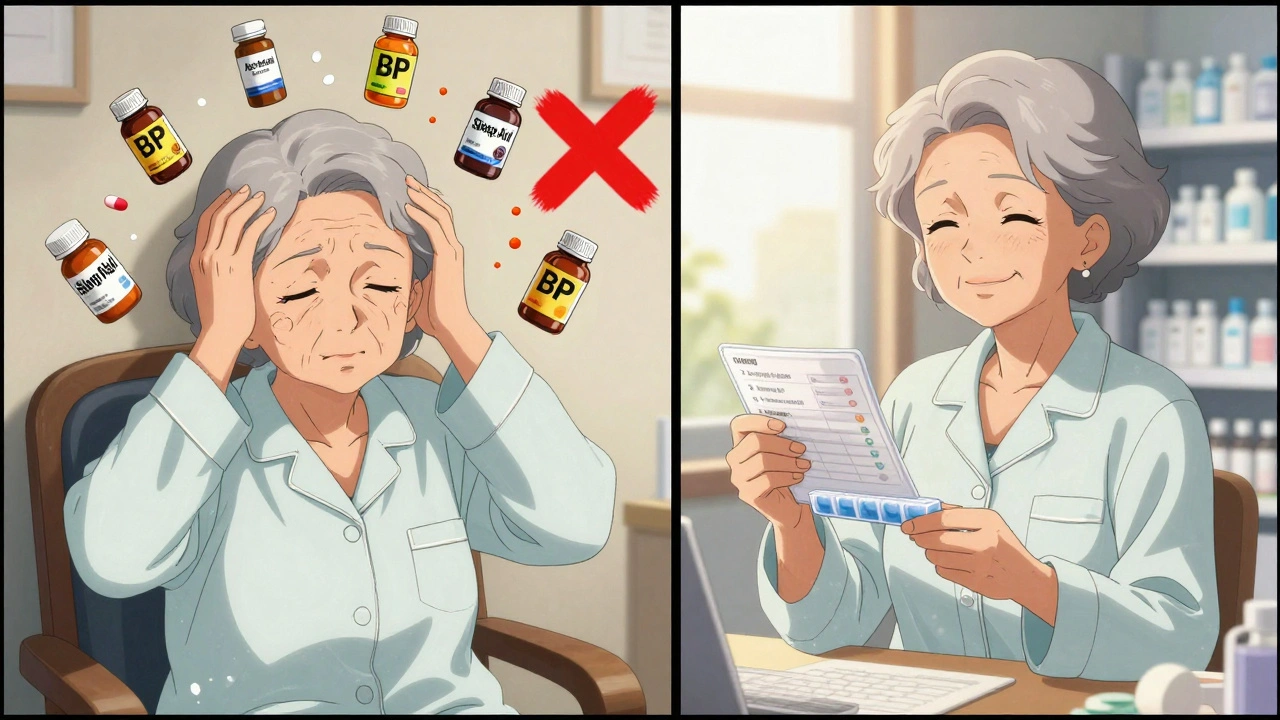
- They’ll make a plan. This might mean stopping one drug, switching to a safer alternative, changing the time you take it, or adding a tool like a pill organizer.
- They’ll write it down. You’ll get a clear, updated list of what to take-and what to stop. They’ll also send a summary to your doctor if you give permission.
What You Might Discover
People are often shocked by what they learn:- They were taking two different drugs for acid reflux-one prescribed, one bought over the counter-both with the same active ingredient.
- Their sleepiness wasn’t from insomnia; it was from an antihistamine in their cold medicine they’d been taking daily for years.
- A joint pain medication they’d been using for 10 years was no longer needed because their arthritis had improved.
- They were paying $120 a month for a brand-name drug when a generic version worked just as well for $10.
Why Pharmacists Are Better at This Than Doctors
Doctors are amazing at diagnosing illness. But they’re not trained to be drug experts. Pharmacists are. They spend years learning how drugs interact, how they’re metabolized, how side effects build up over time. Also, pharmacists have more time. You might spend five minutes with your doctor. With a pharmacist, you get 30. They’ll ask about your daily routine, your finances, your ability to open bottles, whether you forget doses because you’re overwhelmed. And they’re accessible. About 90% of Americans live within five miles of a pharmacy. You don’t need an appointment. Many offer walk-in reviews. And if you’re on Medicare Part D, the review is free.What to Do Before Your Appointment
Don’t wing it. Preparation makes the difference between a good review and a great one.- Write down every medication, supplement, and OTC product you take-even if you think it’s harmless.
- Include doses and how often you take them.
- Bring the actual bottles or photos of the labels.
- Write down any symptoms you’ve noticed-headaches, dizziness, nausea, mood changes, trouble sleeping.
- Ask yourself: Have I been taking this longer than I should? Did my doctor say it was temporary?
What Happens After the Review
You’ll leave with a printed list of your updated meds. No more guessing. No more wondering if you’re taking something you don’t need. The pharmacist will also send a summary to your doctor-with your permission. This ensures everyone’s on the same page. If a drug needs to be stopped or changed, your doctor will approve it. But the pharmacist is the one who spotted the problem. Some pharmacies offer follow-ups. You might get a call a week later to see how you’re doing. Others will help you set up reminders on your phone or recommend a pill box that sorts your meds by day and time.
Cost, Insurance, and Accessibility
If you’re on Medicare Part D, you’re eligible for a free annual medication review. No copay. No extra fee. You don’t even have to be in a special plan-just enrolled in Part D. Many commercial insurers now offer similar programs. Check your plan’s website or call customer service. Even if you’re not on Medicare, ask your pharmacy. Some offer the service for a small fee or as part of their care package. The real cost? Not paying for this review. The NIH says medication errors cause about 20% of all adverse drug events-and those lead to hospitalizations that cost billions. A 30-minute review can save you thousands in emergency care down the road.Who Might Not Need It
If you only take one or two medications, and they’re simple-like a daily blood pressure pill and a statin-and you feel fine-then you might not need a full review. But even then, it’s worth asking your pharmacist: "Is there anything here I shouldn’t be taking?" It’s less helpful for people with severe dementia who can’t participate in the conversation. But for caregivers, it’s still valuable. The pharmacist can give you a clear plan to manage someone else’s meds.What’s Next for Medication Reviews
The future is digital. Some pharmacies now offer virtual reviews via video call. Others use AI tools to flag possible interactions before you even walk in. The goal is to connect pharmacy records directly to your electronic health record-so your doctor, pharmacist, and specialist all see the same list. National Check Your Meds Day (October 21) is a reminder to take stock of your pills. But you don’t have to wait for a holiday. Schedule your review now. It’s one of the safest, simplest, and most effective ways to protect your health.Real Impact, Real Results
People who get annual medication reviews report feeling more in control. They sleep better. They fall less. They stop worrying about side effects. They save money. And they avoid trips to the ER. Dr. Trever Calvert, PharmD, says these reviews lead to fewer hospital stays and lower healthcare costs. The data backs it up. And the best part? You don’t need a referral. You don’t need a special form. You just need to walk into your pharmacy and ask. Your health isn’t just about what you take. It’s about what you don’t need to take anymore. And your pharmacist is the one who can help you find out.Is an annual medication review free?
Yes-if you’re enrolled in Medicare Part D, the review is completely free. Many private insurance plans also cover it at no cost. Even if you’re not insured, some pharmacies offer it for a small fee or as part of their wellness services. Always ask before you go.
Do I need a referral from my doctor?
No. You can walk into any pharmacy that offers medication therapy management and request a review. You don’t need a prescription or a note. Just bring your medications and ask.
What if I don’t remember all my medications?
That’s normal. Bring all your pill bottles-even if they’re empty. Or take photos of the labels on your phone. Pharmacists are used to this. They’ll help you sort through what you have and figure out what you’re actually taking.
Can a pharmacist stop my medication?
No, only your doctor can prescribe or stop a medication. But your pharmacist can identify which drugs are unnecessary, dangerous, or outdated-and then recommend changes to your doctor. They’ll write a detailed report and often call your doctor’s office to discuss it.
How often should I get a medication review?
Once a year is the standard, especially if you take four or more medications. But if you’ve had a major health change-like a new diagnosis, hospital stay, or new symptoms-you should schedule one sooner. Don’t wait for your annual appointment.
Are supplements really a problem?
Yes. Supplements aren’t regulated like prescription drugs, and many interact with medications. For example, St. John’s Wort can make antidepressants less effective. Vitamin K can interfere with blood thinners. Garlic and ginkgo can increase bleeding risk. Always tell your pharmacist about everything you take.
15 Responses
oh wow a pharmacist is now a *medication therapist*? next they’ll be prescribing therapy for my existential dread. i mean, sure, i’ll bring my 17 pill bottles to the counter while the guy behind it scans my supplements like they’re contraband. but hey, at least i’m not the one who thinks ‘natural’ means ‘not regulated’ and ‘safe’ means ‘i read about it on a blog.’ 🙄
in india we dont have time for this. one doctor, one pill, one prayer. but still, good idea. thanks for sharing.
so now my pharmacist is my therapist, my detective, and my babysitter? what’s next? will they hug me when i cry because my blood pressure med makes me feel like a zombie? i’m just glad i don’t live in a country where my pills are managed by a guy in a white coat who knows more about my life than my husband. 😭
This is such a simple, powerful thing to do for yourself. Seriously, just walk in and ask. You’ve got nothing to lose and so much to gain. 💪
While I appreciate the sentiment behind this initiative, it is important to recognize that the systemic fragmentation of healthcare delivery in the United States remains the root cause of polypharmacy and adverse drug events. A pharmacist-led review, though beneficial, is a palliative intervention rather than a structural solution. The absence of integrated electronic health records across providers, coupled with the fee-for-service model, incentivizes overprescribing. Until we address these macro-level inefficiencies, we are merely rearranging deck chairs on the Titanic. The fact that this service is free under Medicare Part D speaks volumes about the state of our public health infrastructure - reactive, not proactive.
Man, I used to think my grandma was just being dramatic when she said she felt like a walking pharmacy. Then I took her to her first CMR and she walked out with a 30% reduction in meds. No more dizziness. No more midnight trips to the bathroom from that ‘just-in-case’ diuretic. She cried. I cried. The pharmacist? Just shrugged like it was Tuesday. 🤷♂️💊
Turns out, that ‘vitamin’ she took daily? Was a blood thinner. And that ‘herbal tea’ for sleep? Had enough melatonin to knock out a horse. Turns out, ‘natural’ doesn’t mean ‘harmless.’
Also - if you’re still taking that old aspirin for ‘heart health’ because your uncle did it in ’98? Stop. Talk to someone. Your stomach will thank you. And your pharmacist? They’re not judging. They’re just waiting for you to show up with the bottles.
It is not merely a matter of pharmacological oversight; it is an indictment of the medical-industrial complex's commodification of patient care. The annual review, while superficially benevolent, functions as a bureaucratic band-aid on a hemorrhaging system. The real issue is the pathological overprescription driven by pharmaceutical marketing, physician time constraints, and the pathological normalization of polypharmacy as a default. This is not healthcare. It is pharmaceutical triage masquerading as patient advocacy. The pharmacist, once a dispenser of compounds, is now a compliance officer for a broken system. The review is not a solution. It is a symptom.
Why do we need this? Just follow doctor's orders. Too many pills? Then don't take them. Simple. No need for 30 mins talk. Pharma wants more money. End of story.
so i just walked into cvs and asked for the med review thing and the girl was like ‘oh u mean the free one?’ and i was like ‘yeah’ and she just grabbed my whole medicine bag and went ‘ok so you’re on 14 things including this ginkgo that’s basically liquid chaos’ and i was like… wow. i didn’t even know i had a ginkgo bottle. thanks, pharmacy. 🙏 #medreviewlife
i think this is good. my dad take 8 pills and he forget which one when. now he have list. he feel better. not dizzy. sleep good. thank you for tell this.
Oh, so now we’re outsourcing medical judgment to the guy who sells you cough syrup and discount protein powder? Next they’ll be reading your horoscope to determine your statin dosage. This isn’t healthcare - it’s pharmacy theater. And don’t even get me started on the fact that ‘free’ under Medicare means your doctor gets paid more to refer you. Wake up. This isn’t about safety. It’s about revenue streams.
I did this last year and it changed everything. I was taking two different acid reflux meds - didn’t even know they were the same thing. Stopped one, saved $80/month, and my heartburn vanished. My pharmacist even helped me switch to a cheaper generic for my blood pressure. I felt so empowered. You don’t need to be ‘old’ to need this. You just need to care about your body. 💛
i just found out my ‘daily allergy pill’ was making me feel like i was underwater all day. like, literally. i thought it was stress. turns out? diphenhydramine. i’ve been taking it since 2018. my pharmacist looked at me like i’d been living in a cave. i cried. then i laughed. then i threw out the bottle. best 30 mins of my life.
Just did this yesterday and it felt like a reset button for my health. 🧠💊 I brought in everything - even the gummy vitamins I thought were ‘harmless.’ Turns out, the gummies had iron in them, and I was already on a supplement with iron. My liver enzymes were elevated. No symptoms. Just… quietly broken. The pharmacist didn’t judge. She just said, ‘Let’s fix this.’ Now I’ve got a color-coded pill box, a list, and a phone reminder. I feel like I finally got the manual for my own body. 🙌
Let us not mistake this superficial, commodified ritual for genuine medical stewardship. The annual review is a performative gesture - a ritualistic appeasement to the growing anxiety of a population medicated into compliance. It is not about safety; it is about liability mitigation for providers and pharmacies. The real problem is not polypharmacy - it is the normalization of pharmacological dependency as a substitute for lifestyle medicine, psychological support, and systemic access to preventive care. You bring your pills. They ‘review’ them. You leave with a list. And the machine grinds on. This is not empowerment. It is pharmaceutical pacification dressed in the language of wellness. The only true solution? Stop prescribing so much in the first place.